Showing posts with label skin disease. Show all posts

Saturday, November 1, 2014

The Power Of The First Impression

I got a call from a client last week. I called her back the same day as any respectable success business minded fellow human being would do.

Winston's pyoderma on the tail.
We call it a hot spot.
First place to start with these cases is flea prevention.
"Thank-you so much for calling me back!" I could hear that she was troubled, jittery, and grateful in her over-expressive preface. I have known her for many years. She is a smart articulate doting mom; always a need, a worry, and a barrage of questions with every examination. She travels a great deal and always finds home back in our little town. She would be intimidating and over bearing to others but she allows me to be my honest, forthwith self, and it is abundantly clear that she loves her dog, so I accept her abrupt inquiries with ease.

"We moved full time to Atlanta a few months ago and we have yet to find a real vet here so we need your help." So began the second line to the phone call.

"Molly had a rash on  her belly and private parts and a bought of facial swelling last week. We thought it might pass, but after a few days it appeared that she needed more than the Benadryl we were giving. We looked on the internet and thought this was the correct treatment so we waited,,,and after all you are her vet and we aren't comfortable anywhere else."

Zeus visits for hives.


Zeus is a pup with life long skin challenges,
Ugh, those white Boxer/Pitties they are a dermatologists daily planner. 

I jotted  few notes in her chart and a few in my head.

The chart contained;

  • Owner moved,
  • Rashes on ventrum, inguinal and perineum regions,
  • Facial swelling three days duration last week,
  • Non-responsive to Benadryl with accompanying dose.
My head contained;
  • Why did they wait?
  • Why did they diagnose with the internet?
  • When did they think they needed to find a new vet?
And then there was Molly. My worries with any swelling or rash are the following;
  1. Root cause? 
    • If it is allergies the swelling can progress to causing life threatening breathing difficulties.
    • If it is NOT allergies, is it lymph nodes? Could this be cancer or infection? 
  2. Time delay.
    • ALL of these need IMMEDIATE INTERVENTION for optimal outcome.
Lucy demonstrates her relaxation technique while waiting for  her annual exam.
We are very good friends.

The third part of her phone call was even more troubling...

"I also went online to find a vet. I was looking for someone close who had been in practice for some time. I found a vet who had been in business for over 30 years. I figured he had to know what he was doing and be good. I made an appointment and went the next day. It was an awful experience. When I arrived the technicians immediately took Molly away from me. I thought I don't know you, you don't know my dog. I was very uncomfortable. Sometime later she re-appeared. They told me that she was having an allergic reaction and they were prescribing some medication. I thought, 'Where is the doctor? I haven't even met him yet?' He arrived a little while later. When he came into the room he didn't introduce himself. He didn't greet Molly. He went on to say he was prescribing medications. When I asked 'Why she had gotten the rash?', he replied, 'Well, you know girls don't always wipe from front to back.' I was so dumbfounded I didn't know what to do."

The redness on her belly and inner thighs is from licking and laying frog-legged in the dirt.


I swallowed hard. Trying to choose my words carefully I said, "Well, that is indeed pretty awful, I agree. I think that if you are ever uncomfortable with anything being done you should speak up and remember that you know Molly better than anyone else. If you didn't want her to be taken away you can tell the technician that you want to be with her. That's a perfectly acceptable request. If you have questions you are paying for his time and his expertise. He should be happy to answer your questions. And, as far as the wiping comment goes, I have no descent excuse for that. It's immature, unprofessional and inappropriate. I don't know how you are feeling now, but as a practice owner I would want to know if anything like that was happening here. It might benefit another pet and another client if you called them and voiced these same concerns to the hospital owner or practice manager. And, certainly only go to a veterinarian and veterinary clinic that you trust and feel both comfortable and well taken care of. Maybe it would be  better to ask your co-workers and neighbors for a veterinary recommendation?"

If you aren't seeing a face like this often you are missing the great joys of a pet.


Related blogs;


If you have a pet story I would love to hear it. If you are looking for some help for your pet you can find me and a whole bunch of pet friendly people at Pawbly.com. Pawbly is a free service dedicated to connecting pet people to help pets the world over.

You can also find me on Twitter @FreePetAdvice and Facebook, or book an appointment with me at Jarrettsville Vet.


Sunday, July 15, 2012

The REAL value of the annual exam

I was running with my very good friend the other morning and we were talking shop as we always do. You see I live about 5 minutes away from a veterinary hospital, and that hospital is owned by my very good friend Amy. We run together at least 4 times a week and those 4 miles blow by when you have a comrade to commiserate with. We swap stories, gossip, medicine, and go over the hard cases together. We also bring our dogs. We both agree that the dogs love the run more than we do. For all 5 of us its usually the best part of our day.
We were discussing how the face of veterinary medicine has changed over the years and venting a little. I know that for both of us it’s nice to have an understanding shoulder to lean on and ear to chew at. It’s a great combination of cardiovascular exercise and psychotherapy.
I was telling her about a case I had just seen of a 6 year old Chihuahua male neutered dog named Nacho. He had come in for his yearly physical examination and shots. He was brought in by his very caring concerned involved parents and their late teenage daughter.
Nacho, unlike many of his small counterparts is a gentle calm trusting patient. He was a tiny bit nervous but not aggressive or excited. After I said my “Hello’s!” to everyone in the room and especially to my patient (tip to vets: always greet your patient!) I asked my usual list of questions. I am a big believer in the question and answer part of the exam. I get very concerned when a client requests a “drop-off appointment” because your pet can’t tell me the things I need you to answer for on their behalf. Therefore, in my opinion, if you are dropping your pet off and not getting a dialog with your veterinarian you are not getting the full value of what you are paying for.
This gets me back to my point on my run with Amy. We were discussing how many of our clients don’t want to pay for an exam, they just want to get the “shots their pet needs.” We were discussing how frustrating it is to try to impress upon our clients that the most important part of the annual examination and vaccines is the annual examination and probably less the vaccines. She reminded me that as a profession we drilled into our clients head that “they needed to return every year to get their shots,” and that we “sort of did this to ourselves.” 
I said “I agree, and now that so many of the shots are available as tri-annual we are finding it even harder and harder to convince owners to bring their pets in to see us.”
Ten years ago when there weren’t three year shots available, and so many more pets died of diseases that we don’t see much of anymore, like distemper and parvovirus we were right in pleading for annual shots. But these days the diseases are less prevelant in household pets that get their initial series of shots, so the importance of vet care has shifted from disease prevention through vaccination to disease prevention through veterinary care and intervention. 
We started talking about how many annual exams that we have done on pets that were apparently healthy in the eyes of their owners where we inadvertently found major issues. I have found splenic tumors, diagnosed thyroid disease, Cushings disease, and all sorts of cancers.
The REAL value we agreed these days is not so much in the vaccines, but in many cases it is in the question and answer period, the review of diet and lifestyle, and the behavioral issues many pet owners deal with. As an example these days I  prescribe many annual exam pets Thundershirts, Prozac, and “more exercise less treats” and give fewer vaccines.
To all of you pet parents out there overdue, or questioning the importance of calling the vet to schedule the list on the post card stuck on the fridge I encourage you to call and schedule your pets exam. 
When you are scheduling and get there think about the following;
1.       Avoid the drop-off examinations at all costs. If you do have to drop-off, make sure you have a lengthy conversation with the vet first, so that you can both discuss your concerns and costs.
2.       Discuss the vaccine protocol that the vet is suggesting for your pet. Ask if there are 3-year vaccine options available for your pet? And whether they are appropriate.
3.       Discuss food/diet, and treats.
4.       Discuss activity level and exercise regimen.
5.       Discuss any and all behavioral issues, and remember that behavioral issues tend to worsen and magnify over time. So if it doesn’t seem like a big deal now, will it be if it is twice as often as it is now? Or more?
6.       Stress plays a role in your pet’s lives and health. So if there are any different members of the family (kids, parents, other new pets), noisy activities in the house, or changes to the household, etc. mention them. Things that we see as being a minor change (like moving furniture, redecorating, etc) can really stress out your pets.
7.       Anything that you feed your pet (be honest!), or your pet chooses to eat, or gets into (stealing food) are also important pieces of information. I currently have a client who is using homeopathic herbs and additives and I suspect is causing kidney diseasein her 6 year old house cat. It took 20 minutes of Q & A to get this information because she thinks “homeopathic is equivalent to harmless.” In some cases it is and in others it isn’t.
8.       Leave the appointment with a good list of things to think about, remember to-do (monthly heartworm and flea & tick preventative), upcoming future appointments and re-checks, etc. At our clinic we give out report cards for each visit. It really helps go over all of the information we discussed, and provides a good overall summary of our PE findings.
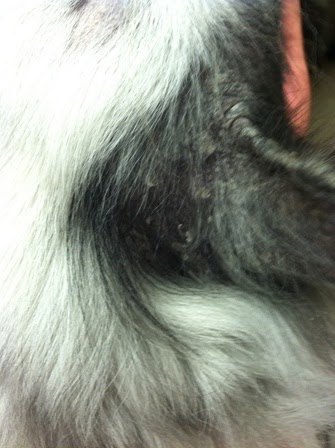
Last week at Nacho’s appointment I immediately noticed that his hair is very thin, sparse, and flaky, especially around the top of his head and ears. When I inquired about this his owners told me that “he has been like this for years.” I was shocked! Why would this be disregarded? A skin issue can be a health issue, especially if it is a chronic problem. We began our exam with a lengthy discussion of Nacho’s diet, lifestyle, and history of this condition. I asked them to start a long term plan with me to try to get to the bottom of what the skin issue might be caused by. We decided to start with the easy things like a good diet, an omega-3 supplement, and taking a picture of his head every month.  I also reminded them that hair re-growth is a slow process. It took years to get to this point, it will take some time, like months, to start to resolve.

Base of the ear. Note the sparse hair and big flakes of dead skin.


Thickened ear pinna (flap), lots of dead crusty skin flaking off.


I ask clients to take pictures/document their pets because in the day to day progress of a disease (or response to a treatment plan to identify a disease) the owners doesn’t often notice the subtle changes. So I either have them come in for regularly scheduled visits over set intervals of time (like every 1, 2, 3 weeks, or monthly, etc.) so I can help them monitor. I also take a picture of the pet every visit to keep in my phone, or on a hard drive. Or we print a picture out in the clinic and staple it into the chart that way no matter which vet does the follow-up we know where we were at the last visit.
I am notorious for assigning homework to my clients. It helps get everyone involved and provides a much more consistent patient monitoring.
I will keep you posted on little Nacho.
His initial treatment plan is as follows;
1.   Better food. No little gravy cans with funky colors and junk food ingredients. Very hard for small dogs, they get used to junk food, they want to keep eating junk food, so a transition to a better food takes time, patience, and persistence.
2.   Start Welactin daily, the omega-3 fatty acid supplement from Nutrimax.
3.   Use monthly flea & tick prevention. We switched him from intermittent to almost negligible to monthly revolution.
4.   Re-check in 1 month.