Showing posts with label vaccines. Show all posts

Sunday, December 22, 2013

Tail Vaccinations. The New Protocol For Vaccinating Cats?


Vaccine induced sarcomas are a specific type of cancer caused by the injection of a vaccine. This type of cancer is highly aggressive and requires wide surgical excision to remove. The sarcomas begin as a firm mass under the skin. Based on location and behavior it is recommended that they be surgically removed and submitted for biopsy. I have seen many cats of all ages and breeds, and ages present with their parents concerned about a marble sized knot they stumbled upon while petting their cat. The mass can be painful when palpated, but for some cats it seems to to be bothersome at all. Unfortunately, even with an early diagnosis and surgical intervention most of my patients have recurrence of their cancer and succumb to the sarcoma in a matter of months. The prevalence and nature of this has influenced not only how often we vaccinate our cats but also where we vaccinate. Veterinarians started moving the placement of the vaccine from the shoulder blade area to the extremities when the American Association of Feline Practitioners recommended that vaccines be placed below the elbow or stifle. We also began using three year duration of immunity vaccines instead of annual vaccines.

Cats with sarcomas require aggressive surgical excision with wide margins. Excision for a sarcoma in the shoulder blade area, in many cases, needs to include the dorsal (top) aspect of the spinous processes of the vertebrae. This includes the skin all of the underlying muscle and the top part of the spine. For a general practitioner this surgery is beyond our comfort zone, or ability, so these patients are referred to specialists. The cost of this surgery is in many cases considerable leading many owners to decline treatment. The hope with placing vaccines low on the limb was that if, or when, a sarcoma occurred that the leg could be amputated to remove the cancer and hopefully save the cat.

For those of us who love our cats the thought of a vaccine costing our pet’s life or limb seemed too much to pay. Some clients chose not to vaccinate and others want to vaccinate even less then every three years. The cost-benefit decision was significantly altered by the fear of sarcomas.

Enter Dr. Levy of the University Of Florida College Of Veterinary Medicine. She has just released the findings from her study on feline tail vaccinations. She estimates that “1 to 10 cats out of 10,000 vaccinated against infectious diseases develop cancer at the infection site.” Dr. Levy studied 60 cats and found that using the tail as an injection site was just as effective and should a vaccine cause a sarcoma or require excision the tail is an easy structure to remove and will not disfigure or alter the cat’s ability to function normally. Dr. Levy recommends vaccinating as distally (down the tail away from the body) as possible. She also notes that cats tolerate tail vaccination as well as they do in traditional sites.

After reading Dr. Levy’s study I hesitantly  jumped on the band wagon. Cats are not the easiest patients. The traditional spot of vaccinating between the shoulder blades was chosen because their is ample skin, less chance of being bitten, and it is the place our assistants scruff to hold our patients still. Admittedly, when I first read the article I thought, "this is never going to work." There just isn't enough room to hold safely, and there isn't enough skin to tent to place a SQ shot safely. But if it can save a cat I'm going to try. So, with some trepidation I vaccinated my first cats for a local rescue during their spay/neuter clinic. These cats were waking up from anesthesia and provided a quiet, calm patient for my first vaccination attempts. (Note about vaccinating anesthetized patients..)

I will add a few first impressions. It is difficult to tent the skin in the distal tail. The traditional 22 or 23 gauge 1 inch needle is too long and a bit large to place in the distal tail. I do think that it will take me a while to get used to this protocol. The standard pulling the plunger back to make sure that we are not in a blood vessel before we inject the vaccine needs to be done faster and I in inadvertently hit bone with each attempt when trying distally. Also, if you are placing multiple vaccines it is difficult to get enough SQ space to place them. Lastly, every site I used bled. So, be prepared to hold off those bleeders, and hold the cat, and not stick yourself. Like everything else "practice will make perfect." I  hope.

I will keep you all posted as I transition to the more “lively” patients.

Dr. Levy’s study is published in The Journal of Feline Medicine and Surgery.


I posted this picture on my Wordless Wednesday blog and I received this from a reader;

"I read your blog – love it. 
I wanted to comment on your Dec 18 entry – but not on the blog.  You have a picture of a cat that you just spayed and are giving a vaccine into the tail.  I am assuming that the cat is still under anesthesia since you say:  “a nice, quiet pet to practice this on.”  My concern is that it is not advisable to vaccinate a pet when under anesthesia.  Not that I want to criticize – I just read a lot and have come across this many times – and feel that I should share this with you.  I have attached a link to an article that is posted on the rabieschallengefund.org website and is authored by Dr. Dodds and Dr. Schultz who you are probably familiar with."


I sincerely appreciate her reminder! We all learn together, so please never hesitate to offer your opinion, advice, or experience. It is my sincere hope that this blog is an exchange of information to help pets worldwide.

If you have any pet questions, or thoughts to help other pet lovers, please find me on Pawbly, or on Twitter @FreePetAdvice.

Sunday, July 15, 2012

The REAL value of the annual exam

I was running with my very good friend the other morning and we were talking shop as we always do. You see I live about 5 minutes away from a veterinary hospital, and that hospital is owned by my very good friend Amy. We run together at least 4 times a week and those 4 miles blow by when you have a comrade to commiserate with. We swap stories, gossip, medicine, and go over the hard cases together. We also bring our dogs. We both agree that the dogs love the run more than we do. For all 5 of us its usually the best part of our day.
We were discussing how the face of veterinary medicine has changed over the years and venting a little. I know that for both of us it’s nice to have an understanding shoulder to lean on and ear to chew at. It’s a great combination of cardiovascular exercise and psychotherapy.
I was telling her about a case I had just seen of a 6 year old Chihuahua male neutered dog named Nacho. He had come in for his yearly physical examination and shots. He was brought in by his very caring concerned involved parents and their late teenage daughter.
Nacho, unlike many of his small counterparts is a gentle calm trusting patient. He was a tiny bit nervous but not aggressive or excited. After I said my “Hello’s!” to everyone in the room and especially to my patient (tip to vets: always greet your patient!) I asked my usual list of questions. I am a big believer in the question and answer part of the exam. I get very concerned when a client requests a “drop-off appointment” because your pet can’t tell me the things I need you to answer for on their behalf. Therefore, in my opinion, if you are dropping your pet off and not getting a dialog with your veterinarian you are not getting the full value of what you are paying for.
This gets me back to my point on my run with Amy. We were discussing how many of our clients don’t want to pay for an exam, they just want to get the “shots their pet needs.” We were discussing how frustrating it is to try to impress upon our clients that the most important part of the annual examination and vaccines is the annual examination and probably less the vaccines. She reminded me that as a profession we drilled into our clients head that “they needed to return every year to get their shots,” and that we “sort of did this to ourselves.” 
I said “I agree, and now that so many of the shots are available as tri-annual we are finding it even harder and harder to convince owners to bring their pets in to see us.”
Ten years ago when there weren’t three year shots available, and so many more pets died of diseases that we don’t see much of anymore, like distemper and parvovirus we were right in pleading for annual shots. But these days the diseases are less prevelant in household pets that get their initial series of shots, so the importance of vet care has shifted from disease prevention through vaccination to disease prevention through veterinary care and intervention. 
We started talking about how many annual exams that we have done on pets that were apparently healthy in the eyes of their owners where we inadvertently found major issues. I have found splenic tumors, diagnosed thyroid disease, Cushings disease, and all sorts of cancers.
The REAL value we agreed these days is not so much in the vaccines, but in many cases it is in the question and answer period, the review of diet and lifestyle, and the behavioral issues many pet owners deal with. As an example these days I  prescribe many annual exam pets Thundershirts, Prozac, and “more exercise less treats” and give fewer vaccines.
To all of you pet parents out there overdue, or questioning the importance of calling the vet to schedule the list on the post card stuck on the fridge I encourage you to call and schedule your pets exam. 
When you are scheduling and get there think about the following;
1.       Avoid the drop-off examinations at all costs. If you do have to drop-off, make sure you have a lengthy conversation with the vet first, so that you can both discuss your concerns and costs.
2.       Discuss the vaccine protocol that the vet is suggesting for your pet. Ask if there are 3-year vaccine options available for your pet? And whether they are appropriate.
3.       Discuss food/diet, and treats.
4.       Discuss activity level and exercise regimen.
5.       Discuss any and all behavioral issues, and remember that behavioral issues tend to worsen and magnify over time. So if it doesn’t seem like a big deal now, will it be if it is twice as often as it is now? Or more?
6.       Stress plays a role in your pet’s lives and health. So if there are any different members of the family (kids, parents, other new pets), noisy activities in the house, or changes to the household, etc. mention them. Things that we see as being a minor change (like moving furniture, redecorating, etc) can really stress out your pets.
7.       Anything that you feed your pet (be honest!), or your pet chooses to eat, or gets into (stealing food) are also important pieces of information. I currently have a client who is using homeopathic herbs and additives and I suspect is causing kidney diseasein her 6 year old house cat. It took 20 minutes of Q & A to get this information because she thinks “homeopathic is equivalent to harmless.” In some cases it is and in others it isn’t.
8.       Leave the appointment with a good list of things to think about, remember to-do (monthly heartworm and flea & tick preventative), upcoming future appointments and re-checks, etc. At our clinic we give out report cards for each visit. It really helps go over all of the information we discussed, and provides a good overall summary of our PE findings.
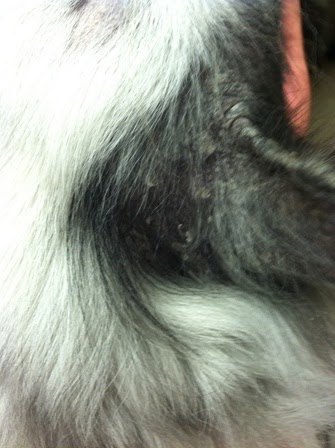
Last week at Nacho’s appointment I immediately noticed that his hair is very thin, sparse, and flaky, especially around the top of his head and ears. When I inquired about this his owners told me that “he has been like this for years.” I was shocked! Why would this be disregarded? A skin issue can be a health issue, especially if it is a chronic problem. We began our exam with a lengthy discussion of Nacho’s diet, lifestyle, and history of this condition. I asked them to start a long term plan with me to try to get to the bottom of what the skin issue might be caused by. We decided to start with the easy things like a good diet, an omega-3 supplement, and taking a picture of his head every month.  I also reminded them that hair re-growth is a slow process. It took years to get to this point, it will take some time, like months, to start to resolve.

Base of the ear. Note the sparse hair and big flakes of dead skin.


Thickened ear pinna (flap), lots of dead crusty skin flaking off.


I ask clients to take pictures/document their pets because in the day to day progress of a disease (or response to a treatment plan to identify a disease) the owners doesn’t often notice the subtle changes. So I either have them come in for regularly scheduled visits over set intervals of time (like every 1, 2, 3 weeks, or monthly, etc.) so I can help them monitor. I also take a picture of the pet every visit to keep in my phone, or on a hard drive. Or we print a picture out in the clinic and staple it into the chart that way no matter which vet does the follow-up we know where we were at the last visit.
I am notorious for assigning homework to my clients. It helps get everyone involved and provides a much more consistent patient monitoring.
I will keep you posted on little Nacho.
His initial treatment plan is as follows;
1.   Better food. No little gravy cans with funky colors and junk food ingredients. Very hard for small dogs, they get used to junk food, they want to keep eating junk food, so a transition to a better food takes time, patience, and persistence.
2.   Start Welactin daily, the omega-3 fatty acid supplement from Nutrimax.
3.   Use monthly flea & tick prevention. We switched him from intermittent to almost negligible to monthly revolution.
4.   Re-check in 1 month.