Showing posts with label splenectomy. Show all posts

Monday, March 28, 2016

Canine with Distended Belly; Splenectomy. Costs, Advice, Tips, and Why Immediate Surgical Intervention Is Critical.


This is Buddy. 

He is like most of the Jack Russell Terriers that we see in rural Maryland. He is fierce, brave, obstinate, and incorrigible. He is also unapologetic about all of this. He is a big personality in a small football sized package. He is the quintessential JRT. There are a few breeds that follow the breed specific personality test to the  letter; JRT's are that breed. They go full tilt full time and they want, need, or desire few things. It is a short list of "likes" and a long list of unmatched indifference. To love one you have to own one, to understand one you have to live with one.

Buddy is a fit muscular pup.
Can you appreciate the "roundness" to his belly?

Rather suddenly his parents noted that his belly was getting mysteriously bigger rather quickly. 

Should this happen to your dog you should go your vet as quickly as possible, OR, you could visit me at Pawbly.com and ask me what might be going on?

At Pawbly.com I am first going to tell you to head directly and immediately to the vet. Any vet, anywhere as this can certainly be a life threatening emergency.

Then I am going to answer as follows;
There are a few things you need to be worried about..

1. Something is leaking. Maybe blood? Maybe fluid. All are bad.

2. Something is expanding. Maybe the stomach (gastric) is inflating like a balloon? This is called dilatation. If that balloon twists it is called volvulus. If this happens these organs can become strangulated, this is like placing a string that is too tight around your finger. If not treated and relieved quickly this tissue dies. We all need a stomach. GDV can kill your dog in minutes to hours.

3. Something inside is growing. After adulthood is reached your organs aren't supposed to keep growing. In almost all cases that growing thing inside is not supposed to happen. Cancer is the most common cause of abnormal growth.

4. The abdominal wall can be stretching due to muscle loss,, but this is usually a slow gradual process. Think diabetes, Cushing's disease, hypothyroidism.

Now some of these cases these pets are simply getting fat. But fat is not a round basketball just got inflated in the belly.

Buddy is not fat.. Buddy is in crisis for something else.. Where do you go after the examination ($50 at Jarrettsville Vet) confirms your burgeoning belly suspicion?

A radiograph is the best way to decide which of the above Buddy has going on. ($100-$150 at JVC).


And there it is.. well, maybe not a basketball,, but it is a big round mass in Buddy's belly. 


After the radiograph was taken it was time to make some decisions. Up until now every vitally needed diagnostic has been done. You need to do these two things if this happens to your dog. I also should mention that the radiographs allowed us to assess the chest for evidence of metastasis. This piece of information is vital to the dogs prognosis moving forward. If there are mets in the chest the surgery will likely not change the prognosis or lifespan. 

The next decisions and steps are the ones filled with question, doubt, and intense scrutiny for clients.

Here's my advice on where to go from here;

1. Listen to your dog. Buddy was still rambunctious and barking at every passing dog. Buddy was still behaving like Buddy. In other words, Buddy thought he was perfectly fine. Huge prognostic indicator for a likely successful surgery. Do surgery on these dogs. Don't sit there thinking about worst case scenario. 

2. Be prepared for a financial hit. These happen to every dog that lives long enough. Every pet owner should have pet insurance for these situations, OR, a pet savings account. I recommend $1,000 for each pet. If you do not have this have a way to get access to this; a friend, a vet who trusts you, etc.

3. Start strategically planning the next few scenarios. Here is how I approach these cases with my clients; I want to get as much information as possible pre-operatively. This includes blood work ($170). I also want to do an ultrasound ($200) to "see" what the rest of the internal organs look like. If there are other lesions throughout the abdomen the prognosis is more guarded. 

4. Here's what my reality for these cases is;
I am NOT GOING TO SPEND SO MUCH OF MY CLIENTS MONEY THAT THEY CANNOT AFFORD SURGERY. I sit down with my clients and discuss what everything costs and what I want to do with the money they are spending on the information I am gathering. Nothing in the world drives me to the brink of insanity than talking to a client who has exhausted all of their resources on diagnostics and now cannot afford to treat their pet. There is no sense spending money to get a diagnosis if the treatment then becomes unattainable. I consider it unethical and reprehensible.

We suspected that Buddy's spleen was the culprit and that spleen needed to be removed ASAP! 

If you do not do surgery these dogs will very likely die of internal blood loss. 

The estimate for a splenectomy at JVC is $1000*. Buddy's parents did not have $1,000. We did what we always do in these cases. We discuss with our clients how we can get them the help their dog needs. This is the difference between JVC and too many other clinics. We will help your pet get back out the door. We have multiple options to help insure this. For Buddy's family a deposit and a payment plan through our good friends at Vet Billing Solutions were his answers. 


Buddy's spleen was the only thing you could see in his belly when we opened him up. It never ceases to amaze me how large a tumor can get and how incredibly resilient these patients are. When it comes to splenic tumors a few things are key;
  1. Get it out as soon as it is discovered. The spleen is essentially a blood sac. It loves to bleed, even when it is happy and healthy, if it has even the tiniest bit of trauma. BUT, when it is an abnormal mass of tissue it really, really, likes to bleed. A bleeding tumor, especially in the spleen, is ticking time bomb. 
  2. Get as much information as possible. radiographs, blood work (full chemistry, CBC, PT/PTT), and ultrasound are super helpful.
  3. Buddy was happy and acting oblivious to his tumor. This is the best prognostic indicator I ever hope to have.


Have an excellent surgeon and support staff. I don't say this often. In my heart I love being a small town quiet rural practice, BUT, I also have a stacked exceedingly capable veterinarians and staff. At JVC we can do almost every emergency surgery on almost everyday. When it comes to picking a vet to call your own, remember to ask about the dark days that may lie ahead. I know of many small practices that either do not, or will not, do emergency surgeries. There are too many times where the cost to go to a specialist prohibits care.* 


When I am about to do an exploratory surgery on a patient I ask my clients to be standing by a phone. Here's why;
Closing.. with a big sigh of relief!
I am never really sure what I am going to find until I look inside that patients abdomen? In some cases I have found widespread disease that was not evident in the pre-op work-up (most of the time we had to skip these due to finances), and in others the mass is not resectable (cannot be safely removed). If the patient cannot be saved by the splenectomy I want to discuss whether it is fair to wake them up?

The very dark red at the 9 to 11 o'clock position is normal spleen tissue.
Everything else is tumor.

The most common presentation of dogs in need of a splenectomy are weak, lethargic, pale, internally bleeding, and teetering on the brink of death. These cases require quick confirmation of the diagnosis and surgery.


Buddy is a 20 pound dog who had a 3.25 pound splenic mass. That's enormous on anyone's scale. Buddy did very well through surgery and woke up calmly, quietly and effortlessly.

Buddy returned the next day his normal bull headed dominant self. He also had a beautifully quiet incision.


And now a trim waistline.


Closing Notes;
  • There are some surgeons who perform routine gastropexy after splenectomy to prevent post-op GDV. It is something you should discuss with your vet pre-operatively.
  • Post-operatively these patients should be monitored very closely. Ideally, at a 24 hour facility. ECG, blood pressure, PCV/TP. Transfusions may be needed in cases where blood loss was severe.
It is my belief that any and all abdominal masses warrant an internal look before euthanizing. We are reminded daily that life is full of miracles and second chances. I know it is hard to hear, scary to admit, and expensive to treat but 50% of these pets are curable! Take a leap, look inside, and get the spleen out fast... sometimes fate will deal you a good hand and often life will remind you it is worth fighting for.


Buddy's cost of care at JVC was as follows;

Presentation;
  • Exam $50 and radiograph $100.

Surgery Day;
  • pre-op chemistry w/ CBC $50
  • injectable NSAID $20
  • injectable antibiotic $30
  • iv catheter and fluids $80
  • splenectomy $350
  • surgical supplies $75
  • anesthesia $200
  • post-op analgesia and antibiotics $40
Total cost $1050. 

Many thanks to Vet Billing Solutions for helping us provide a way to make Buddy's surgery affordable to his family.

*Estimates for this surgery at an emergency clinic can range from $1500-$3500.

Related Blogs;


If you have a pet question, or want to share your pet knowledge, please join the free online pet information exchange network that is dedicated to helping pet parents learn about how to best care for their pets. Pawbly.com is free to use and open to anyone who loves pets.

I can also be found at the clinic, Jarrettsville Vet, in Jarrettsville Maryland. We post our prices and fees every year and we have a wonderful Facebook page. I am also on Twitter @FreePetAdvice.

Friday, January 31, 2014

Greta. Getting the Answer BEFORE Giving Up. WARNING, surgery pictures are included.


Greta. Sunday January 26, 2014
I saw Greta on a Sunday exam. She arrived wagging her tail, looking around inquisitively and happy overall. But, I noticed that even under that think dense dark coat she was looking a bit "pendulous." A "pendulous belly" is term vets use when the abdomen looks distended. The belly can be distended due to having fluid, (called ascites), enlarged organs, weakened abdominal muscles, or even air inside of it. There are lots of fluids that can leak into your abdomen. They include urine (called uroabdmonen), blood (hemoabdomen), gastrointestinal perforation or leakage, abscesses or infections can leak puss into the abdomen,  bile leakage, chyle, or angry organs (think liver, pancreas, heart, and lungs). Regardless of the inciting cause a pendulous belly is something to pay attention to immediately.

Can you see a pendulous abdomen?


Greta was accompanied by her mom Patty. I have known her for many years. She is one of the women who started All Shepherd Rescue. Patty is a stoic woman with a strong determined personality. She is dedicated to helping shepherd's find homes when the public fails them. As a popular breed they need strong, staunch support because many people under estimate their need for work, attention, mental stimuli and a good dermatologist. They lead the breed category list for behavioral problems,  (ALWAYS due to lack of socialization as a puppy OR boredom) and dermatological disorders. Don't get a German Shepherd unless you are well informed as to the complex needs of the breed. Please?. Greta came to them as they all do; on death row as an old dog with multiple needs. She had been in the rescue for about two years.

Greta arrived on Sunday a few minutes before closing. After all, she looked and was acting normal to the average on looker. When I met Greta in the exam room her mom said rather matter-of-factly that Greta was here simply because she was drinking more. She just attributed it to old age, and the awful weather. In veterinary medicine we call this polydipsia. Polydipsia can be caused by a multitude of factors. A few are easily treated, and a few are serious and can be life threatening. Never ignore  pet that you think is drinking excessively.

AND NEVER EVER WITH HOLD WATER!

Some pets come to me with the other end of this problem, called polyuria. Polyuria is excessive urine output. Some pets demonstrate this by urinating outside of the box, or peeing in the house after being housebroken for years, but in (almost) all cases the polydipsia is causing the polyuria. And,

BOTH REQUIRE QUICK VETERINARY ATTENTION.

As I examined Greta her mom asked me, "Well, what do you think it could be?" Still sounding as if perhaps she might be over reacting to bringing her in on a Sunday.

I looked at her and said, "Well, she has a pendulous abdomen, an excessive heart and respiratory rate, muffled heart and lung sounds and I am very worried about her. She needs an x-ray, full blood work, and probably an ultrasound before I recommend exploratory surgery."

Greta is a fit and trim girl, BUT, she has lost her normal taper at her waist.
This can and does happen quickly IF there is something leaking inside that belly.


Her mouth opened a bit, she stayed very still, as if waiting for a punchline and then hesitantly asked me "if I thought it was serious?" She was clearly not expecting any of this.

We took x-rays and blood for a complete CBC and chemistry as well as a urine sample. Based on her normal temperature, attitude, and mucous membrane color we decided to have her return first thing in the morning for her ultrasound.


Her x-rays were as I expected, pendulous fluid filled belly with undefined organ definition. Of greatest concern was the inability to see her spleen. I sent a text to Dr. Morgan to beg her to come in on Monday (her very deserved day off) to do an ultrasound for Greta.

On Monday morning Greta returned. But she was a shadow of the girl she had been a few hours ago. She was no longer eating, or happy. She was lethargic, quiet, reluctant and pale. Her blood work from the day before was normal..very normal. The blood was not giving us a clue that she was as sick and critical as she was. Her ultrasound showed an enlarged spleen with nodules and an abnormal liver.

I sat down with Patty to talk about where to go from here. It was not an easy conversation.

She had some very valid concerns, a whole belly of unknowns, and other mouths to save and feed. I get it.

I had a whole host of concerns to. Add to that a dying dog who is a sweet gentle girl, the emotional gravity of the situation, and two strong minded animal advocates, and the boiling pot can explode.

Her concerns were;

  1. Greta is 8 years old. That is about the normal life span for a German Shepherd.
  2. She has multiple lesions on her ultrasound.
  3. To treat her she needs an expensive surgery. At our clinic it is about $1,000. And she runs a rescue.
  4. The average lifespan IF the surgery is successful is about 6 months. 
  5. Greta will have a recovery period after surgery. She was very concerned about putting her through surgery.
My concerns, and replies to her concerns, were;
  1. Age is not a disease. I know people use it as a reason to decline treatment but I just don't agree with giving up on treating a pet because of age. We decline more pets lifesaving and beneficial quality of life treatments because we use age as an excuse not to do so.
  2. Multiple lesions can be evidence of the spread of disease, but they can also be found because we were looking. For example, I took my old dog Ambrose in for an ultrasound and we found three distinct lesions in his abdomen. They included a nodule on his kidney, spleen and in the omentum. I was getting the ultrasound in preparation for chemotherapy to treat the cancer he had on his elbow. Can you imagine how bleak I felt his prognosis was when I realized he had four problems instead of just one? What did I do? I had an exploratory surgery done. Turns out that ALL three abdominal lesions were unrelated benign things. They had nothing to do with his cancer. He went on to have his radiation and did remarkably well for another 6 months. How many other people would have looked past three lesions?
  3. I cannot argue that resources are scarce for many of us. BUT, what I did argue was that we were at the place where we were deciding to put her down with presumptions. We were about to end her life based on educated guesses. I am not ever content with this. Further, putting her on the surgery table and exploring her abdomen would give us a definitive answer. AND, if it was worst case scenario, where she had metastatic cancer throughout her belly we would know for sure, and we would humanely euthanize her on the table. The cost of this would be about $100.
  4. I cannot argue with the sands of time. I can only promise to try to offer the best options to return a happy pet to a place where pain is minimized and quality of life is paramount.
  5. Surgery has inherent risks, and dogs need to be kept quiet and monitored post-operatively. BUT, many pets do very well post-operatively, and there are many good pain medications available, just like in people, to help with this. 
At the end of our discussion Patty agreed to give Greta another chance.


 Within  few minutes Dr. Morgan had Greta on the operating table. Greta's abdomen had 350 mls of blood in it. We removed this and when we did we saw that her liver was engulfed in tumors of all sizes. Her spleen looked similar and her cancer was too advanced to treat. 


Removing the free abdominal fluid.
Hemoabdomen.

A very abnormal spleen

A peak in the abdomen.
The liver is full of round tumors.

Patty said goodbye to her and we stopped her surgery.

Now I understand that many of you will read this and be angered that we put Greta on the table. I want to add that at no point was Greta stressed, or uncomfortable. Putting her to sleep under anesthesia is not any worse (or better) than while she is sitting in front of us. She was not consciously put through anything  that was painful or unnecessary. It was done in an effort to save her life. When I spoke to Patty afterward I asked her if she was OK with everything. 

She sent me this;


Greta came to All Shepherd Rescue in March 2013 at the estimated age of 7.  Her previous owner had had a stroke and could no longer walk or care for the dog. Greta weighed an unhealthy 114 pounds, her coat was matted, and her skin was very dry with some open cysts draining.

Greta was placed on prescription diet food and allowed unlimited exercise in the large yard.  She thrived chasing squirrels and chipmunks and playing with the resident dog. 

By mid-summer, Greta was a svelte 95 pounds with healthy skin and a glossy coat.
Greta did not appear ill during the months it took her cancers to develop.  She was at the vet for treatment and observation in December, 2013 after she ate a loaf of raisin bread.  All blood tests were normal and Greta returned home to continue counter surfing.

As January progressed, I noticed Greta seemed to be eating less.  She was moving more slowly but I attributed that to the cold weather and possible arthritis.  Greta had always enjoyed her water and I was filling the water bucket more often.   Saturday night 1/26 Greta drank a gallon of water and refused her dinner and breakfast.  We went to the vet that afternoon and sadly she was euthanized the following day.

I have adopted Greta.  Every dog at All Shepherd Rescue gets a home eventually.

Patty Visser


If you have a pet related question you can ask it, meet other pet lovers, and help a pet in need next door, or across the globe. You can also find me answering questions for FREE, at Pawbly.com. 

Or find me on Twitter @FreePetAdvice.


Sunday, October 23, 2011

Bailey's Beyond bad Belly, really it was Abominable!

I have introduced you to Bailey already, but I thought I would give you her full story.
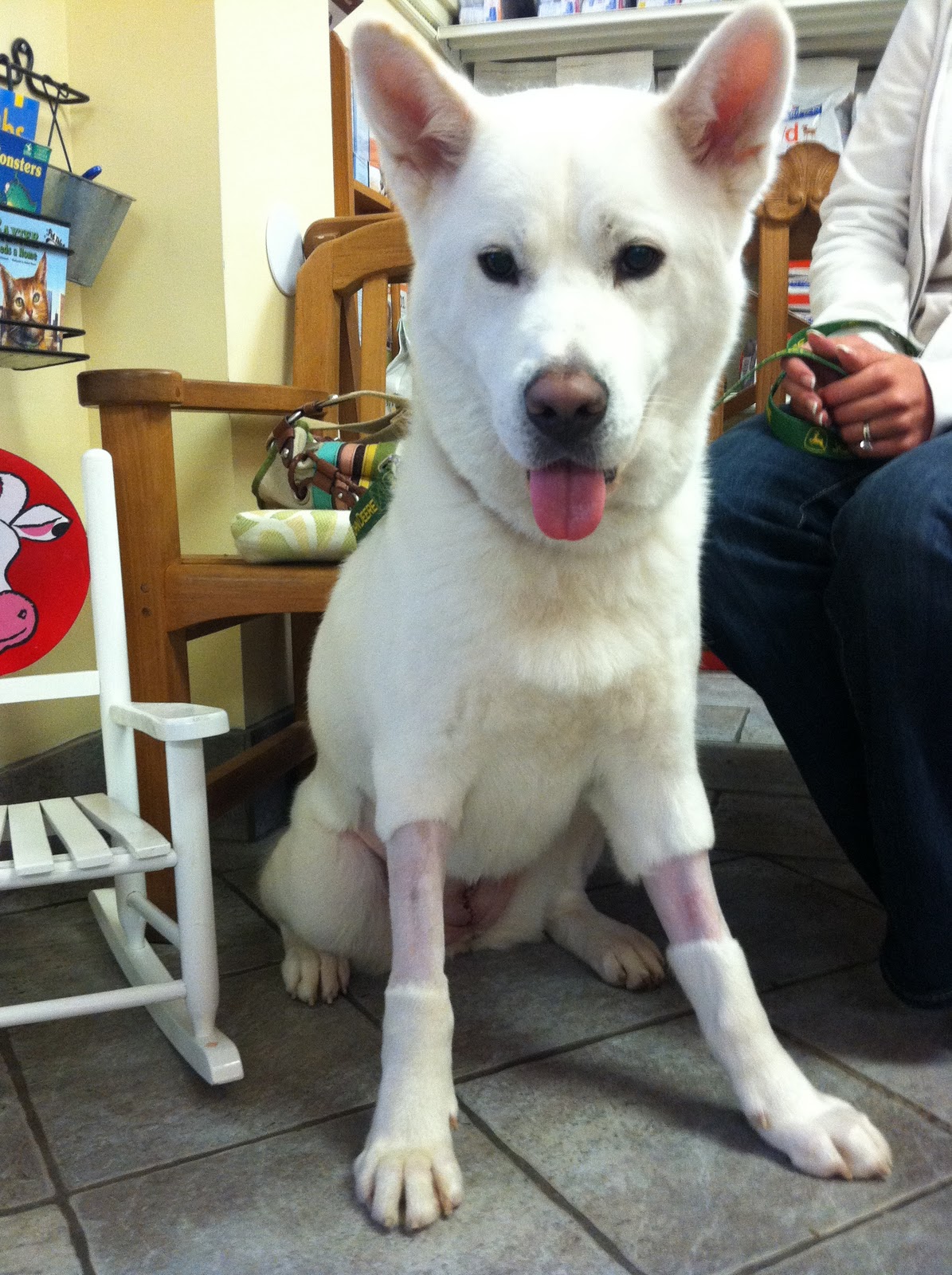
I met Bailey on a Tuesday evening appointment. She was brought in by her owners who were in their mid-twenties and full of smiles. They told me that they had just returned from their 2 week honeymoon.  After the “congratulations” were exchanged I started to focus on Bailey. Bailey was a big (like 100 pounds) fluffy, (which makes you look even bigger) 2 year old spayed female white Husky. She had sky blue eyes, an open sweet mouth with her tongue was always hanging out. She was always engaged in her surrounding company, always very alert, and always a big cuddly, fluffy, sweet, gentle girl. She looked a little intimidating but she was as friendly as a Golden Retriever. I will say though, that for as friendly and gentle as Bailey is she also possesses that stoic, strong, impressive stance. She is definitely a big boy’s dog. Every manly man loves her. She is the dog my husband would pick if he could pick, (don’t EVER tell him he can pick, he can’t, sorry, that’s just the way it is in this household).
Bailey’s parents had left the care of her and their other dog with their parents while they were honeymooning in sunny Mexico. Their parents had called them and reported that “Bailey wasn’t acting quite herself.” Apparently everyone wrote this off as her just not used to being in a different house and missing her parents. Later their parents called them back to report that “Bailey’s gums were pale.” Now as soon as this came out of their mouths I wanted to scream! This is like telling me that you noticed that your child had had passed out, had a seizure and stopped breathing. I was waiting to hear that their parents had recognized the immense severity of this clinical sign and IMMEDIATELY brought her to the emergency clinic, but this never came. I let them continue to tell me about her, from the perspective of their parents. They went on to tell me that Bailey had seemed to wax-and-wane the whole time they were away. She wasn’t playing, or eating as well, then she would be a little better the next day and worse a day later. They also said that after their parents noted her pale gums they watched the gums very closely, and reported her gums were pale pink, then pale, then white, then got pale again.
I was writing all of this down as fast as I could, because it kept me from talking, and I was afraid my gasps and looks of horror might cause us to loose track, and Damn, I couldn’t really believe what I was hearing. After they told me about what their parents had observed I asked them what they had observed. I think that they had been pretty wrapped up in wedding plans, honeymoon plans, and each other to be too observant with Bailey. It was all very understandable. (FYI they told me that the wedding and honeymoon were fabulous!)
Bailey’s parents had just gotten back the day before and they too had realized that she just wasn’t right.
I started my examination of her. One of the things we have to “train” ourselves to do is understand what a “normal” gum color looks like in all of the different breeds of dogs. There are some breeds of dogs with very dark gums, it can be hard to tell the color pink when your background is black. And then the white dogs can have a red, pink, or pale gum. It is definitely a learned assessment. I looked at Bailey and she had what we call a “muddy pale” color. I did not like this at all. The second I see such a bad color I stand on alert and dig hard. There is NO way a pale mucous membrane pet is getting out my door without a lot of talking about my fears for their pet. AND just in case you aren’t getting my “I am really afraid” vibe yet, I will say for the record..
Every single person and pet with pale gums needs to be at the emergency room right now!
Further, if you or your pet, or anyone else, ever has a seizure you must go to the emergency room ASAP!  My dad actually came home one day and found their dog having a seizure, what did he do? He got back in his car, and drove to my mom’s work, to tell her. He left the dog at their house. He got a lecture from me later. Now I understand we don’t always respond correctly in the event of an emergency, that’s why I write this blog, and talk to my clients a lot.
Bailey’s physical exam also revealed an increased heart and respiratory rate, and a palpable mass in her belly. I discussed my exam findings with the owners. I wanted to do some blood work and take an x-ray. They told me they had a budget. I thought to myself, this was not the case to have a budget on.
The x-ray revealed an enlarged spleen, which had been what I suspected when I felt the mass in her belly, but thankfully no blood in her abdomen. I ran a PCV (packed cell volume to get a red blood cell count), because by this point it was after 7 pm and I couldn’t keep her in the hospital alone, and they told me they couldn’t afford the few thousand dollars a transfer to the ER would likely cost. Her PCV was 30, it is supposed to be mid 40’s. I told them I would have the blood work back in the morning and I wanted her back at the hospital by 9 am and left here for the day. I suspected that she would need her spleen taken out then, (splenectomy). They said “ok” left with a brochure for Care Credit. Care Credit is a credit card for those who need to pay for a medical procedure.
The next morning Bailey was dropped off with a large amount of trepidation from her parents who had been warned she would probably be having a surgery today, and a Care credit limit of $1500. Which we were pretty sure would cover her needs.
Dr. C looked at Bailey and to my surprise did not feel an abdominal mass. She did however see bailey urinate. The urine was bright orange. This is a big CLUE! I called Baileys owners immediately and told them our newest findings. We were now concerned that maybe she had Immune-Mediated Hemolytic Anemia. Which made a little more sense, because Bailey was so young and splenic tumors are much more common in older dogs. I wanted to give Bailey an ultrasound but this was going to cost $200. They couldn’t afford this. So I tried to cut a corner. Dr. C and I tried to do an ultrasound on Bailey. Neither one of us has had enough practice to be proficient at ultrasounds. I was fairly certain that there wasn’t a mass in her belly, but we don’t have eyes trained well enough to distinguish the finer details of a trained ultrasonographer.
Because there wasn’t a mass on palpation, and we couldn’t see it on the ultrasound. We defaulted to the IMHA diagnosis.  We started her on a steroid, and sent her home. I wanted to see her in 3 days to re-check her PCV and immediately if anything worsened or changed. They came in 3 days later and then 3 days after that. Bailey’s PCV never changed. Neither did her demeanor. I wasn’t settled we were right. The next Monday, 6 days later I begged them to come back and let the very very well trained ultrasonographer take a look at her. I told them we wouldn’t charge them for this.
As soon as the ultrasound probe hit Baileys belly the ultrasonographer said. “Splenic torsion!, “ “you have to cut this dog now!” I very quickly called the owners and braced them for surgery, again. I told them that if we didn’t remove her spleen she would die.
Bailey’s surgery happened a few minutes later. Thankfully there were 2 other vets in the building. For a bad splenic surgery you need a few more hands in the belly. I have done probably 20 splenectomies in the last few years. When I looked in Bailey’s belly I couldn’t believe what I was seeing. Her whole entire spleen looked like it had been tied in knots. I couldn’t even recongnize the surrounding organs. My heart sank. I had to look up, close my eyes, and take a few deep breaths. How was I going to break the news that she had an inoperable, beyond the worst thing I have ever seen abdomen, and that she was certainly going to die soon, and shouldn’t even be woken up from this surgery? I just sank.
This is what a REALLY bad spleen looks like
I asked Dr. E to help out. I needed another set of hands and eyes, and I damn well needed to be sure before I made that phone call. Dr. E scrubbed in and helped me lift out the tangled mess. She couldn’t believe what she was seeing either. That belly looked so bleak.
We looked at each other and I just said. “Let’s just start taking out what we know we need to, and let’s see what’s left.” “Okay,” she replied.
3 hours later, we had what used to be a spleen out and some completely unrecognizable structures that I think were really angry lymph nodes? Maybe? Without being able to explain it the stomach and kidney which were right up to, but not incorporated with the mass, were fine.
I closed her up, said a little prayer, and crossed my fingers. I called her parents and told them how lucky this girl was. And, how after seeing what was in her belly, how I couldn’t believe that she could walk, eat, live, not be screaming in pain, and how lucky we were that we did that ultrasound and didher surgery today.
Bailey walked out of the clinic the next day. She was actually wagging her tail, and eating. It took a week for her PCV to get back to normal. But I swear that dog is a miracle.
1 day post-op picture, going home

As a parting thought I told Bailey’s parents to RUN to the emergency room if she ever hints at not feeling well, because that girl can mask the most horrific illness. Talk about stoic, that’s an understatement!
1 week post-op


It has been about a month since Baileys surgery. She has done remarkably. And she has her sparkle and playfulness back. And her parents still have room left on their Care Credit. JIC they go away again.

Friday, September 23, 2011

my last week

Hello Everyone,

Hard as I try to get a post posted every other day I seem to have these bumps in the road that cause me to de-rail.

I had three terrible days in a row. It all started last week when a friend I had'nt seen in 15 years dropped in for a few days. It was wonderful to see her, and I really tried to take some time off. But last Wednesday I saw a 1.5 year old spayed female Akita that had been ADR (vet term for Ain't Doin' Right, (its one of my favorite terms, so gritty and ole timey)). Her owners were in their mid-twenties. All smiles and full of new life. It was palpable the minute I walked into the exam room. They very quickly spilled the beans that they had just gotten hiome from their honeymoon. They had left their dogs with their parents and their parents had reported to them that Bailey's (Akita's name) had been lethargic, not interested in food, and had had white gums for the last two weeks. I very quickly gasped and interjected, "Ok, in the future white gums equals immediatley get in the car and drive to the emergency hospital or here." They went on to tell me that they had been very busy and thought she might recover on her own, (small gasp again). I looked at her gums, and they were a pale muddy slightly purplish color, aka crap-ola. I palpated her abdomen and there was an enlarged mass in the area of her spleen. I took an x-ray and reported back to them that she needed her spleen removed ASAP. I scheduled her first thing the next morning. Problem was I had my friend coming in, had a very messy house to try to get ready for compoany and i was exhausted.

It was the beginning of my cascade of avalanche of disasters that has kept me from posting. I will finish Baileys story soon, stay tuned. It's a goodie!

Back to my tumultous week. My poor friend Marta showed up at the clinic whike I was in the middle of trying to get things wrapped up so I could go spend  some time with her. She ended up assisting us with Wren my "worst case ever kitten" (I have a long story on him coming soon), and Momma Kitty with the worst polyp ever, (she's coming up to), and the turtle, Bailey, and a few others. Sorry Marta, and Thanks for all of your help.

I did spend a great Friday and Saturday with her, Diedra, (sister) and Joe (husband). And then we left on Saturday afternoon for Philadelphia to run the Rock N' Roll 1/2 marathon. It was a blast! The run is flat, the weather was great, a band plays music to cheer you on every mile. We all finished together and had a concert to dance to at the end. It was a great day. Needless to say I was tired on Monday.

The event of Monday are the last blog.

But this is my real-life. Crazy, insane busy, drama life and death, and I love it!

Ok, Here's a few pictures of Bailey,

Here are some pictures of the three of us at the Philadelphia Rock N' Roll Half Marathon