Showing posts with label spleen. Show all posts

Monday, March 28, 2016

Canine with Distended Belly; Splenectomy. Costs, Advice, Tips, and Why Immediate Surgical Intervention Is Critical.


This is Buddy. 

He is like most of the Jack Russell Terriers that we see in rural Maryland. He is fierce, brave, obstinate, and incorrigible. He is also unapologetic about all of this. He is a big personality in a small football sized package. He is the quintessential JRT. There are a few breeds that follow the breed specific personality test to the  letter; JRT's are that breed. They go full tilt full time and they want, need, or desire few things. It is a short list of "likes" and a long list of unmatched indifference. To love one you have to own one, to understand one you have to live with one.

Buddy is a fit muscular pup.
Can you appreciate the "roundness" to his belly?

Rather suddenly his parents noted that his belly was getting mysteriously bigger rather quickly. 

Should this happen to your dog you should go your vet as quickly as possible, OR, you could visit me at Pawbly.com and ask me what might be going on?

At Pawbly.com I am first going to tell you to head directly and immediately to the vet. Any vet, anywhere as this can certainly be a life threatening emergency.

Then I am going to answer as follows;
There are a few things you need to be worried about..

1. Something is leaking. Maybe blood? Maybe fluid. All are bad.

2. Something is expanding. Maybe the stomach (gastric) is inflating like a balloon? This is called dilatation. If that balloon twists it is called volvulus. If this happens these organs can become strangulated, this is like placing a string that is too tight around your finger. If not treated and relieved quickly this tissue dies. We all need a stomach. GDV can kill your dog in minutes to hours.

3. Something inside is growing. After adulthood is reached your organs aren't supposed to keep growing. In almost all cases that growing thing inside is not supposed to happen. Cancer is the most common cause of abnormal growth.

4. The abdominal wall can be stretching due to muscle loss,, but this is usually a slow gradual process. Think diabetes, Cushing's disease, hypothyroidism.

Now some of these cases these pets are simply getting fat. But fat is not a round basketball just got inflated in the belly.

Buddy is not fat.. Buddy is in crisis for something else.. Where do you go after the examination ($50 at Jarrettsville Vet) confirms your burgeoning belly suspicion?

A radiograph is the best way to decide which of the above Buddy has going on. ($100-$150 at JVC).


And there it is.. well, maybe not a basketball,, but it is a big round mass in Buddy's belly. 


After the radiograph was taken it was time to make some decisions. Up until now every vitally needed diagnostic has been done. You need to do these two things if this happens to your dog. I also should mention that the radiographs allowed us to assess the chest for evidence of metastasis. This piece of information is vital to the dogs prognosis moving forward. If there are mets in the chest the surgery will likely not change the prognosis or lifespan. 

The next decisions and steps are the ones filled with question, doubt, and intense scrutiny for clients.

Here's my advice on where to go from here;

1. Listen to your dog. Buddy was still rambunctious and barking at every passing dog. Buddy was still behaving like Buddy. In other words, Buddy thought he was perfectly fine. Huge prognostic indicator for a likely successful surgery. Do surgery on these dogs. Don't sit there thinking about worst case scenario. 

2. Be prepared for a financial hit. These happen to every dog that lives long enough. Every pet owner should have pet insurance for these situations, OR, a pet savings account. I recommend $1,000 for each pet. If you do not have this have a way to get access to this; a friend, a vet who trusts you, etc.

3. Start strategically planning the next few scenarios. Here is how I approach these cases with my clients; I want to get as much information as possible pre-operatively. This includes blood work ($170). I also want to do an ultrasound ($200) to "see" what the rest of the internal organs look like. If there are other lesions throughout the abdomen the prognosis is more guarded. 

4. Here's what my reality for these cases is;
I am NOT GOING TO SPEND SO MUCH OF MY CLIENTS MONEY THAT THEY CANNOT AFFORD SURGERY. I sit down with my clients and discuss what everything costs and what I want to do with the money they are spending on the information I am gathering. Nothing in the world drives me to the brink of insanity than talking to a client who has exhausted all of their resources on diagnostics and now cannot afford to treat their pet. There is no sense spending money to get a diagnosis if the treatment then becomes unattainable. I consider it unethical and reprehensible.

We suspected that Buddy's spleen was the culprit and that spleen needed to be removed ASAP! 

If you do not do surgery these dogs will very likely die of internal blood loss. 

The estimate for a splenectomy at JVC is $1000*. Buddy's parents did not have $1,000. We did what we always do in these cases. We discuss with our clients how we can get them the help their dog needs. This is the difference between JVC and too many other clinics. We will help your pet get back out the door. We have multiple options to help insure this. For Buddy's family a deposit and a payment plan through our good friends at Vet Billing Solutions were his answers. 


Buddy's spleen was the only thing you could see in his belly when we opened him up. It never ceases to amaze me how large a tumor can get and how incredibly resilient these patients are. When it comes to splenic tumors a few things are key;
  1. Get it out as soon as it is discovered. The spleen is essentially a blood sac. It loves to bleed, even when it is happy and healthy, if it has even the tiniest bit of trauma. BUT, when it is an abnormal mass of tissue it really, really, likes to bleed. A bleeding tumor, especially in the spleen, is ticking time bomb. 
  2. Get as much information as possible. radiographs, blood work (full chemistry, CBC, PT/PTT), and ultrasound are super helpful.
  3. Buddy was happy and acting oblivious to his tumor. This is the best prognostic indicator I ever hope to have.


Have an excellent surgeon and support staff. I don't say this often. In my heart I love being a small town quiet rural practice, BUT, I also have a stacked exceedingly capable veterinarians and staff. At JVC we can do almost every emergency surgery on almost everyday. When it comes to picking a vet to call your own, remember to ask about the dark days that may lie ahead. I know of many small practices that either do not, or will not, do emergency surgeries. There are too many times where the cost to go to a specialist prohibits care.* 


When I am about to do an exploratory surgery on a patient I ask my clients to be standing by a phone. Here's why;
Closing.. with a big sigh of relief!
I am never really sure what I am going to find until I look inside that patients abdomen? In some cases I have found widespread disease that was not evident in the pre-op work-up (most of the time we had to skip these due to finances), and in others the mass is not resectable (cannot be safely removed). If the patient cannot be saved by the splenectomy I want to discuss whether it is fair to wake them up?

The very dark red at the 9 to 11 o'clock position is normal spleen tissue.
Everything else is tumor.

The most common presentation of dogs in need of a splenectomy are weak, lethargic, pale, internally bleeding, and teetering on the brink of death. These cases require quick confirmation of the diagnosis and surgery.


Buddy is a 20 pound dog who had a 3.25 pound splenic mass. That's enormous on anyone's scale. Buddy did very well through surgery and woke up calmly, quietly and effortlessly.

Buddy returned the next day his normal bull headed dominant self. He also had a beautifully quiet incision.


And now a trim waistline.


Closing Notes;
  • There are some surgeons who perform routine gastropexy after splenectomy to prevent post-op GDV. It is something you should discuss with your vet pre-operatively.
  • Post-operatively these patients should be monitored very closely. Ideally, at a 24 hour facility. ECG, blood pressure, PCV/TP. Transfusions may be needed in cases where blood loss was severe.
It is my belief that any and all abdominal masses warrant an internal look before euthanizing. We are reminded daily that life is full of miracles and second chances. I know it is hard to hear, scary to admit, and expensive to treat but 50% of these pets are curable! Take a leap, look inside, and get the spleen out fast... sometimes fate will deal you a good hand and often life will remind you it is worth fighting for.


Buddy's cost of care at JVC was as follows;

Presentation;
  • Exam $50 and radiograph $100.

Surgery Day;
  • pre-op chemistry w/ CBC $50
  • injectable NSAID $20
  • injectable antibiotic $30
  • iv catheter and fluids $80
  • splenectomy $350
  • surgical supplies $75
  • anesthesia $200
  • post-op analgesia and antibiotics $40
Total cost $1050. 

Many thanks to Vet Billing Solutions for helping us provide a way to make Buddy's surgery affordable to his family.

*Estimates for this surgery at an emergency clinic can range from $1500-$3500.

Related Blogs;


If you have a pet question, or want to share your pet knowledge, please join the free online pet information exchange network that is dedicated to helping pet parents learn about how to best care for their pets. Pawbly.com is free to use and open to anyone who loves pets.

I can also be found at the clinic, Jarrettsville Vet, in Jarrettsville Maryland. We post our prices and fees every year and we have a wonderful Facebook page. I am also on Twitter @FreePetAdvice.

Sunday, October 23, 2011

Bailey's Beyond bad Belly, really it was Abominable!

I have introduced you to Bailey already, but I thought I would give you her full story.
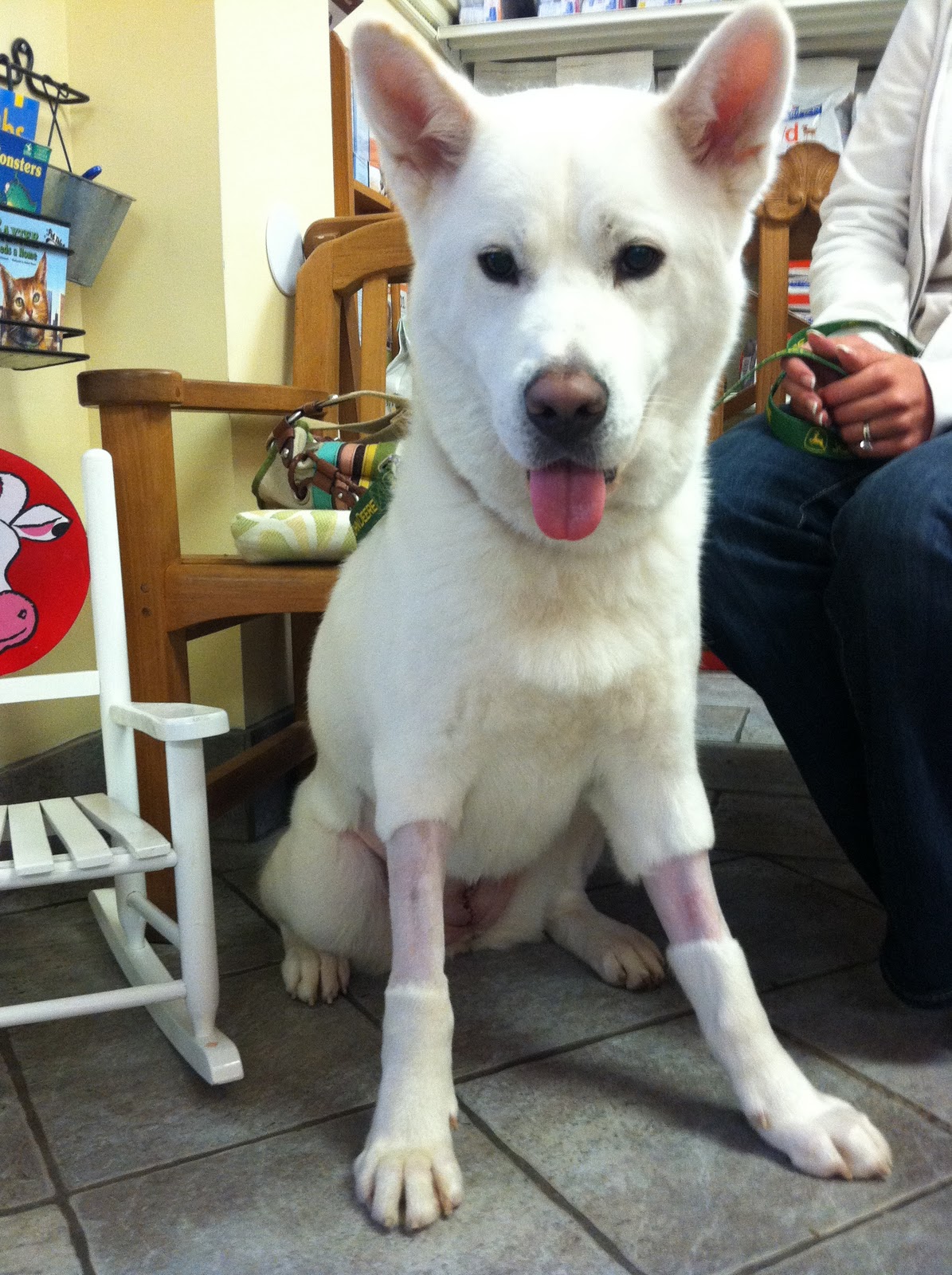
I met Bailey on a Tuesday evening appointment. She was brought in by her owners who were in their mid-twenties and full of smiles. They told me that they had just returned from their 2 week honeymoon.  After the “congratulations” were exchanged I started to focus on Bailey. Bailey was a big (like 100 pounds) fluffy, (which makes you look even bigger) 2 year old spayed female white Husky. She had sky blue eyes, an open sweet mouth with her tongue was always hanging out. She was always engaged in her surrounding company, always very alert, and always a big cuddly, fluffy, sweet, gentle girl. She looked a little intimidating but she was as friendly as a Golden Retriever. I will say though, that for as friendly and gentle as Bailey is she also possesses that stoic, strong, impressive stance. She is definitely a big boy’s dog. Every manly man loves her. She is the dog my husband would pick if he could pick, (don’t EVER tell him he can pick, he can’t, sorry, that’s just the way it is in this household).
Bailey’s parents had left the care of her and their other dog with their parents while they were honeymooning in sunny Mexico. Their parents had called them and reported that “Bailey wasn’t acting quite herself.” Apparently everyone wrote this off as her just not used to being in a different house and missing her parents. Later their parents called them back to report that “Bailey’s gums were pale.” Now as soon as this came out of their mouths I wanted to scream! This is like telling me that you noticed that your child had had passed out, had a seizure and stopped breathing. I was waiting to hear that their parents had recognized the immense severity of this clinical sign and IMMEDIATELY brought her to the emergency clinic, but this never came. I let them continue to tell me about her, from the perspective of their parents. They went on to tell me that Bailey had seemed to wax-and-wane the whole time they were away. She wasn’t playing, or eating as well, then she would be a little better the next day and worse a day later. They also said that after their parents noted her pale gums they watched the gums very closely, and reported her gums were pale pink, then pale, then white, then got pale again.
I was writing all of this down as fast as I could, because it kept me from talking, and I was afraid my gasps and looks of horror might cause us to loose track, and Damn, I couldn’t really believe what I was hearing. After they told me about what their parents had observed I asked them what they had observed. I think that they had been pretty wrapped up in wedding plans, honeymoon plans, and each other to be too observant with Bailey. It was all very understandable. (FYI they told me that the wedding and honeymoon were fabulous!)
Bailey’s parents had just gotten back the day before and they too had realized that she just wasn’t right.
I started my examination of her. One of the things we have to “train” ourselves to do is understand what a “normal” gum color looks like in all of the different breeds of dogs. There are some breeds of dogs with very dark gums, it can be hard to tell the color pink when your background is black. And then the white dogs can have a red, pink, or pale gum. It is definitely a learned assessment. I looked at Bailey and she had what we call a “muddy pale” color. I did not like this at all. The second I see such a bad color I stand on alert and dig hard. There is NO way a pale mucous membrane pet is getting out my door without a lot of talking about my fears for their pet. AND just in case you aren’t getting my “I am really afraid” vibe yet, I will say for the record..
Every single person and pet with pale gums needs to be at the emergency room right now!
Further, if you or your pet, or anyone else, ever has a seizure you must go to the emergency room ASAP!  My dad actually came home one day and found their dog having a seizure, what did he do? He got back in his car, and drove to my mom’s work, to tell her. He left the dog at their house. He got a lecture from me later. Now I understand we don’t always respond correctly in the event of an emergency, that’s why I write this blog, and talk to my clients a lot.
Bailey’s physical exam also revealed an increased heart and respiratory rate, and a palpable mass in her belly. I discussed my exam findings with the owners. I wanted to do some blood work and take an x-ray. They told me they had a budget. I thought to myself, this was not the case to have a budget on.
The x-ray revealed an enlarged spleen, which had been what I suspected when I felt the mass in her belly, but thankfully no blood in her abdomen. I ran a PCV (packed cell volume to get a red blood cell count), because by this point it was after 7 pm and I couldn’t keep her in the hospital alone, and they told me they couldn’t afford the few thousand dollars a transfer to the ER would likely cost. Her PCV was 30, it is supposed to be mid 40’s. I told them I would have the blood work back in the morning and I wanted her back at the hospital by 9 am and left here for the day. I suspected that she would need her spleen taken out then, (splenectomy). They said “ok” left with a brochure for Care Credit. Care Credit is a credit card for those who need to pay for a medical procedure.
The next morning Bailey was dropped off with a large amount of trepidation from her parents who had been warned she would probably be having a surgery today, and a Care credit limit of $1500. Which we were pretty sure would cover her needs.
Dr. C looked at Bailey and to my surprise did not feel an abdominal mass. She did however see bailey urinate. The urine was bright orange. This is a big CLUE! I called Baileys owners immediately and told them our newest findings. We were now concerned that maybe she had Immune-Mediated Hemolytic Anemia. Which made a little more sense, because Bailey was so young and splenic tumors are much more common in older dogs. I wanted to give Bailey an ultrasound but this was going to cost $200. They couldn’t afford this. So I tried to cut a corner. Dr. C and I tried to do an ultrasound on Bailey. Neither one of us has had enough practice to be proficient at ultrasounds. I was fairly certain that there wasn’t a mass in her belly, but we don’t have eyes trained well enough to distinguish the finer details of a trained ultrasonographer.
Because there wasn’t a mass on palpation, and we couldn’t see it on the ultrasound. We defaulted to the IMHA diagnosis.  We started her on a steroid, and sent her home. I wanted to see her in 3 days to re-check her PCV and immediately if anything worsened or changed. They came in 3 days later and then 3 days after that. Bailey’s PCV never changed. Neither did her demeanor. I wasn’t settled we were right. The next Monday, 6 days later I begged them to come back and let the very very well trained ultrasonographer take a look at her. I told them we wouldn’t charge them for this.
As soon as the ultrasound probe hit Baileys belly the ultrasonographer said. “Splenic torsion!, “ “you have to cut this dog now!” I very quickly called the owners and braced them for surgery, again. I told them that if we didn’t remove her spleen she would die.
Bailey’s surgery happened a few minutes later. Thankfully there were 2 other vets in the building. For a bad splenic surgery you need a few more hands in the belly. I have done probably 20 splenectomies in the last few years. When I looked in Bailey’s belly I couldn’t believe what I was seeing. Her whole entire spleen looked like it had been tied in knots. I couldn’t even recongnize the surrounding organs. My heart sank. I had to look up, close my eyes, and take a few deep breaths. How was I going to break the news that she had an inoperable, beyond the worst thing I have ever seen abdomen, and that she was certainly going to die soon, and shouldn’t even be woken up from this surgery? I just sank.
This is what a REALLY bad spleen looks like
I asked Dr. E to help out. I needed another set of hands and eyes, and I damn well needed to be sure before I made that phone call. Dr. E scrubbed in and helped me lift out the tangled mess. She couldn’t believe what she was seeing either. That belly looked so bleak.
We looked at each other and I just said. “Let’s just start taking out what we know we need to, and let’s see what’s left.” “Okay,” she replied.
3 hours later, we had what used to be a spleen out and some completely unrecognizable structures that I think were really angry lymph nodes? Maybe? Without being able to explain it the stomach and kidney which were right up to, but not incorporated with the mass, were fine.
I closed her up, said a little prayer, and crossed my fingers. I called her parents and told them how lucky this girl was. And, how after seeing what was in her belly, how I couldn’t believe that she could walk, eat, live, not be screaming in pain, and how lucky we were that we did that ultrasound and didher surgery today.
Bailey walked out of the clinic the next day. She was actually wagging her tail, and eating. It took a week for her PCV to get back to normal. But I swear that dog is a miracle.
1 day post-op picture, going home

As a parting thought I told Bailey’s parents to RUN to the emergency room if she ever hints at not feeling well, because that girl can mask the most horrific illness. Talk about stoic, that’s an understatement!
1 week post-op


It has been about a month since Baileys surgery. She has done remarkably. And she has her sparkle and playfulness back. And her parents still have room left on their Care Credit. JIC they go away again.