Monday, June 27, 2016

Barking Puppy in the Middle of The Night.. Waking Me Up Before I Want To Get Up

Here is a question I get often. The dog who wakes the parents up too early. How do you re-train your pup to sleep in when you need an extra few winks?

Here is the question on Pawbly from Lindsay;

"After a few hours, usually between midnight-2, if I move or get up, she wakes up and wants to play. Starts walking all over me, pawing me in the face, etc. This is when I put her in her crate for the rest of the night. Every morning around 4:45 she starts barking continuously. I start getting up around 5:15 but am awake as soon as the barking starts. It drives me crazy and of course my husband sleeps right through it. How can I get her to stop barking in the mornings? Or how can I train her to sleep later, and wake up when I get her up? Please help!! I wake up earlier than normal to sit, drink coffee and relax before I have to start my day, and this pup is driving me crazy!! Thanks!"

Raven

Krista Magnifico, DVM, Founder of Pawbly answered ...

"Hello Lindsay,

I am not sure how much research you did on this breed, but I would say that this behavior is very normal for this breed. They are incredibly energetic and need lots and lots of exercise to keep them from developing a bad habit. Which is why they are such excellent farm dogs. Up early, out running after livestock ALL day,, sleep 8 hours at night, get up and repeat.

She needs more exercise, and you need to adjust your schedule to provide it. When I talk about an average exercise pattern for these guys I know some clients Aussies who run 10 -20 miles a day. Now I know that no normal person can provide this much, but try to get as much in as possible, dog parks, play dates, finding other friends with dogs to play with, doggie day care, anything like this will help.

Without drugs the only successful way to manage this is to get up and start exercising in the morning. I run my dogs (mind you I have less energetic dogs) 4 miles each morning. They sleep quietly until I get up at 6. ((thank goodness!). Here is the real dilemma with drug therapy to adjust a behavior; drugs are the least preferable and worst option. Drugs should only be used in two cases; 1. I am beginning the training program and need help transitioning, OR. 2. I have given up on training and accept that my dog will need life long medications to keep their behavior tolerable.

Your puppy is barking because she misses you and wants to spend more time with you. Remember being a kid on Christmas morning? Who could wait for the parents to wake up? We always woke them up at 4 am..

Best of luck!"


Annie
Lindsey commented ...
"Thank you! I will work on the place command with her! Also, she's getting spayed in a few weeks, does that cause a behavioral change in female dogs or is that mostly male dogs?"


Laura M., dog and cat owner, former reptile rescue owner commented ...
"I honestly don't know. I have not spayed my bitch...and I do not agree with pediatric spays."


Krista Magnifico, DVM, Founder of Pawbly replied ...

"At 8 months old I would not call this pediatric. adolescent maybe? But I would recommend spaying at this age. For most people accidental pregnancies would be occurring as common place. Most people cannot and do not have the ability to monitor and management intact pets after about 6-8 months old. I agree that there are benefits to the pets in some cases waiting to spay/neuter, but an average client with a pregnant dog can't manage puppies. Spay her asap. It wont help with barking, but it will help with not having to manage one more issue, or a whole bunch of little issues."


Laura M., dog and cat owner, former reptile rescue owner answered ...

"Have you worked on a place command with her?  That would help.  I'd also work on mental training late at night, just before bed, so she konks out.

Mental training at this stage would be obedience.  Work on things until she's 100% solid with every command."

Me and my Jekyll
There are some amazing conversations happening at Pawbly.com. Lots of different opinions, experts from all walks of life and helping pets just because we share a love for them.

Please join us in building a safe, credible place to share information, build relationships and help animals in all corners of the world.

If you would like to talk to me about your pet please find me on Pawbly.com (search for me and ask me a question). I can also be found at the clinic, Jarrettsville Vet, in northern Maryland. I am also on Twitter @FreePetAdvice.

Always be kind..

Wednesday, June 22, 2016

Play Biting, Mouthy Puppies and How We Screw Them Up.


Parenting is a universal task we all take on in varying capacities. The hovering mother hen, the satellite spoiling aunts, uncles, grandparents, and the over burdened exhausted "there was an old woman who lived in a shoe. She had so many children, she didn't know what to do;" We each raise our kids with our own experiences, abilities and ideas in mind. We treat our pets in the same fashion. Our pets, like our children, are a reflection of this. 

As a veterinarian I feel that it is our duty and obligation to raise happy, acceptable, responsible members of society regardless of whether your kids have two or four legs. The over bearing, demanding barking parent who jerks on a choke chain beating his dog into submission is raising a powder keg of frustration who is likely to erupt into some unprovoked fight when he gets the chance away from angry militia man dad. I see it too often. I had a client last week yank the choke collar forcing his 100 pound dog to the floor cowering. He then stood over the dog screaming "He's Got To Learn!!" What was his dog doing that was so reprehensible? He was looking over the front counter at the dogs playing. He was being inquisitive without permission. It was met by anger and force.  The action caused gasps of disbelief amongst the staff and clients who witnessed it. This is not parenting, this is bullying. It breaks my heart that some people are so demanding, cruel and forceful. What are you trying to prove? That you are an abusive jerk? (Well, don't worry its apparent). Abuse elicits fear. Fear breeds more fear. Never ever be mean. It is counter productive. If you (the human) have an anger, control, abusive issues get help. Join a gym. Move to a deserted island (by yourself). 


In every puppy appointment I see I discuss both the health aspects of raising a puppy and the behavioral needs to transition confidently into adulthood. I am also the vet who swoons, kisses, snuggles, and offers treats the entire time with rare regard to pending meal times. The exam time is not just about the stethoscope stuff, I am watching your puppies responses to a stranger, a new place with lots of weird sounds and smells, and I am challenging them with restraint, interaction and emotional stability. Clients don't see this, but a good vet is always collecting data and always making notes about places we can help you and your puppy on the road to successful adulthood.


There is great debate about dogs, mouth parts, and appropriate puppy training. I am not a militia woman. I understand the consequences of training versus discouraging inquisitive behaviors. I also understand defining limits in a healthy productive positive fashion. 

Fingers in the mouth is an important part of understanding limits, greeting, and acceptance. Dogs are not human beings. They absorb and interact with the world differently. I know that many people are vehemently apposed to any kind of mouth interaction. I am not so hard lined for a few reasons. Knowing your dog, your breed tendencies, your abilities, your training aptitude, environment and how you influence your dogs growth are all key to this.

It is important to remember that as a veterinarian who sees lots of pets, lots of people, and a huge varied range of ways they each raise their pets. I have to adjust what I say, how I say it, and why I offer advice. My goal is simple and consistent across every step of the journey;

Maintain and strengthen the bonds between a pet and their parents.


Here is the string of conversations that went on between a Pawbly user and three of the Pawbly Pack experts;

Question:

We have a 4 month old Golden Retriever puppy. She likes to do what they call "play biting". We thought it would eventually start getting better but it is as bad now as when she was a month old. It is very annoying. Will she eventually grow out of this or is it something we may have to look forward too for sometime.


Here are the Pawbly Pack experts replies;

Laura answered:
"She won't stop on her own - just like with anything you'd like her to do, you need to train her to stop.  Immediate corrections work but you need to be consistent.  If you had her at 4 weeks, you have an extra bit of difficulty as she should have learned valuable social interactions from her litter mates and dam.

Have you planned to take her to training classes?  If not, I would...it sounds like you would benefit from it."


My answer;
Krista Magnifico, DVM, Founder of Pawbly answered ...

"I don't discourage, nor get annoyed with play biting and I think it is incredibly important that puppies learn to explore the world, taste everyone and (almost) everything in it, and learn boundaries. A play bite is your puppies way of greeting, thanking and telling you that they love you. It is only to be discouraged if it is too hard. In which case a sharp "OUCH!" and walking away is appropriate. Telling your puppy to stop their expression of gratitude, curiosity, and friendship is disheartening. Please don't get annoyed she loves you and she is happy.

And yes she will grow out of it. She will also learn to explore the world through smell, sight and sound. The taste sense will decrease. I never ever want to curb or discourage a happy puppy, just teach boundaries. We ruin more puppies with ridiculous over bearing human demands. I just think it is tragic.

If you cannot grow to love the hand and mouth try a chew toy or some option for her to play with.

I totally agree with Laura about training and you cannot ever understand the importance of socialization. Although this breed is naturally very social,, hence the play biting.

Very best of luck"

PK Dennis, Terrier lover, Cairn rescue foster home, Feeds Raw answered ...

"She will NOT grow out of it!  You need to teach her that doing this us unacceptable to you!  Zak George has a great video on YouTube that shows you how to teach your girl not to put your teeth on you."


Krista Magnifico, DVM, Founder of Pawbly answered ...

"Let me clarify..biting has a negative connotation and needs to be addressed if it is truly biting. Being a mouthy puppy is normal and not equivalent to biting. It is normal interactive play for a puppy learning to understand the world. Your vet can help identify one versus the other. The overwhelming majority of puppies of this breed at this age are playing. They progress to biting because they are not being given adequate time and exercise. Then they are reprimanded which exacerbates their frustration and worsens their demand for time and play. I agree that Biting needs to be addressed and boundaries need to be established. But Discouraging mouth play and interaction (which is what I see overwhelmingly) is equivalent in your puppies eyes as being dismissed and treated as annoying.

This terrible advice to manage every second of a puppies life and extinguish their love and curiosity is making our puppies crazy and turn into them into unsocialized fearful anxious dogs. Parents drive puppies into corners where only bad things result and surrenders to shelters become reality. It takes time and a change in perspective to teach pet parents how to raise happy healthy socialized pets. Most of the time they mess it up unknowingly and unintentionally.

So if your puppy is biting they are trying to tell you something. Seeing that display of need as annoying concerns me deeply that you aren't understanding what she is trying to tell you. I see it everyday in practice and the statistics for pet surrenders prove it. If you have had her for two months and she has turned into a biter you have missed the expression and need she has been trying to express to you. She needs more of something and she is biting to try to get it. Reprimanding her for a failure of your understanding of her need will worsen the relationship you have with her.

I recommend that you find a positive reinforcement trainer to help meet her needs and assist her j to growing up as a happy healthy socially responsible member of her community."


Now I know these other two experts. They are truly experts. They have dedicated their lives to dogs. Their dogs are the picture of model dog behavior in every sense. They come to the training table with the highest of standards in place and a firm ability to implement and train almost any dog with any problem.

Here's where I differ in my approach; I have to do whatever I can to keep these dogs (almost ALL of them teenagers who have been screwed up by the unknowing mistakes of their misguided, over tired, under prepared pet parents) in the home, and get to the "happy place" as soon as possible. At 4 months old, if this person obtained this puppy at 4 weeks old, it is clear to me that this person has caused this problem by not knowing how to address it. How did that happen? They forgot to answer, or understand, their puppies needs and pleas. They are trying to extinguish a request in stead of understand and provide for it.

If I don't figure out how to bridge the gap between needs, expectations, and reality this puppy will end up being disposed of.

In my opinion of all the things pet parents need to improve upon behavior is the single greatest failure. (After we get this licked I am moving onto;
1. Sentient Beings. Animals understand us more than we give them credit for.
2. Spaying/neutering. 3 million dog and cat euthanasia's in the USA every year! What??.
3. Preventative Care. Want to save $$ and emergencies? Preventative care will help.
4. Responsible Ownership. Abuse, neglect should have real consequences. If you lack the ability to provide kindness please don't have a pet.

Then my work is done.

Oh, And there is still Pawbly. Pawbly is poised to help with all of these.... (note to self; eat more spinach, pace yourself).

If you have a pet question, or a pet related concern, please join us on Pawbly.com. We are here to help and always free.

I am also available for appointments and individual care at Jarrettsville Vet in Jarrettsville Maryland, or find me on Twitter @FreePetAdvice.

And YouTube has lots of videos on common conditions, treatment options, and at home care. Follow me there too!

Saturday, June 11, 2016

Limping Dog. How to do your own at home examination.

Classic "non-weight bearing" stance of a dog with a dislocated hip.


Two weeks post-op knee surgery and a seated dog with a bent knee proves that the joint is happy and healing.

One of the most common questions we get on Pawbly.com is about the limping dog.

To help people at home understand some of the most common injuries that cause lameness in a pet I thought I would provide a very basic "How to examine your limping dog at home" instruction blog.

Remember an examination doesn't just include the affected limb, it must include the whole pet. For this reason I recommend starting at the tip of the nose and letting your hands walk slowly from the nose to the tail. Inspecting everything very closely along the way.

Then we go to the "off" leg.

In most of these cases I advise my clients to check the leg by palpating (using your fingers to be your guide) and examining very closely  everything as your fingers walk your way over the leg from the toes to the spine. Palpate and probe every inch 360 degrees around as you move gradually up the leg. I know that most dogs are not fond of the feet (toes especially) being poked and prodded but in lots of cases the answer lies somewhere around here.

It is also important to remember symmetry. Use the opposite leg as a guide for what "normal" should look like.

Here we go on our virtual tour up the leg..

1. Check toenails. Some have grown into the pad and some are broken. All are painful. Broken toenails should be trimmed or clipped back as far as possible, or even removed, if broken severely. At the clinic I use a topical numbing agent and a muzzle and a quick cut. It hurts for one second,, like pulling off a band-aid. Then the pet is pain free again and using the leg as normal.

A very sharply pointed nail had grown into the foot pad.
When trimmed the evidence of the puncture is evident.

This pups toe required twice daily soaks and an oral antibiotic.
This must be treated as a wound.

This toenail is white because it was avulsed from the toe.
Regie had pulled the nail off the tissue and every time he walked the
nail rocked on the sensitive tissue underneath.
We trimmed it back as far as possible and this stopped the pain.
It will eventually grow out enough to be easily removed.
For now foot soaks, and clotting powder are all that's needed.
Oh, and no licking!

Clipped short enough to not touch the floor and cause pain.
Yellow styptic powder was used to stop the bleeding.

The toenail was broken, removed and leaves the "quick" exposed.
But, it will no longer be painful and the limp will cease.

Keeping the nail bed clean is all that is needed,
No Licking!

2. Look for redness or swelling, or wet, moist skin in between the toes. Some dogs get allergies, infections, even splinters in between their toes.


Interdigital cysts are painful.
This causes the pet to lick, which inflames the skin and seeds infection
.

Many dogs with allergies lick their feet because they itch.
The licking causes red staining, inflamed skin and infection
.


3. Look for injury to the foot pads. If bleeding soak foot in warm very mildly soapy water for a few minutes, then apply direct pressure with a clean cloth for 10 minutes,, no peeking, no wiping, no tight bandages. A small laceration to the foot pad is usually just allowed to heal. A deep laceration (full skin thickness) usually requires and antibiotic and protection from further trauma ( i like a panti liner (absorbs small amounts of blood and is super cheap) and a sock.. but change at least twice a day. Please call your vet if the wound is deep.

My pup, Charlie, who found a stray surgical staple. Sorry Charlie!

4. Look for any skin damage. Areas of injury. All penetrating wounds need veterinary assistance for an antibiotic and in some cases exploration to make sure nothing internal is damaged.


5. Broken bones cause significant non-weight bearing lameness and usually have considerable swelling. I know lots of people worry about broken bones but they are not normally seen without significant trauma like hit by car, jumping off bed, etc. They are swollen, painful and the leg often looks disfigured. Do not touch a broken leg without a muzzle in place. If the bone is sticking out of the skin wrap the leg in a towel and get to a vet to help stop the bleeding.

Maci a few days after her cruciate repair surgery.
6. Joint injuries are one of the most common lameness causes we see. Most often these occur after excessive or strenuous play. Some clients report that their dog was playing and they heard a sharp "Yelp!" and since then the dog has been sporadically lame. Typically this is a cranial cruciate injury. These dog have persistent lameness that may slightly improve and then worsen but in general they do not go back to normal weight bearing until the knee is stabilized. This is usually a surgical fix.

Ella is all done with her knee surgery.
I always advise that every limping and lame dog be kept quiet and calm by leashing walking outside at all times, or crating until your vet can see you. No running, jumping or play. Rest the leg. In many cases that is the only needed treatment.

A dog in significant pain to the point of not using the leg, being reluctant to stand or walk, or not interested in play, interaction, or even eating needs a vet immediately. In general a limping dog is not an emergency unless they are bleeding excessively, progressively worsening, or having a change in attitude or behavior.

In all cases your vet should be consulted. There are lots of options available after a diagnosis is provided.
Sarge,, the big ham

As always you can ask me a question about your limping (or otherwise) pet anytime for free on Pawbly.com. Pawbly is free to use and open to anyone and everyone.

Twitter has me sporadically @FreePetAdvice, And the whole majority of the rest of my life has me at the veterinary clinic, Jarrettsville Veterinary Center in Jarrettsville Maryland. 

Sunday, June 5, 2016

Why the Spay Price Isn't Fixed.


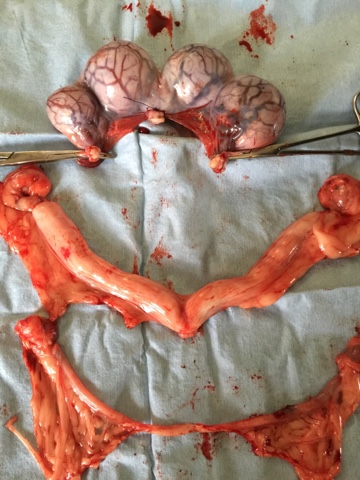
Three reproductive tracts of the three spays I did a few days ago. They are an excellent explanation as to why there is not a flat fee for spay surgeries (at least at my clinic).

Could you guess which reproductive tract belong to which patient?

Patient Number 1;
A 7 month old domestic short haired cat.


Patient Number 2;
An 8 month old 38 pound Cattle Dog.


Patient Number 3;
An 8 month old Labradoodle who is 55 pounds.


At my clinic I try to do everything I can to treat every case independently and be fair to each. Therefore, providing a "one  size fits all" approach doesn't work in many surgery cases. With the exception of routine cat and dog neuters, every other surgery has a price range and every other surgery is based on the patient. 

Historically vets have put themselves in the predicament of dismissing spays as a "basic" surgery done so often that it has been diminished to "routine" status. This perception has understandably caused clients to price shop and balk at spay costs of anything over $100. High volume low cost spay and neuter clinics have popped up to meet demand and only reinforced the perception.

For all of the knee surgeries that I do weekly with a $1200 price tag, that clients are more than happy to pay based on the specialists average going rate of upwards of $3,000, I have to argue and justify a spay price of $200 plus. Ridiculously that spay has a much higher chance of causing a life threatening post operative complication than my knee surgery does. I will take a bad knee to correct over a fat dog in heat to spay any day of the week.. and I make 5 times the amount of money doing it. 

Why does "one size not fit all"? Because some dog spays are ridiculously difficult to do. And some patients need more time, more pre-op consideration and more peri-op care, not to mention post-op goods and services. All of these cost more time and more money. Wouldn't you want your vet to tailor and customize your pets care to their needs. Isn't it fair to pay for that?


The three uteruses (probably grammatically correct to say 'uteri' but that just sounds snooty scholarly, which I am not, so I'll move on).. belong to the pets above and listed in their perspective order. (Note; I did not use the actual patients for this,, they are in fact my cat Wren, and my dear friends Madeleine and Maizie.. but they represent the actual patients very well.). The top uterus is an early pregnancy in a feral cat. Middle is an 8 month old who is 38 pounds and in heat, and the last is also an 8 month old who is 55 pounds and not in heat.

The costs of a spay should vary based on the patient. If your dog is in heat, pregnant, or has a uterine infection it is going to be more difficult to perform the procedure. It will take more anesthetic time, require more equipment and suture and should also be followed up with post operative medications to include analgesics and antibiotics.

As I  discuss why spay surgeries are each entitled to their own charges I will admit that I never charge a different price for cats. A pyometra cat is the same cost as a pregnant cat is the same cost as a regular cat spay. In truth there is not enough of an additional degree of difficulty to warrant the extra fee. The only exception to this is the post operative care and medications. I challenge other vets to argue differently. I especially challenge the emergency clinics who give estimates of cat pyometras in the thousands of dollars. 


The cat below is also pregnant. Although no one wants to be stuck in the middle of this moral and ethical argument it is Spring here and the kittens are blooming as fast as the flowers. Sadly, many of the cats in our rural area are also feral. Feral cats having kittens perpetuates more feral cats having kittens and many of these are eaten, killed, or die of infection. When a feral cat  is caught and brought to us for a spay or neuter we can't touch them, examine them, or even know if they are pregnant. Once they are sedated they are all spayed and neutered regardless of their condition. It is the only way the cats can be released responsibly and spared their life. But a cat is a cat and a cat uterus is easily surgically removed regardless of uterus size. If your cat is given a thousand dollar estimate (or anything near close to that call me. I will do it for a fraction of that.


If you asked me to spay your dog as I would my own dog here's what I would do;

1. Have the vet who is performing the spay on your dog do a physical examination while you are present. Can you imagine going in for surgery and never meeting your surgeon, OR, having never met them and they never examined you? That's plain neglectful.

2. Every human patient has pre-operative blood work done to check basic organ function. I now want to check clotting function too.

3. Your pet should be free of internal and external parasites. Having fleas walk through the surgery site is not maintaining an acceptable sterile field. People with invasive surgeries these days have to use a special surgical soap and shower with it every day.

4. Every spay should be intubated and maintained on inhalant general anesthesia. The best way to maintain an open airway is to have one. The best way to maintain an acceptable anesthetic plane is to use gas.

5. Intravenous fluids via an indwelling iv catheter. I use it for every spay these days. Why risk it for $80?

6. Every spay gets and goes home with analgesics. For the cats most of these are injectable. or the dogs a 24 hour dose of an NSAID is given pre-op and oral meds go home for the next 4 days.

7. Suture material. The glue that holds the tissue together and keeps your pet from bleeding internally or opening up their incision. You get what you pay for in this department and no one ever asks what this vital material is. There is still debate in the veterinary field about what  is and is not considered acceptable standard of care. For many experienced vets I will not argue that using what works for you is fine, but, the rules of engagement are shifting and clients have the right to know what we use and why we use it. If a surgery fails they also have the right to their pets records and challenge us on our choices.

There is a terribly fragile line between low cost and affordable and borderline substandard care.

Chloe who needed an emergency pyometra surgery and couldn't afford the ER price.
Her story below.
We all like to have an idea of what something will cost. It allows us to plan, budget, and bargain shop. Medicine allows for only so much planning and presuming.. the rest is decided on luck, fate and preparedness for worst case scenario.

If you are price shopping for a spay you are asking for more cut corners than I would ever be comfortable with. If your pet has a problem while being spayed or neutered your vet has a much better chance at your pets survival if they are intubated, under inhalant anesthesia, with iv  fluids, and a full sterile surgical suite. Wouldn't you expect the same for yourself?

There are a few brave clinics who provide set prices for a service and rely on the law of averages to make the bad cases dilute out the overwhelmingly easy cases. It allows for clients to not be side swiped by sticker shock when those inevitable outlier surgeries are their pets surgery.

I much prefer the open and honest approach. I treat each case as their own and each is priced fairly based on their own merit. I also care far more about every pet walking out of surgery happy, comfortable and safe. If you cannot provide optimal care due to financial struggles we will work with you,, it is the reason we maintain a fund for hardship cases at the clinic. Good patient care should not be  about bottom lines, budgets, and unacceptable risks.

Related Blogs;
The Ode of My Obligation. Why does the ER charge so much?

Chloe's Emergency Pyometra. Saving Your Pets Life When Optimal Options Aren't Possible.

Jarrettsville Vet Price List 2016 Edition.

Pyometra. Finding a Happy Ending With A Preventable Disease.

If you would like to discuss your pets medical or behavioral condition with me you can find me on Pawbly.com. Pawbly is a free online community dedicated to helping people who love their pets. If you are a pet lover please join us in and share your experience and expertise. Together we can shape the destiny to provide more happy endings to those who need them.

If you would like help and you are in the northern Maryland area come visit me at the clinic, Jarrettsville Veterinary Center in Harford County.

Or find me on Twitter @FreePetAdvice.

Thursday, May 26, 2016

IVDD. Dr Kelcourses' Advice.


Matthew Kelcourse, DVM commented ...

Hello Sara.

I have managed hundreds of spinal patients in my years - from conservative home therapy to surgery; so I am copy pasting my client education handout I provide to my clients when the earliest signs of IVDD are evident. (I don't know well it may copy/paste but I could not see a way to attach the handout to this post.

Dr K
Intervertebral Disc Disease (IVDD)

What is IVDD?

IVDD is a degenerative condition that affects the cartilage discs that act as shock absorbers between each of the boney vertebrae of the spine. Degenerative means that over time, the daily stresses of normal activities take their toll on the cartilage discs, causing them to become more resistant and less resilient to the mechanical forces endured while running, playing and jumping. The condition is commonly referred to as a bulging disc, a slipped disc, a herniated disc, or a ruptured disc.

Who is Affected by this Condition?

Chondrodystrophic breeds such as the Dachshund, Shi Tzu, Lhasa Apso, Miniature Poodle and other small breeds (including mixed and designer breeds) that are known for having short legs in comparison to the length of their spine make up the majority of patients affected by this condition.


Why Does This Condition Affect Some Breeds More Than Others?

The shorter legs of chondrodystrophic breeds do not have the ability to absorb as much of the high impact energy of running and jumping as the larger, longer legs of some other breeds and this excessive impact energy is passed along to the spine and intervertebral discs. This excessive energy absorption the spine needs to deal with adds up; and the more they jump, the faster it adds up and the sooner the symptoms of IVDD begins to affect the patient.

The act of a dog jumping down from a height results in two very different but damaging actions:
• The high impact energy we discussed a moment ago is focused solely on the front legs when landing (instead of sharing the load with all four legs) and this energy is passed along to the spine and intervertebral discs.
• Upon landing on the front legs, a dog will arch its back while bringing the back legs down to the floor and this arching of the back will focus a lot of the impact energy in the middle of the arched back and neck.
• Simply said; the more often a dog jumps off the furniture or out of a car, the faster the spinal discs will degenerate and the sooner symptoms will begin to become obvious.

What are the Symptoms of IVDD?

The symptoms may vary for each patient, but the symptom first noticed by most guardians is pain and this pain may actually seem to manifest in many different ways:
• Poor appetite and/or decreased water consumption: back pain may cause nausea but may also be preventing a pet from comfortably bending over or leaning down to the food or water dish
• Not defecating on a normal schedule: the back may be too painful to position properly for defecation; so a patient may hold it in or sometime just release it while laying in their bed
• Difficulty finding a comfortable position for sitting or laying down
• Arching their back or neck as if their stomach is painful
• Noticeable decrease in activity levels (including playing, jumping, greeting at the door, etc…)
• Crying out in pain when picked up
• Excessive salivation (drooling)
• Vomiting
• Panting
• Whining
More involved symptoms in order of increasing urgency of medical attention are:
• Drunken Sailor Syndrome: the pet is walking around on wobbly limbs as if they got into the liquor cabinet. This is actually an indication that a bulging disc is pressing on the spinal cord and causing an interruption of communication between the brain and the limbs; causing a kind of balance disorder known as proprioception deficits.
• Dragging the limbs occurs when the interruption of communication between the brain and the limbs is severe enough to cause partial or complete paralysis of one or more limbs.
• Drooping Tail Syndrome: is when a bulging disc has traumatized the spinal cord to the point where all, or nearly all, communication between the brain and limbs has been interrupted and the pet is now dragging their limbs while also being unable to use a limp tail.


What are the Treatment Options for IVDD?

There are three stages of treatment options for intervertebral disc disease and the recommended treatment is determined by the the severity of the symptoms.

I. Conservative Outpatient Therapy: is ideal for those patients who present with early and minimal symptoms such as back pain and only mild proprioception deficits. Treatment begins with the use of NSAIDs (non-steroidal anti-inflammatory drugs); pain-relief medications; and sometimes a muscle relaxant while resting quietly at home.

II. Conservative Inpatient Therapy: is a 42 to 48 hour inpatient therapy necessary for patients who have moderate to severe Drunken Sailor Syndrome and treatment involves receiving an intravenous anti-inflammatory steroid medication administered through an IV catheter (called a constant rate infusion; or CRI); pain medications; muscle relaxants; and other medications that may be required.


III. Surgical Decompression Procedure: is reserved for patients with severe Drunken Sailor Syndrome and those having difficulty moving their limbs. Spinal surgery will always come with intrinsic risks and is therefor performed only when a surgeon believes the patient will not be able to walk and play normally again without surgical intervention. This treatment may require a few days in the hospital and entails the Inpatient Therapy described above (II.); performance of a myelogram (or other special imaging technique) to locate the exact position of the bulging/ruptured disc; and surgical decompression of the spinal cord at the identified location by performing a laminectomy to remove some of the bone covering the spinal cord to release pressure from the spinal cord.

What to do if You Suspect Your Pet has IVDD

The best thing to do is to contact your veterinarian as soon as possible to set up a physical examination. If the symptoms are more serious – such as Drunken Sailor Syndrome or worse – contact your veterinarian or your nearest veterinary emergency hospital immediately. This is important because the sooner treatment is initiated, the better the prognosis for a patient suffering with IVDD.

How do You Minimize the Risk of Your Pet Developing IVDD?

1. Keep your pet in a healthy body condition; feeding a proper diet and getting plenty of low-impact exercise – obesity is one of the major contributing factors increasing the risk of IVDD.
2. Prevent, or at least minimize, jumping off furniture, out of cars, etc…. You can help by placing pet steps at the edge of furniture: even if your pet doesn’t use the steps, it’s important they are there just in case they decide to use them some day.
3. Use a daily joint supplement like Glycoflex Chews that help maximize joint health; including the joints in the spine.


The original Pawbly question can be found here.

Dr. Kelcourses bio from Pawbly; Graduated from Tufts University School of Veterinary Medicine in 1992. Special interests in orthopedic and spinal medicine and surgery.

If you have a pet question about IVDD, or any other pet related question please come visit us at Pawbly.com. It is free to use and open to anyone who loves animals.

Related IVDD blogs can be found here;


Sunday, May 15, 2016

Feeding tube in a feline. Why being aggressive saves you one of those 9 lives.

This is Minnie. Her story is a testament to how unfair life can seem, and why you have to believe in miracles..
Minnie and her surgical set up

Perhaps there is some deeply seeded catholic benediction my foreparents bestowed upon me that moves me to do the things I do? In too many cases I find myself inexplicably emotionally invested in my patients care. When the case is a cat with a poor prognosis and a back story fitting for the Hallmark channel I also find myself barging into them. 

For all of my intrusive Dr House desire I have grown increasingly impatient for owners to make up their minds when it comes to their pets direly needed treatments. Finding the way to promote being proactive without scaring them into more treatment paralysis takes conviction, dogged determination, and willingness to participate in the responsibility of every possible outcome.

Seems most clients need more prodding than I do to jump in and change the course it so obvious their cat is headed in. Call it my veterinary ability to forecast medical futures and having seen too many unhappy endings, but living with regret for cases that could have ended differently should time have been on our side, I have become more resolved to not let a patient fail if at all possible. A decade of experience in foretelling the future has reaffirmed that people wait too long to make treatment choices, most especially when it comes to their cats. Parents need to be motivated by death looming at the door. Not the tiny chimes of angelic bells on the horizon, No, people wait until cats are taking their last breath. Waiting in too many cases is letting biology keep its course toward death. DON'T WAIT FOR FATE TO DECIDE! If Mother Nature were to decide for us I would have to find another profession. Medicine and Mother Nature are polar opponents within science.


Cats are special critters. They may have nine lives but they need aggressive care when it comes to the following;

1. Warmth. Young and old cats need to be kept warm. Warmth is attainable only when they have dry fur and adequate muscle mass. Debilitated, diseased, skinny (cachexic) elderly and young cats need help. They need shelter and warmth. If they are unable to stand or walk you must monitor their temperature with a thermometer. They get very cod very fast and when you put them on a heating pad (wrapped in a towel always or it will burn them!) they warm up too fast. They need to be between 100 - 102 Fahrenheit. 

2. Parasite free. Fleas and intestinal worms are small lethal killers when found in great numbers. This idea of knowing that your cat "doesn't have intestinal worms" is not based on any shred of intellect. Unless your vet looks at the feces under the microscope ASSUME they DO have parasites. And, just because I ask you to assume this, please (pleeeease) don't go buy some toxic stuff at the corner store and throw it down your cats gullet without checking with your vet.. that stuff is toxic.. yes, terribly toxic... bleck!

3. Eating. Regardless of the cause (and it is SUPER important to identify the cause) you have to get a cat eating. Any cat not eating for over 48 hours is at great risk of hepatic lipidosis. I don't wait longer than 48 hours to decide what to do about an anorexic cat, I get aggressive, I put in a feeding tube. Kittens (anyone under 4 months old), need to eat every 4-6 hours. If they aren't they need to be seen by a vet immediately. Products like NutriCal, Karosyrup on the gums, or syringe feeding might buy you a few hours,, might,, and hours, not days.


This is Minnie, a middle aged petite all black domestic short hair feline. She had just been adopted by her new family a week ago. When she came to the clinic I was spying on her exam work up. The clinic has 5 supremely wonderful vets. We are an eclectic bunch with our own areas of expertise, strengths, diverse experience and most wonderful sense of camaraderie. We share each others successes, failures, frustration, and hard cases. But, when it comes to cats I always volunteer for the hardest and most bleak cases. Worse of all I want the sickest kittens and the broken bodies. They are my favorite cases to fight for. When I heard her story I was determined to get her case in my hands.. (bet you never knew that the vets arm wrestle over cases?).


Minnie was considered "unadoptable" at the shelter. A label that pretty much assures that only crazy people or rubber neckers will glance at you. Being at a shelter is hard enough for any pet, being labeled "not worthy" is unimaginable. Pity is a powerful motivator. I was enamored with her story, her little fragile broken spirit and two people who could cast aside her Scarlett Letter and love her in spite of the professional warnings.

Minnie had waited 2 years to get adopted and within 1 week she was falling apart. Poetic country song justice was being served. The first appointments of Minnie's new life had cost her family over $500. They were looking at and accepting taking the writing on the wall and giving up... until I stepped in (even if it more closely approximated a 'barging in'). 


Minnie presented to JVC with significant diarrhea. The kind that looks like brown water dripping out the anus. Hard to manage for all involved. Medications were sent home. They had minimal effect.

She returned shortly after for more help. Blood work and x-rays then lead to a diagnosis of a mass in her chest.. typically evidence of cancer. All of the vets converged on her case. It was a caucus of opinions, emotional outbursts, "what-if's?", worst case scenarios, suggestions on how to pitch the findings without costing Minnie her second chance, and managing liability, and expectations. Not to mention the heated debate about what treatment options to actually recommend. The negotiations of what to say, what to do, how to help your patient without condemning the unknown future that lies ahead is some of the most stressful moments of every vets life.

I did not want her new parents to be convinced that she wasn't worth another chance of trying..

In reality we guess waaay more than we should. In the obligation of providing advice we GUESS! Without a lung biopsy that white blob on the radiograph is an unknown. No one knows Minnie's past, there are no x-rays to compare, and further that bleb may not have anything to do with her parents presenting complaint. We saw it because we went looking. Differentiating between "incidental findings" and "life threatening"is something left to more invasive diagnostics that most clients do not pursue.

Vets are supremely confident guessers. Handing down a death sentence is a burden vets take too lightly. In an effort to cover all of our bases and be thorough, and cover our asses we throw around words like "cancer," "expensive diagnostics" and "poor prognosis." In the human field it takes weeks to months and massive numbers of tests before you get a diagnosis. Human medicine is elusive and mysterious and often frustrating becuase people are desperate for answers that are not provided UNTIL the discovery process is complete. It is as it should be. Maintaining pursed lips until we have a definitive answer saves lives. Prognosis? Well, that is only for the brave and the well armed. 

Within another few days she was losing weight and not eating. 

"Great," I thought. "I was so hopeful that maybe her chest mass wasn't something bad? And now she has to prove me wrong?" Ugh!

And still I thought,,, "How could everything unravel like this? How is it statistically possible that she is fine for two years in a shelter and within 1 week she is dying from cancer? Stress can explain the diarrhea. The not eating was the congestion, runny, nose, and sneezing like every other cat from a rescue gets." She fit that scenario much better than the 1 week collapse and cancer affliction.

And so it was settled,, I was going with the more plausible scenario, jumping in, and willing Minnie into finally having her 'happily ever after'.


So I did what I wanted to do. I asked her family to let me try? They wanted a happy ending as much as I did. The financial investment was getting concerning. I see it so often. The bill gets bigger, the answers get shadier, and the prognosis for "full recovery" is more and more in question. I get it. I also get that many vets don't want to make assumptions that certainly could be wrong, and we don't want to scare our clients into giving up. So, our answer? We make a deal. Barter for service. 


"What if I do the feeding tube placement for free?"

Or,

"What if you only pay me if the treatment in successful?" 

Deals, and discounts.. and you and I both put some skin in the game to influence the outcome.

Sometimes sheer will power can make miracles happen.


So Minnie got her feeding tube placed by the Good Samaritan Fund. She also got four days in the hospital to try a whole new set of medications. Me, well, I got to try. The longer I practice the more I am seeking the challenges, the battles between biology and faith. The more I realize that the beauty lies in the struggle. Happy endings take work and effort, they are not supposed to be quick and easy.


Now I am not a surgeon, nor an expert of any species of any kind of veterinary anything, BUT, I do place feeding tubes way before anyone else around me contemplates doing it. Being proactive saves lives. It is why we use preventatives, advocate for yearly examinations, and promote vaccines, examinations, and excellent animal husbandry.

Feeding tubes save lives. They are cheap (tube $5, anesthesia $100, and suture $5, skill about $40).. I also take a radiograph with barium (contrast) to show that I have the tube where I want it to be. When I have the bill in my own hands I take liberties other vets have to scrutinize. Minnie was my case to do as I thought best. I did everything I thought she needed. If your clinic doesn't have an in-house slush fund I urge you to consider why not?


There is the always resistance when I mention  or suggest a feeding tube. We humans relate to medical treatment options as if we are the patient. Your cat is not a human. There are many treatment options that pets seem to tolerate far better than we do. Broken bones, spay/neuter, illness, cancer, you can almost name anything. They often bounce back very quickly and never feel sorry for themselves. Minnie was losing weight and getting sicker, she needed help to maintain her body weight, deliver the medications she needed and have a chance. She needed a feeding tube. She needed it now.


Helpful Real-Life Vet Tip; Don't hesitate to put a feeding tube in a cat. EVER! (OK, I should never say never, or ever,, But I do mostly mean it here).

The myths behind feeding tubes;

1. They are invasive. Not hard to place not difficult to do. A few photos in a training manual and basic surgery skills.

2. They are extra-ordinary life saving measures. Not any more so than an iv catheter and we do this daily.

3. They are hard to manage. They aren't. A few simple instructions and they are a satisfyingly simple life savers..

4. They are cumbersome and bothersome to our patients. of all that I have placed not one cat has seemed to even notice them.


Here are some things to remember about feeding tubes;

1. They are transient short term lifesavers.

2. They permit for adequate food and medication delivery quickly and efficiently.

3. Cats can (and do) eat around them. We let Minnie decide when she was ready to have it removed.

After a few days of hospitalization she started eating very well. We sent her home with a few basic instructions on monitoring the tubes placement site to make sure it wasn't moving, looking infected, or had food caked around it. Feeding requires liquefying one of the many prescription foods and allocating the daily allowance over the 4-8 feedings prescribed. After each meal the tube is cleared by flushing a small amount of water. The tube is capped and tucked away in the neck bandage.

Food and water is offered and kept available at all times.

Most of these cases are given concurrent;

1. Probiotics (after all we are adding a lot of water to liquify the food and lots of water leaves likely diarrhea).

2. Appetite stimulant. I like mirtazapine. The point of Minnie's plan was to get her eating. Use all tricks, tips and tools available.

3. Address and correct Minnie's underlying issues. Feeding tubes buy you a little bit of time but they don't cure. Like all medical procedures we buy bits of time, we continue to search, 


Minnie went home for a few days to acclimate (again),  feeding tube in place. Her parents had a daily list of medications to give, and instructions on how to monitor her feeding tube. The biggest fear I had was pulling her feeding tube too soon. She had to be well enough that she was maintaining her weight, could stay on her prescribed medications, and be comfortable in her new home.


Things that indicate a problem;

1. Cat isn't eating or looking interested in food. A feeding tube can't stay in forever. Start an appetite stimulant, look for additional underlying issues, and don't forget to address behavioral components (a stressed or unhappy cat will not eat).

2. The feeding tube is vomited up, or coughed up and coming  out of the mouth. These cats will chew off the end of the tube and we don't want the tube to be swallowed. 

3. The entry site of the tube needs to be checked daily. We change the bandage that covers it daily. Infection is dealt with aggressively and immediately. 

4. Using a feeding tube takes practice and calculated amounts of the correct prescription food. Your vet needs to help you so that enough calories are given, enough water is used to move the food into the stomach, and a flush of water as a chaser is given after the food is delivered so that the tube doesn't clog.


Minnie has a new second (maybe we are on our third?) chance at life. She is being monitored closely. Given her own spot to acclimate to her new home, and get used to life after the shelter.

And me, well, I've got your back Minnie, and all of us at Jarrettsville Vet are rooting for you!

One week post op.

Many thanks to all of the friends of Jarrettsville Vet who help us provide second chances to those in need. The Good Samaritan Fund is available at the discretion of the staff of Jarrettsville Vet to our clients. If you would like to contribute please contact us here. The veterinarians who utilize the fund are not paid out of it. The vets donate their time if they elect to use the Fund. Everyone (we mean everyone) puts some skin in the game and is personally invested in the case.

If you have questions about anorexia, feeding tubes, hospital care, and how sheer will and determination can shape health and destiny, please find us on Pawbly.com. It is free to use and open to all who care about animals.

You can also find me on Twitter @FreePetAdvice.

And if you have a cat who needs a friend find me at Jarrettsville Vet. I am always looking for a case to champion and a cat who hasn't exhausted their 9 lives.