Wednesday, July 27, 2016

Ear Hematoma. The Complete Veterinarians Guide To Understanding, Treating and Avoiding Them.


I get these shaking head painful and swollen dog ear questions too often. Perhaps for me the 'old hat stuff' has progressed into dismay that I haven't adequately gotten the word out? Maybe the whole pet loving world doesn't know what an ear hematoma, or, aural hematoma is yet?

So here I go... pull out soapbox and cross fingers that I can spare a dog the excessive expense of an emergency visit, or, the worsening of a condition that allows the snowball to escalate in to needed a TECA (total ear canal ablation), and maybe even help a pet parent out there thwart a bug at the pass and save their pet from having an ear that resembles the one above.

If you think this is painful, you would be right! A hot, swollen, tender, blood filled pillow hanging off the side of your face blocking your ears from any kind of basic function, usually corking off infection inside your ears so it can stealthily fester and ferment while the world is far beyond reach, IS ouchy!

Note the perpendicular ear pinna and the head tilt.
I have seen many of these and in each case the degree of pinna damage, area of the swelling (base of ear or tip of ear), chronicity of disease (how many times has this ear flap been down this road?), and patient and client abilities and expectations.

I always discuss how the hematoma happened, or at least why I think it happened?

Possible causes include;

1. Ear Infection (about 40 % of the time). The ear is usually smelly and full of fluid, goopy soupy discharge, red, and painful. If your dog fits this description spend time talking to your vet about how the infection happened and how you can avoid it from happening again. Most of the repeat hematomas are infection or allergy. Your pet is very likely to be back here again. Avoid this if at all possible.

2. Allergies, about 40 % of the time. The ears are usually red but are not smelly or have any fluid in them. If your dog has allergies ask for a referral to a dermatologist sooner versus later.

3. Trauma, about 15 % of the time. The puppy and the adult dog are playing and the next thing you know someone needs an e-collar.

4. Idiopathic,, also known as, "we don't know?" I would guess these are about 2%


At the clinic I usually use a teat canula (this is what the dairy farmers place in the nipples of a diary cow with a clogged gland) to correct the severely swollen full pinna hematomas. For the very small fluid pockets at the ear base I remove the fluid and add a dilute steroid to stop the inflammatory process. For cats I use a through and through suture technique after an "S" incision is made on the medial side of the pinna.


This is what the ear looks like after three weeks of the canula being in place. The wrinkling and thickening of the ear pinna in these cases may be due to the chronicity of this ear hematoma, delay in seeking medical therapy, or not addressing the underlying problem adequately. This is why I advise getting these cases early and aggressively.


After 3 weeks the teat canula is removed. There should not be any discharge or swelling during the last week.


The ear is painful. We numb it with a local lidocaine block, but, we still place a muzzle.

The most important part of the treatment of an ear hematoma is to figure out what caused it. Both ears should be examined with an otoscope to look for infection, parasites, debris, polyps, and even tumors. I have found some crazy stuff in those ears, and every pet was telling me there was a problem by shaking, rubbing, or tilting their head to the side.


In many cases cytology of the ear may also be done. This allows us to diagnose the infection and more appropriately provide a focused treatment option.


The teat canula is sutured and glued into place. 

The end of the canula needs to be checked twice daily to make sure it doesn't get clogged. It is after all there to drain the fluid.


Daisy gives a shrug and smirk of disapproval.


Daisy is ready to go home.


A teat canula should stay in for three weeks. The e-collar should stay on for the first 3-5 days, and then if the head continues to shake, or the pet rubs or paws at the ear.

Here is the break down of Daisy's ear hematoma repair;
 Exam $50
 Aural Hematoma Repair $65
 Medications; NSAID and ear antibiotic $50
 E-collar $20
 Ear Cleaner $22
In most cases with client compliance we do not charge for re-checks or the canula removal.

For those pups who have itchy painful ears, or for those who have not progressed to hematomas (but are well on their way) I wrap the ear to the head. The disadvantage of this is if there is an infection in the ear. A wrapped ear needs air, monitoring, and care. Only wrap an ear that is NOT infected. And, be very careful to NOT cut these bandages off (you don't want to add injury to insult).


I always instruct my ear clients on how to clean their pets ears. Here is a video on how I recommend doing this. It should be quick, easy, stress and pain free. I also advise them on what to have ready at home if head shaking starts again. I typically advise keeping diphenhydramine on hand and starting to clean the ears as soon as a problem seems eminent. Red ears, head rubbing, pawing or scratching at the ears all indicate that it is time to look and smell under the hood.


Related blogs;

Ear Cleaning blog.

Ears; How to Treat 'Em Right.

There is a blog on cat (feline aural hematomas) here.

Another part of keeping ear healthy is removing excessive ear hair. Blog on Ear Hair Removal here.

If you have a pet question please find me on Pawbly.com. The Pawbly community is free for all to use. We hope to help pets in every walk of life and in every corner of the globe. If you don't have a pet question please just stop over and give a hello to someone in need of a friend or some free advice on how to care for their companions.

If you would like to meet me I am available for appointments at the clinic, Jarrettsville Vet, in Jarrettsville Maryland. Our prices are posted every year. Here is the 2016 Jarrettsville Vet Price Guide.

I am also on Twitter @FreePetAdvice. You can also find helpful tips and more videos on my YouTube channel. 

Sunday, July 17, 2016

Open Admission Shelters are NOT Safe Houses


People should be told the truth. Regardless of whether they can face it, deal with it, or do something about it. We all deserve honesty and transparency. Wouldn't you want to know what was going to happen to your pet if you dropped it off at a shelter? Shouldn't this sign be the first notification that you see? 

I have a very deep troubling sense of despair over open admission shelters. I will also be the first person to admit that I do not know how resolve the problem. 

In too many places of this world you will find the face of poverty, struggle and suffering. There are millions of lives on the brink of death in every corner of the globe. Compassion in some places has manifested into "open admission shelters". Shelters to house and feed and provide the very basic of care so that these animals are not on the streets, in the elements and at the mercy of predators. It sounds like a good answer doesn't it? It shields us from seeing and facing the stark divide between the "haves" and "have-nots". Wouldn't you rather be in a room with a meal then on the merciless ground without? Seems sensible? But what happens when the line at the door is too long for the number of rooms available to lodgers? It is a dilemma faced daily at open admission shelters. The dilemma of what to do when you have a contractual obligation to be the safe house for the lost and the unwanted. If your room is needed and your contractual obligation time frame to hold and house you is up you are most likely going to be killed. In medicine we call it euthanasia. In reality euthanasia is a kinder, more compassionate description of terminating a life. In the shelters the majority of euthanized animals are healthy and killed due to lack of space or resources. 

Buster. Our newest JVC addition.
Owner unable to pay for the cost of his chronic dermatology care.
He is being treated by us and with the help of  the folks at Long Green Dermatology.

He is a happy engaging pup in foster and looking for a new home.

Let's talk about why people surrender pets. Here is the data from PetFinder.com

Dogs:
  1. Moving (7%)
  2. Landlord not allowing pet (6%)
  3. Too many animals in household (4%)
  4. Cost of pet maintenance (5%)
  5. Owner having personal problems (4%)
  6. Inadequate facilities (4%)
  7. No homes available for litter mates (3%)
  8. Having no time for pet (4%)
  9. Pet illness(es) (4%)
  10. Biting (3%)
Two of the 14 homeless kittens we placed so far this Summer

Cats:
  1. Moving (8%)
  2. Landlord not allowing pet (6%)
  3. Too many animals in household (11%)
  4. Cost of pet maintenance (6%)
  5. Owner having personal problems (4%)
  6. Inadequate facilities (2%)
  7. No homes available for litter mates (6%)
  8. Allergies in family (8%)
  9. House soiling (5%)
  10. Incompatibility with other pets (2%)

Does it seem odd to you that these numbers don't even come close to approximating 100 %? It does to me too. I can say that after a decade in practice I have seen too many people turn to a shelter when they can't face the other options. What are the other options? Abandonment or euthanasia. (Perhaps there are others but those are too awful to even contemplate). 


It is inconceivable to me that some of these are on any list.

  • If you are moving you bring your pet. Period. 
  • Landlord doesn't allow,, well, what are you doing there to begin with? 
  • No homes for litter mates, no time, inadequate facilities, and too many pets all sound like lapses in good mature adult judgement.
  • Cost, well, cost is  something we can do something about. Cost is a relative, manipulative entity. There are options when it comes to this. This is where rescues, vets, and society can make a dent in shelter admissions. 
The list of reasons cats and dogs are surrendered is fraught with pet parents who either weren't prepared, weren't making decisions that put their four legged kids first, or simply are irresponsible. This notion that pets are peripheral disposable replaceable accessories is part of the reason there are so many pets in need. This mind set has got to change. How do we do that? We teach respect for life, love for each other, and manifest, nurture and foster kindness to all others. 

Paisely needed a surgery that only JVC was willing to try.
She is Harford County shelter rescue who has since been adopted and is doing great!

There has to be a better way? Has to be! There needs to be a shelter to serve as a holding facility for lost pets where people can bring them. For the few pets who are found and need a place to stay while mom and dad remain frantically searching the neighborhood there needs to be a safe house available. Some sort of central location for reuniting pets and their parents. The only justifiable existence is as a halfway house, a sheltering holding facility for reunions.


Laura (JVC Rescue coordinator) and Sammy.
Cecil County Animal Shelter rescue.
They closed their doors and she would have been euthanized if we didn't rescue her.

The old adage holds true. "You are either a part of the solution OR you are a part of the problem." 

How does my clinic, Jarrettsville Vet, become a part of the solution, if we are, as I believe every clinic is, a part of the problem? We are not going to be the place that decides, influences, or confers that veterinary care and the cost of it is too excessive for parents to provide. There is a considerable amount of fluff in the medical estimates we provide to parents. We, the vets who have been taught by the hand of the specialists at the Ivory Tower should always offer the Gold Standard of care, and we too, need to remember that Gold Standard is not always attainable or financially feasible. We are forgetting that if our client walks out of our hospital without an affordable AND agreed upon treatment plan that some of these pets will be euthanized or surrendered. We are a big part of this problem, and we have to take responsibility in being the force of change that provides for a solution.  

Laura and Chico.
Owner surrendered whose only other options were euthanasia or shelter.
He is now also in a new home
In the last year Jarrettsville Vet has gone to every emergency clinic and shelter in our area and left them with a plea; If any of our patients end up in their lobby for any reason with their parents feeling like they have no options other than surrender or euthanasize call us. Have the person surrendering call us, give our name and number to any of our clients who thinks that there isn't another option. We will do whatever we can to help, and, we will help.

Petey and Dr Allen, his new mom.
Owner surrender or would have been euthanized.

How has this been received? Sadly with disbelief and a deaf ear in some cases. In others with a rapid phone call, Facebook message, or even a behind the scenes emergency hotline call to one of the staff. Jarrettsville Vet has helped many pets get out of a shelter and into a home. Some of these have even been the original home. The majority of the surrendering desperate pet parents just needed help and a shoulder to lean on. Sounds incredibly easy, and it really is just that easy. 

Tanner, Number 2 Cecil County Animal Shelter shut down rescue.
Currently in foster. Ready for a new home soon.

To all of my friends, colleagues, neighboring vet clinics and those of you who think that there has to be a better way and more options there are. Jump in, lend a hand, stick your neck out, and save your patients life. I know you are not a rescue, I am not either. BUT, these pets come through our doors. Their stories are ones we know. We feel and hear our clients frustrations. We see their despair, and often participate unquestioningly in their final decision. We can do better, and we owe our patients more.

Talking about other options can be a difficult task in a time of emotional turmoil. Have I lost clients because I have offered other options? Yes. Of course. What I see as offering their pet a second chance they see as a possession they are determined to decide for. I may never see them again, and I am OK with this. Their anger at me is their shame in being unable to see a different option exists. My obligation is to my patients. They are not disposable, replaceable, and dismissed. Other clients know and believe us when we say that we are here to help, especially even when there are lots of bumps and tears in the road.


Murray and  Diedra.
Owner surrender.
Each owner surrender has been a euthanasia request replaced by a second chance. Every client was offered financial assistance, veterinary services at no cost, and options to keep their pet in their home. Every pet, just like every one of us, deserves a second chance and a friend in your corner at your darkest hour.

Thank you to those clients who help us in offering options that aren't routine. Thank you to the clients who help in providing foster care, making donations, volunteering their time and reminding all of us that this village can care for its own.

If you are interested in learning about different options to running a vet hospital out of the corporate box find me at the clinic, Jarrettsville Vet, on Twitter @FreePetAdvice. Or on our Facebook page.

If you want to help a pet in need please join me on Pawbly.com. We are a village of volunteers to help provide guidance and assistance in the virtual space of pet lovers worldwide.

Monday, June 27, 2016

Barking Puppy in the Middle of The Night.. Waking Me Up Before I Want To Get Up

Here is a question I get often. The dog who wakes the parents up too early. How do you re-train your pup to sleep in when you need an extra few winks?

Here is the question on Pawbly from Lindsay;

"After a few hours, usually between midnight-2, if I move or get up, she wakes up and wants to play. Starts walking all over me, pawing me in the face, etc. This is when I put her in her crate for the rest of the night. Every morning around 4:45 she starts barking continuously. I start getting up around 5:15 but am awake as soon as the barking starts. It drives me crazy and of course my husband sleeps right through it. How can I get her to stop barking in the mornings? Or how can I train her to sleep later, and wake up when I get her up? Please help!! I wake up earlier than normal to sit, drink coffee and relax before I have to start my day, and this pup is driving me crazy!! Thanks!"

Raven

Krista Magnifico, DVM, Founder of Pawbly answered ...

"Hello Lindsay,

I am not sure how much research you did on this breed, but I would say that this behavior is very normal for this breed. They are incredibly energetic and need lots and lots of exercise to keep them from developing a bad habit. Which is why they are such excellent farm dogs. Up early, out running after livestock ALL day,, sleep 8 hours at night, get up and repeat.

She needs more exercise, and you need to adjust your schedule to provide it. When I talk about an average exercise pattern for these guys I know some clients Aussies who run 10 -20 miles a day. Now I know that no normal person can provide this much, but try to get as much in as possible, dog parks, play dates, finding other friends with dogs to play with, doggie day care, anything like this will help.

Without drugs the only successful way to manage this is to get up and start exercising in the morning. I run my dogs (mind you I have less energetic dogs) 4 miles each morning. They sleep quietly until I get up at 6. ((thank goodness!). Here is the real dilemma with drug therapy to adjust a behavior; drugs are the least preferable and worst option. Drugs should only be used in two cases; 1. I am beginning the training program and need help transitioning, OR. 2. I have given up on training and accept that my dog will need life long medications to keep their behavior tolerable.

Your puppy is barking because she misses you and wants to spend more time with you. Remember being a kid on Christmas morning? Who could wait for the parents to wake up? We always woke them up at 4 am..

Best of luck!"


Annie
Lindsey commented ...
"Thank you! I will work on the place command with her! Also, she's getting spayed in a few weeks, does that cause a behavioral change in female dogs or is that mostly male dogs?"


Laura M., dog and cat owner, former reptile rescue owner commented ...
"I honestly don't know. I have not spayed my bitch...and I do not agree with pediatric spays."


Krista Magnifico, DVM, Founder of Pawbly replied ...

"At 8 months old I would not call this pediatric. adolescent maybe? But I would recommend spaying at this age. For most people accidental pregnancies would be occurring as common place. Most people cannot and do not have the ability to monitor and management intact pets after about 6-8 months old. I agree that there are benefits to the pets in some cases waiting to spay/neuter, but an average client with a pregnant dog can't manage puppies. Spay her asap. It wont help with barking, but it will help with not having to manage one more issue, or a whole bunch of little issues."


Laura M., dog and cat owner, former reptile rescue owner answered ...

"Have you worked on a place command with her?  That would help.  I'd also work on mental training late at night, just before bed, so she konks out.

Mental training at this stage would be obedience.  Work on things until she's 100% solid with every command."

Me and my Jekyll
There are some amazing conversations happening at Pawbly.com. Lots of different opinions, experts from all walks of life and helping pets just because we share a love for them.

Please join us in building a safe, credible place to share information, build relationships and help animals in all corners of the world.

If you would like to talk to me about your pet please find me on Pawbly.com (search for me and ask me a question). I can also be found at the clinic, Jarrettsville Vet, in northern Maryland. I am also on Twitter @FreePetAdvice.

Always be kind..

Wednesday, June 22, 2016

Play Biting, Mouthy Puppies and How We Screw Them Up.


Parenting is a universal task we all take on in varying capacities. The hovering mother hen, the satellite spoiling aunts, uncles, grandparents, and the over burdened exhausted "there was an old woman who lived in a shoe. She had so many children, she didn't know what to do;" We each raise our kids with our own experiences, abilities and ideas in mind. We treat our pets in the same fashion. Our pets, like our children, are a reflection of this. 

As a veterinarian I feel that it is our duty and obligation to raise happy, acceptable, responsible members of society regardless of whether your kids have two or four legs. The over bearing, demanding barking parent who jerks on a choke chain beating his dog into submission is raising a powder keg of frustration who is likely to erupt into some unprovoked fight when he gets the chance away from angry militia man dad. I see it too often. I had a client last week yank the choke collar forcing his 100 pound dog to the floor cowering. He then stood over the dog screaming "He's Got To Learn!!" What was his dog doing that was so reprehensible? He was looking over the front counter at the dogs playing. He was being inquisitive without permission. It was met by anger and force.  The action caused gasps of disbelief amongst the staff and clients who witnessed it. This is not parenting, this is bullying. It breaks my heart that some people are so demanding, cruel and forceful. What are you trying to prove? That you are an abusive jerk? (Well, don't worry its apparent). Abuse elicits fear. Fear breeds more fear. Never ever be mean. It is counter productive. If you (the human) have an anger, control, abusive issues get help. Join a gym. Move to a deserted island (by yourself). 


In every puppy appointment I see I discuss both the health aspects of raising a puppy and the behavioral needs to transition confidently into adulthood. I am also the vet who swoons, kisses, snuggles, and offers treats the entire time with rare regard to pending meal times. The exam time is not just about the stethoscope stuff, I am watching your puppies responses to a stranger, a new place with lots of weird sounds and smells, and I am challenging them with restraint, interaction and emotional stability. Clients don't see this, but a good vet is always collecting data and always making notes about places we can help you and your puppy on the road to successful adulthood.


There is great debate about dogs, mouth parts, and appropriate puppy training. I am not a militia woman. I understand the consequences of training versus discouraging inquisitive behaviors. I also understand defining limits in a healthy productive positive fashion. 

Fingers in the mouth is an important part of understanding limits, greeting, and acceptance. Dogs are not human beings. They absorb and interact with the world differently. I know that many people are vehemently apposed to any kind of mouth interaction. I am not so hard lined for a few reasons. Knowing your dog, your breed tendencies, your abilities, your training aptitude, environment and how you influence your dogs growth are all key to this.

It is important to remember that as a veterinarian who sees lots of pets, lots of people, and a huge varied range of ways they each raise their pets. I have to adjust what I say, how I say it, and why I offer advice. My goal is simple and consistent across every step of the journey;

Maintain and strengthen the bonds between a pet and their parents.


Here is the string of conversations that went on between a Pawbly user and three of the Pawbly Pack experts;

Question:

We have a 4 month old Golden Retriever puppy. She likes to do what they call "play biting". We thought it would eventually start getting better but it is as bad now as when she was a month old. It is very annoying. Will she eventually grow out of this or is it something we may have to look forward too for sometime.


Here are the Pawbly Pack experts replies;

Laura answered:
"She won't stop on her own - just like with anything you'd like her to do, you need to train her to stop.  Immediate corrections work but you need to be consistent.  If you had her at 4 weeks, you have an extra bit of difficulty as she should have learned valuable social interactions from her litter mates and dam.

Have you planned to take her to training classes?  If not, I would...it sounds like you would benefit from it."


My answer;
Krista Magnifico, DVM, Founder of Pawbly answered ...

"I don't discourage, nor get annoyed with play biting and I think it is incredibly important that puppies learn to explore the world, taste everyone and (almost) everything in it, and learn boundaries. A play bite is your puppies way of greeting, thanking and telling you that they love you. It is only to be discouraged if it is too hard. In which case a sharp "OUCH!" and walking away is appropriate. Telling your puppy to stop their expression of gratitude, curiosity, and friendship is disheartening. Please don't get annoyed she loves you and she is happy.

And yes she will grow out of it. She will also learn to explore the world through smell, sight and sound. The taste sense will decrease. I never ever want to curb or discourage a happy puppy, just teach boundaries. We ruin more puppies with ridiculous over bearing human demands. I just think it is tragic.

If you cannot grow to love the hand and mouth try a chew toy or some option for her to play with.

I totally agree with Laura about training and you cannot ever understand the importance of socialization. Although this breed is naturally very social,, hence the play biting.

Very best of luck"

PK Dennis, Terrier lover, Cairn rescue foster home, Feeds Raw answered ...

"She will NOT grow out of it!  You need to teach her that doing this us unacceptable to you!  Zak George has a great video on YouTube that shows you how to teach your girl not to put your teeth on you."


Krista Magnifico, DVM, Founder of Pawbly answered ...

"Let me clarify..biting has a negative connotation and needs to be addressed if it is truly biting. Being a mouthy puppy is normal and not equivalent to biting. It is normal interactive play for a puppy learning to understand the world. Your vet can help identify one versus the other. The overwhelming majority of puppies of this breed at this age are playing. They progress to biting because they are not being given adequate time and exercise. Then they are reprimanded which exacerbates their frustration and worsens their demand for time and play. I agree that Biting needs to be addressed and boundaries need to be established. But Discouraging mouth play and interaction (which is what I see overwhelmingly) is equivalent in your puppies eyes as being dismissed and treated as annoying.

This terrible advice to manage every second of a puppies life and extinguish their love and curiosity is making our puppies crazy and turn into them into unsocialized fearful anxious dogs. Parents drive puppies into corners where only bad things result and surrenders to shelters become reality. It takes time and a change in perspective to teach pet parents how to raise happy healthy socialized pets. Most of the time they mess it up unknowingly and unintentionally.

So if your puppy is biting they are trying to tell you something. Seeing that display of need as annoying concerns me deeply that you aren't understanding what she is trying to tell you. I see it everyday in practice and the statistics for pet surrenders prove it. If you have had her for two months and she has turned into a biter you have missed the expression and need she has been trying to express to you. She needs more of something and she is biting to try to get it. Reprimanding her for a failure of your understanding of her need will worsen the relationship you have with her.

I recommend that you find a positive reinforcement trainer to help meet her needs and assist her j to growing up as a happy healthy socially responsible member of her community."


Now I know these other two experts. They are truly experts. They have dedicated their lives to dogs. Their dogs are the picture of model dog behavior in every sense. They come to the training table with the highest of standards in place and a firm ability to implement and train almost any dog with any problem.

Here's where I differ in my approach; I have to do whatever I can to keep these dogs (almost ALL of them teenagers who have been screwed up by the unknowing mistakes of their misguided, over tired, under prepared pet parents) in the home, and get to the "happy place" as soon as possible. At 4 months old, if this person obtained this puppy at 4 weeks old, it is clear to me that this person has caused this problem by not knowing how to address it. How did that happen? They forgot to answer, or understand, their puppies needs and pleas. They are trying to extinguish a request in stead of understand and provide for it.

If I don't figure out how to bridge the gap between needs, expectations, and reality this puppy will end up being disposed of.

In my opinion of all the things pet parents need to improve upon behavior is the single greatest failure. (After we get this licked I am moving onto;
1. Sentient Beings. Animals understand us more than we give them credit for.
2. Spaying/neutering. 3 million dog and cat euthanasia's in the USA every year! What??.
3. Preventative Care. Want to save $$ and emergencies? Preventative care will help.
4. Responsible Ownership. Abuse, neglect should have real consequences. If you lack the ability to provide kindness please don't have a pet.

Then my work is done.

Oh, And there is still Pawbly. Pawbly is poised to help with all of these.... (note to self; eat more spinach, pace yourself).

If you have a pet question, or a pet related concern, please join us on Pawbly.com. We are here to help and always free.

I am also available for appointments and individual care at Jarrettsville Vet in Jarrettsville Maryland, or find me on Twitter @FreePetAdvice.

And YouTube has lots of videos on common conditions, treatment options, and at home care. Follow me there too!

Saturday, June 11, 2016

Limping Dog. How to do your own at home examination.

Classic "non-weight bearing" stance of a dog with a dislocated hip.


Two weeks post-op knee surgery and a seated dog with a bent knee proves that the joint is happy and healing.

One of the most common questions we get on Pawbly.com is about the limping dog.

To help people at home understand some of the most common injuries that cause lameness in a pet I thought I would provide a very basic "How to examine your limping dog at home" instruction blog.

Remember an examination doesn't just include the affected limb, it must include the whole pet. For this reason I recommend starting at the tip of the nose and letting your hands walk slowly from the nose to the tail. Inspecting everything very closely along the way.

Then we go to the "off" leg.

In most of these cases I advise my clients to check the leg by palpating (using your fingers to be your guide) and examining very closely  everything as your fingers walk your way over the leg from the toes to the spine. Palpate and probe every inch 360 degrees around as you move gradually up the leg. I know that most dogs are not fond of the feet (toes especially) being poked and prodded but in lots of cases the answer lies somewhere around here.

It is also important to remember symmetry. Use the opposite leg as a guide for what "normal" should look like.

Here we go on our virtual tour up the leg..

1. Check toenails. Some have grown into the pad and some are broken. All are painful. Broken toenails should be trimmed or clipped back as far as possible, or even removed, if broken severely. At the clinic I use a topical numbing agent and a muzzle and a quick cut. It hurts for one second,, like pulling off a band-aid. Then the pet is pain free again and using the leg as normal.

A very sharply pointed nail had grown into the foot pad.
When trimmed the evidence of the puncture is evident.

This pups toe required twice daily soaks and an oral antibiotic.
This must be treated as a wound.

This toenail is white because it was avulsed from the toe.
Regie had pulled the nail off the tissue and every time he walked the
nail rocked on the sensitive tissue underneath.
We trimmed it back as far as possible and this stopped the pain.
It will eventually grow out enough to be easily removed.
For now foot soaks, and clotting powder are all that's needed.
Oh, and no licking!

Clipped short enough to not touch the floor and cause pain.
Yellow styptic powder was used to stop the bleeding.

The toenail was broken, removed and leaves the "quick" exposed.
But, it will no longer be painful and the limp will cease.

Keeping the nail bed clean is all that is needed,
No Licking!

2. Look for redness or swelling, or wet, moist skin in between the toes. Some dogs get allergies, infections, even splinters in between their toes.


Interdigital cysts are painful.
This causes the pet to lick, which inflames the skin and seeds infection
.

Many dogs with allergies lick their feet because they itch.
The licking causes red staining, inflamed skin and infection
.


3. Look for injury to the foot pads. If bleeding soak foot in warm very mildly soapy water for a few minutes, then apply direct pressure with a clean cloth for 10 minutes,, no peeking, no wiping, no tight bandages. A small laceration to the foot pad is usually just allowed to heal. A deep laceration (full skin thickness) usually requires and antibiotic and protection from further trauma ( i like a panti liner (absorbs small amounts of blood and is super cheap) and a sock.. but change at least twice a day. Please call your vet if the wound is deep.

My pup, Charlie, who found a stray surgical staple. Sorry Charlie!

4. Look for any skin damage. Areas of injury. All penetrating wounds need veterinary assistance for an antibiotic and in some cases exploration to make sure nothing internal is damaged.


5. Broken bones cause significant non-weight bearing lameness and usually have considerable swelling. I know lots of people worry about broken bones but they are not normally seen without significant trauma like hit by car, jumping off bed, etc. They are swollen, painful and the leg often looks disfigured. Do not touch a broken leg without a muzzle in place. If the bone is sticking out of the skin wrap the leg in a towel and get to a vet to help stop the bleeding.

Maci a few days after her cruciate repair surgery.
6. Joint injuries are one of the most common lameness causes we see. Most often these occur after excessive or strenuous play. Some clients report that their dog was playing and they heard a sharp "Yelp!" and since then the dog has been sporadically lame. Typically this is a cranial cruciate injury. These dog have persistent lameness that may slightly improve and then worsen but in general they do not go back to normal weight bearing until the knee is stabilized. This is usually a surgical fix.

Ella is all done with her knee surgery.
I always advise that every limping and lame dog be kept quiet and calm by leashing walking outside at all times, or crating until your vet can see you. No running, jumping or play. Rest the leg. In many cases that is the only needed treatment.

A dog in significant pain to the point of not using the leg, being reluctant to stand or walk, or not interested in play, interaction, or even eating needs a vet immediately. In general a limping dog is not an emergency unless they are bleeding excessively, progressively worsening, or having a change in attitude or behavior.

In all cases your vet should be consulted. There are lots of options available after a diagnosis is provided.
Sarge,, the big ham

As always you can ask me a question about your limping (or otherwise) pet anytime for free on Pawbly.com. Pawbly is free to use and open to anyone and everyone.

Twitter has me sporadically @FreePetAdvice, And the whole majority of the rest of my life has me at the veterinary clinic, Jarrettsville Veterinary Center in Jarrettsville Maryland. 

Sunday, June 5, 2016

Why the Spay Price Isn't Fixed.


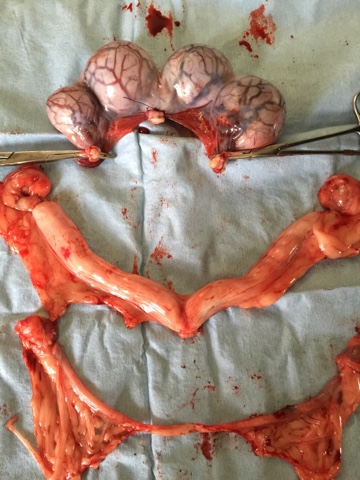
Three reproductive tracts of the three spays I did a few days ago. They are an excellent explanation as to why there is not a flat fee for spay surgeries (at least at my clinic).

Could you guess which reproductive tract belong to which patient?

Patient Number 1;
A 7 month old domestic short haired cat.


Patient Number 2;
An 8 month old 38 pound Cattle Dog.


Patient Number 3;
An 8 month old Labradoodle who is 55 pounds.


At my clinic I try to do everything I can to treat every case independently and be fair to each. Therefore, providing a "one  size fits all" approach doesn't work in many surgery cases. With the exception of routine cat and dog neuters, every other surgery has a price range and every other surgery is based on the patient. 

Historically vets have put themselves in the predicament of dismissing spays as a "basic" surgery done so often that it has been diminished to "routine" status. This perception has understandably caused clients to price shop and balk at spay costs of anything over $100. High volume low cost spay and neuter clinics have popped up to meet demand and only reinforced the perception.

For all of the knee surgeries that I do weekly with a $1200 price tag, that clients are more than happy to pay based on the specialists average going rate of upwards of $3,000, I have to argue and justify a spay price of $200 plus. Ridiculously that spay has a much higher chance of causing a life threatening post operative complication than my knee surgery does. I will take a bad knee to correct over a fat dog in heat to spay any day of the week.. and I make 5 times the amount of money doing it. 

Why does "one size not fit all"? Because some dog spays are ridiculously difficult to do. And some patients need more time, more pre-op consideration and more peri-op care, not to mention post-op goods and services. All of these cost more time and more money. Wouldn't you want your vet to tailor and customize your pets care to their needs. Isn't it fair to pay for that?


The three uteruses (probably grammatically correct to say 'uteri' but that just sounds snooty scholarly, which I am not, so I'll move on).. belong to the pets above and listed in their perspective order. (Note; I did not use the actual patients for this,, they are in fact my cat Wren, and my dear friends Madeleine and Maizie.. but they represent the actual patients very well.). The top uterus is an early pregnancy in a feral cat. Middle is an 8 month old who is 38 pounds and in heat, and the last is also an 8 month old who is 55 pounds and not in heat.

The costs of a spay should vary based on the patient. If your dog is in heat, pregnant, or has a uterine infection it is going to be more difficult to perform the procedure. It will take more anesthetic time, require more equipment and suture and should also be followed up with post operative medications to include analgesics and antibiotics.

As I  discuss why spay surgeries are each entitled to their own charges I will admit that I never charge a different price for cats. A pyometra cat is the same cost as a pregnant cat is the same cost as a regular cat spay. In truth there is not enough of an additional degree of difficulty to warrant the extra fee. The only exception to this is the post operative care and medications. I challenge other vets to argue differently. I especially challenge the emergency clinics who give estimates of cat pyometras in the thousands of dollars. 


The cat below is also pregnant. Although no one wants to be stuck in the middle of this moral and ethical argument it is Spring here and the kittens are blooming as fast as the flowers. Sadly, many of the cats in our rural area are also feral. Feral cats having kittens perpetuates more feral cats having kittens and many of these are eaten, killed, or die of infection. When a feral cat  is caught and brought to us for a spay or neuter we can't touch them, examine them, or even know if they are pregnant. Once they are sedated they are all spayed and neutered regardless of their condition. It is the only way the cats can be released responsibly and spared their life. But a cat is a cat and a cat uterus is easily surgically removed regardless of uterus size. If your cat is given a thousand dollar estimate (or anything near close to that call me. I will do it for a fraction of that.


If you asked me to spay your dog as I would my own dog here's what I would do;

1. Have the vet who is performing the spay on your dog do a physical examination while you are present. Can you imagine going in for surgery and never meeting your surgeon, OR, having never met them and they never examined you? That's plain neglectful.

2. Every human patient has pre-operative blood work done to check basic organ function. I now want to check clotting function too.

3. Your pet should be free of internal and external parasites. Having fleas walk through the surgery site is not maintaining an acceptable sterile field. People with invasive surgeries these days have to use a special surgical soap and shower with it every day.

4. Every spay should be intubated and maintained on inhalant general anesthesia. The best way to maintain an open airway is to have one. The best way to maintain an acceptable anesthetic plane is to use gas.

5. Intravenous fluids via an indwelling iv catheter. I use it for every spay these days. Why risk it for $80?

6. Every spay gets and goes home with analgesics. For the cats most of these are injectable. or the dogs a 24 hour dose of an NSAID is given pre-op and oral meds go home for the next 4 days.

7. Suture material. The glue that holds the tissue together and keeps your pet from bleeding internally or opening up their incision. You get what you pay for in this department and no one ever asks what this vital material is. There is still debate in the veterinary field about what  is and is not considered acceptable standard of care. For many experienced vets I will not argue that using what works for you is fine, but, the rules of engagement are shifting and clients have the right to know what we use and why we use it. If a surgery fails they also have the right to their pets records and challenge us on our choices.

There is a terribly fragile line between low cost and affordable and borderline substandard care.

Chloe who needed an emergency pyometra surgery and couldn't afford the ER price.
Her story below.
We all like to have an idea of what something will cost. It allows us to plan, budget, and bargain shop. Medicine allows for only so much planning and presuming.. the rest is decided on luck, fate and preparedness for worst case scenario.

If you are price shopping for a spay you are asking for more cut corners than I would ever be comfortable with. If your pet has a problem while being spayed or neutered your vet has a much better chance at your pets survival if they are intubated, under inhalant anesthesia, with iv  fluids, and a full sterile surgical suite. Wouldn't you expect the same for yourself?

There are a few brave clinics who provide set prices for a service and rely on the law of averages to make the bad cases dilute out the overwhelmingly easy cases. It allows for clients to not be side swiped by sticker shock when those inevitable outlier surgeries are their pets surgery.

I much prefer the open and honest approach. I treat each case as their own and each is priced fairly based on their own merit. I also care far more about every pet walking out of surgery happy, comfortable and safe. If you cannot provide optimal care due to financial struggles we will work with you,, it is the reason we maintain a fund for hardship cases at the clinic. Good patient care should not be  about bottom lines, budgets, and unacceptable risks.

Related Blogs;
The Ode of My Obligation. Why does the ER charge so much?

Chloe's Emergency Pyometra. Saving Your Pets Life When Optimal Options Aren't Possible.

Jarrettsville Vet Price List 2016 Edition.

Pyometra. Finding a Happy Ending With A Preventable Disease.

If you would like to discuss your pets medical or behavioral condition with me you can find me on Pawbly.com. Pawbly is a free online community dedicated to helping people who love their pets. If you are a pet lover please join us in and share your experience and expertise. Together we can shape the destiny to provide more happy endings to those who need them.

If you would like help and you are in the northern Maryland area come visit me at the clinic, Jarrettsville Veterinary Center in Harford County.

Or find me on Twitter @FreePetAdvice.