Showing posts with label weight loss. Show all posts

Saturday, February 23, 2013

How to Maintain Your Pets Weight Loss


This came from a reader of yesterdays blog.

I thought it was a good question and it would help others, so I am posting the question and my answer..

From Veglils,

"On the subject of ideal weight for your dog -- if your dog has been on a weight-managing food and has reached an ideal weight, do you stay on that food or switch to a regular age-appropriate food?"

My answer
This is a great question!

There is not a simple answer. In almost all cases the answer needs to incorporate a maintenance diet, a good continual monitoring plan, and still be addressing how the pet got to be overweight in the first place. 

Because most pets have a multitude of factors that participated in the weight gain we need a multi-faceted approach to help maintain the weight loss and avoid the weight being regained. Whatever contributed to their demise is likely to still present and creep back into the picture. 

If you were given a specific food (like a veterinary prescription food) and used it to lose the weight then the pet food manufacturers have a computer program to help you find your maintenance plan. Hill's and Purina both have these programs, they really help. They will advise you about which food to feed and how much. By plugging in the desired maintenance weight and a few other items they tell you exactly how much they recommend you feed of one of their maintenance diets. 
 
Remember that most prescription diets are classified as 'weight reducing' or 'maintenance' diets. They use all sorts of ingredients to help keep your pet feeling full but not absorbing the calories. If one diet doesn't work for you try another. 

For some clients an over the counter food is their only option for long term feeding. So, we have to find a measured quantity to feed, based on weight to maintain (see the food bag for this amount, and use a real-official measuring cup), and remember its important to maintain a steady activity level. Simple weight maintenance formula calories in has to equal calories burned. 

Re-weigh your pet every month. The scale never lies! If you find your pet is gaining weight reduce your feeding amount by 20% daily and re-check the weight in 2 weeks. Also scrutinize the hidden calories your pet might be getting, like snacks. Are they getting too many? If you are on a good measured diet then snacks are often the biggest hidden culprit to a pets weight gain demise. Is your pet getting enough exercise? There is no diet plan in the world that works without increasing your pets metabolism. So get moving! Burn those calories! And then maintain that high metabolic rate after you reach your target weight.

If you are having difficulty maintaining see your vet. They will help you find any hidden road blocks, pitfalls, and try to identify any medical reason for the mystery.

So, its not any easy answer. Every pet is unique and every client has different abilities. 

If your pet is not at great risk for regaining the weight try a good OTC food, be strict with amounts, and weigh your pet on a scheduled basis.

If you struggled to get the weight off, or have any other underlying health concerns try to stick with a prescription diet for maintenance. But remember this is likely to be the diet your pet will be on long term.

I hope this helps.

Thanks,
Krista

Friday, March 16, 2012

The Weigh-Ins Begin

Tuesday I saw 3 dogs on appointments who all came in and were all overweight.

I thought that I would begin to introduce them to you.


My first fat dog of the night was Dazzle the Dachshund. She is a middle aged, spayed female short haired walking foot stool. She is so fat that her already stubby legs look to be half the length of what they should. Her dolichocephalic (long nosed face), looks like a little mouse, small pointy nose and ears that go straight out to the side because her face and neck are so fat. (To describe it more graphically her short streamlined body looks squat and stout, and she waddles.)

Her mom had brought her in specifically to address the weight issue.


I think that in my seven years practicing that this is maybe only the second dog that has walked in to see me for this reason. In most cases the owners try to slip by the fact that their dog is overweight. They hope that I won't notice, or that I ''have given up on them trying to correct it for the fourth year in a row."


For those owners that I actually can convince that there is a weight problem, I am happy to sit down and go through the very long conversation about every aspect of their pets life that has contributed to where the scale is now.

This conversation needs to be a 30 minute office visit.

We all need to sit down and discuss the entire home life. I am going to start with the basic questions of ;

1. What do you feed?

2. Do you measure how much you are feeding?

3. How many treats do you give?

4. What kind of treats do you give?

5. How much exercise does your dog get. (OK, pet peeve here is that putting your dog outside in your fenced in yard is not exercise. I almost guarantee that a fat dog is not exercising. Certainly not exercising enough. I want the exercise period to be interactive. I want you and your dog to be outside playing. Either you throwing the ball, or going for walks, or runs, or swims, etc). I want you to be able to tell me how long you are playing and at what intensity.

6. Who else lives in the household? Or who else is responsible for any of the pets care? Here's the concern here. I have many clients who have fat dogs because their kids are spilling their food, and/or offering lots of their own food to the begging, glued to their kids side or high chair, dogs. How do you tell a four year old to stop feeding the dog their vegetables? The other doomed weight loss scenario is the elderly retired and now living at home with their adult children grandparents with Alzheimer's. These poor owners are measuring their dogs food, exercising them, and have told their parents that they cannot feed the dog anymore! How do you tell your elderly parents who are home all day with the begging dog not to feed them? Or worse yet, these parents don't even remember they were told not to feed, or forgot that they did feed. That one is a toughy.


For these owners with the difficult challenges at home monitoring and mandating the feeding I do the following; I recommend that they put the daily food allowance in a Tupperware container on the counter and then lock up the rest of the food. Once the container is empty that's all the dog gets.

For the families with small kids, you have to put the dog in a separate area at feeding times.

I love the use of a calendar to help manage the pets flea & tick, heart worm preventative and even feeding and exercise schedules. Have everyone participate in keeping a calendar of your duties. When you give your monthly dose it gets crossed off of the calendar. When you go for your morning walk it gets crossed off the calendar. At the end of the month see how you did, and see what your weight looks like. All of this information is really helpful in helping us adjust the diet for your pets weight loss plan.


After I went through all of this with Dazzle's mom I learned the following :
Dazzle has always been fat. She lives with another Dachshund who is skinny. The skinny dachshund never finishes her food, so Dazzle does this for her.
OK, Dazzle is eating too much, and Skinny sister is being offered too much. Lucky for Skinny sister that she can self regulate her feeding, (we should all be so lucky) but clearly Dazzle cannot. When Skinny sister leaves her bowl the rest is tossed. DON'T leave it out for Dazzle, because of course she is going to eat it.


Dazzle is a couch potato. Skinny sister is a very active dog. (Not too hard to figure that that's why Skinny is skinny and Dazzle is not). Dazzle needs to be more active.

Dachshunds are a breed that tends to have weight issues. And of all the breeds of dogs these are  one of the breeds of dogs that need to be kept thin, (that and brachycephalics (smooshy-nosed dogs). Dachshunds are also very susceptible to intervertebral disc disease and this is seen more commonly in the overweight Dachschunds than the physically fit Dachshunds.

Dazzles starting weight is 26 pounds . My target weight for her is 22 pounds.

I always try to give a target weight but I always also give a time frame for target weight and a request that we check it monthly together and adjust as we go. I don't want a dog to be going on a crash starvation diet because this is not safe, healthy, or effective long term. I want the dog and owners

The quick fixes in life rarely last. My goal is to restore long term health and happiness.

The hope is also that if there is any underlying medical condition we can discover it earlier vs later. Maybe at the first re-check. I have been shocked to find some very under active thyroids in many of these overweight dogs. Don't overlook the medical conditions!

The amount you feed will likely vary with the season and the activity level.

Keep an eye on the scale and start to also keep an eye on your pups waist line. Ask your vet care professional to start training your eye to recognize body condition score.

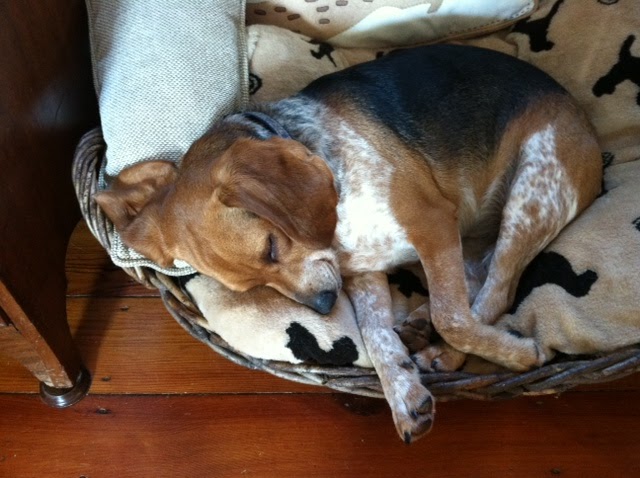
In reality I don't care what the number on the scale is. I care what your dog looks like. There should be a taper at the waist when looking from above and a tuck in the abdomen when looking from the side. I am also using my hands to feel the weight and muscle mass of dogs, especially those dogs with heavy dense furry coats. And to my own Beagles defense he may not have a tucked narrow waist (he is built kind of blocky). But that boy has some massive quadriceps, and he can, and does, run like the wind. He is solid muscle! and there isn't an ounce of fat, even though he is short and stocky, on him. (But he is still soo cute!)


OK, let me know what questions you have about weight loss, obesity, etc. It's springtime, time to get ready for our bikini's, and get out there and exercise!

Update: 2013 Dazzle's reflection in the scale teetered a few pounds up and down for about five months. Our best attempts to help her elderly dad exercise with her daily were foiled by his own health challenges. I believe that he saw her greatest happiness on the other end of a biscuit, and in the end that tail wag from the short term bliss of a snack meant a bigger "I love you" than a walk and a boring bland diet that neither one of them really wanted to participate in.

For many of us it is very difficult to convince you of the long term gains when you are living exclusively in the moment. 

Thursday, March 15, 2012

Fat Tuesday

Yesterday was Tuesday March 13, 2012.

I have said before that I still find it funny how things seem to come in batches.
Yesterday it was fat dogs.

For whatever reason I saw three very fat, (we call them obese and sometimes I throw a "morbid" in front of the obese to drive my point home) dogs in a row. Now there are a multitude of issues we as veterinary medical professional have to address when it comes to obesity in pets.

We have to address all of these;

1. See if the owners also think that their pet is overweight. Denial is a powerful tool of avoidance and if the owners refuse to see that their pet is overweight you can't even begin to tackle how to resolve the problem. (Yes, admitting there is a problem is the first step in overcoming the disease).

2. There is great debate and discussion in veterinary medicine as to how we "delicately and adequately address the problem" with the pet owners. It is documented that the estimates for obesity among household dogs and cats is about 35%. On the human side the statistics are about 50%, (higher in some geographical areas). The statistics are devastating, and the effects of obesity in our pets is just as detrimental as they are in humans. So often the overweight pet is owned by an overweight owner. We don't want to be assigning blame, or issuing guilt, but how do I get an owner who likely doesn't exercise themselves to exercise their pet? The only way I know how to do this is to give the same advice to everyone. For instance, I don't assume someone won't go for a referral if I think it is warranted because they don't look as if they can afford it. I make my recommendations based on what I think is ideal for the pet and then we discuss from there.

3. Discuss how treats play a detrimental role in weight loss. Remember my raw diet blog? If you missed it I learned that a large biscuit is about 200 cals. (That is about equivalent to 1 chocolate chip cookie for us). How many of us can lose weight eating chocolate chip cookies? Try to imagine giving your dog a candy bar every time you are rewarding them. We all get fat from eating candy bars.

4. Once the owners move past the acceptance of the reality that their pet is overweight I ask them what they feed? If they don't know what brand it is, (oddly most owners draw a blank when I ask), then I ask them where they get it? I will say that in general you are not going to find great pet food at the supermarket or big box stores or any store  that touts itself on selling the "cheapest" anything. You get what you pay for AND you are what you eat.

I tell this to my clients all the time. So let me say it again;

You get what you pay for AND you are what you eat.

Therefore, I always recommend that you buy your pets food at either a gourmet high-end pet food store, or PetSmart, Petco, etc., where they have a huge selection of both the low end (don't buy this, well, not unless we tell you to, but that's another topic), and the high end food.

In general, I want my clients to buy the most expensive (lifestyle and breed appropriate) food that they can consistently afford.

5. The question that I am always asked next is, "How much food should I feed?" The answer is always the same for this one. "Every food has a different calorie count, and every pet has a different metabolism and activity level. So one cup of food might be too much, too little, or just perfect for three different dogs that are all 20 pounds."
I will give what I think is an appropriate amount based on how much is being fed now, or what the feeding recommendations are for the food I am switching them to. And then schedule a weight check and re-check in two weeks, and adjust from there.

For those of you doing this weight loss plan at home with your now "great dog food" I recommend that you reduce the amount that you are feeding by 25%, (that means you need to be measuring from now on, and please use a real measuring device, (like a measuring cup), because a "Big Gulp" may be a cup that you use for feeding, but it sure isn't a measuring cup you would use for a recipe, and we all need to be speaking the same language). Feed this amount for two weeks, with no snacks outside of that amount of feeding, and then re-weigh. If your pet hasn't lost any weight then reduce again by 25%. Re-weigh two weeks later. If your pet is not losing weight then have a talk with your Vet. You are either cheating with the snacks, not exercising enough, or have a metabolic disorder.
After you get to your target weight we have to re-adjust the food to maintian this weight.

6. I very clearly understand that the action of giving your pet a treat is a strongly bonding experience. Every pet parent wants to see those sweet begging eyes looking at us with love, affection and longing. And we all know that that face is often tied to a treat. We as parents are very good at rewarding good behavior, and some of us are even very good at rewarding begging. Nothing melts my heart and makes me feel better than seeing my sweet Jekyl-pup looking at me like I am the center of his whole universe. And boy can that Beagle work a snack like a pro. I don't ever want to be telling owners that they can't spoil their pets. If I say "No more treats ever!" I am dooming that plan to failure. Those pups have been trained by snacks, they expect that snack, and if you are Jekyl you are OWED that snack. So snacks are allowed in all of my diet plans. BUT, your snack allowance comes out of your daily calorie allowance.


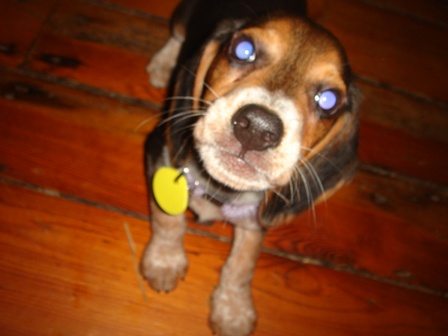
Jekyl-pup as a puppy. SOOO, cute, you can't say "No" to that! It's not possible.
(I'm getting up to to go give him a treat now)
For instance, if I say that you can feed 1 cup of brand X (usually it is Hill's Science Diet r/d, available by prescription only and only after we have a long talk about everything), twice a day to Fido, then I don't care if you feed a half a cup for breakfast and a half a cup for dinner and use the remaining 1 cup as your "snack allowance" for the rest of the day. Put that 1 cup on the counter, or in the treat jar and trick your pet into thinking it is the "treat" instead of the normal boring food. In most cases they won't know the difference.

And one last note on food and snacks. If it comes with a cartoon on it, or has food that comes in colors that are not of the "normal food color" like that nuclear orange or red, then please think of it as equivalent to kids cereal. The "junk cereals" come with toys, artificial coloring and prizes. It is not the "best quality cereal/food" so don't buy it!
I tell my owners that all of the horrible stuff you hear about overweight people also happens to their overweight pets. Diabetes, cancer, joint disease, heart disease, the list goes on and gets longer every year. Sadly the statistics also get higher.

I also tell people that just like on the human side you don't live a long healthy life and die of old age if you are obese. There is nothing more heartbreaking than having to euthanize a pet because they are no longer able to ambulate on their own and because their joints are shot due to their excessive weight.

Obesity in pets is a result of many things. Certainly a large part of it is lifestyle. Maintaining optimum weight is the balance of calories in and calories out. Or said another way, the amount you eat and the amount of energy you burn.

I will now stick my neck out and say. No pet wants to be fat. They may really want that treat in your hand, but after I have seen the miraculous change in the overall degree of happiness of a pet that has lost its excess fat I will tell all of you that a happy active pet is worth the sacrificed treat every single time.

After all of that discussion of FAT dogs I do need to add that there are some medical conditions that cause pets to put on weight and slow down their metabolism. These conditions are often diagnosed with blood work tests. I strongly encourage any pet that is having difficulty losing weight after all of the above issues have been discussed to have a talk with your Vet about some of the tests that can be run to help rule out thyroid disease, and other endocrine diseases. I have had more than 1 fat Lab turn out to be a hypothyroid fat dog. None of us want to discover that all of the guilt, blame, and interrogation over who is feeding what behind whose back is instead the fault of the thyroid gland being defunct. This discussion at the first fat pet visit will save everyone a whole bunch of grief, and that fat poor dogs time from being wasted in treat withdrawal torture.

I wanted to give you all some idea of what the treats that you are buying and feeding look like in terms of calories. The following list is from PetMD's website. The full article is provided at the bottom.

Here are some calorie counts on some of the most popular treats;

  • Milk Bones: 20 for the tiny ones to 225 calories for the biggest ones
  • BusyBones (by Purina): 309 for the small ones to 618 for the big ones
  • DentaBones (by Pedigree): 105 for the small, 188 for the medium and 300 for the large ones
  • Pig ears are about 130 calories for the small ones
  • Rawhides? 100 to about 600 calories

Here are some low fat, low calorie options;
  • Frozen (or fresh) Green Beans (23 calories per half cup)
  • Frozen (or fresh) Broccoli (20 calories per half cup)
  • Baby Carrots (4 calories each)
  • Apple Slices (32 calories per one half apple)
  • Cantaloupe Slices (30 calories per one half cup)
  • Canned Pumpkin (40 calories per half cup)
  • Air Popped Popcorn (15 calories per half cup)
Ok, After I list those I want to add, these can be used as snacks, or fillers to the great food I hope that you have switched to to make your pet "feel full" without providing excess calories.

After I offer this list I have owners coming in 6 months later and telling me that they feed 1 cup of green beans to their 10 pound dog, or 1 can of pumpkin to their 50 pound dog, and I say, "the treat is a treat, not half of your dogs food allotment."

So I often put a limit on the "acceptable treat" list, like "say 4 carrots a day," etc.

http://www.petmd.com/blogs/fullyvetted/2009/may/calorie-counting-your-pets-go-easy-treats

Here are Tusdays dogs. I will introduce each dog in the next few blogs and let you know how they are doing as the weeks go on.

I have asked each of them to come back for routine "weigh-ins." It's our version of Weight Watchers. And because I want this plan to work this time and I am happy to help adjust the plan as we need to.

Here's this season's "Biggest Loser" participant roster;

"Dazzle" the Dachshund. Owned by a devoted mom who wants very much to "fix the weight problem." She weighed 26 pounds, our target weight is about 21-22 pounds.


"Duke" the black Lab. Owned by a wonderful loving family, with a very busy schedule. His current weight is 106 pounds, his target weight is 85-90 pounds.

"Squishy," the happy, snorting, smiling Pug. Owned by a recent widower hear broken by his loss of his wife and hoping to keep her dog alive as long as he can by getting her to her target weight. Her current weight is 20 pounds, her target weight is 16-17 pounds.

Monday, October 31, 2011

The Dead Pile

OK, it's not just a catchy title, we actually have one. We have a box under the front desk where we put the deceased pet's files. I know it is gruesome, but it is a part of life here. We unfortunately lose a pet and by law we have to retain their records for 5 years. So we put them in a Bankers Box under the desk until the box fills up and then we get a new box. Further, I go through the box weekly.

I am not telling you all of this because it is Halloween, (which it truly is), but because it is truly true. I go through these files to see who has passed and to send out my condolence cards. I like to keep apprised of who has passed so I don't say something inappropriate to an owner, (I have done this before, not good). I also occasionally find a file of a particularly interesting pet that I want to talk about.

I went through the box yesterday and found "Skipjack." Based on my sailor background I like this name. It is a great name for a dog, especially a Chesapeake Bay Retriever. There was a time not too long ago where my husband and I were looking for a name for our then new cat, Jitterbug, and we went through all of our favorite nautical terms to find a good name. He liked "deadeye," "bollard," and "plimsal." I liked "dunnage" and "bowline." We settled on Jitterbug because we were making fun of each other getting old, and those phones they marketed to "old people" that the company presumed were too feebleminded to learn more than 9 buttons. (As I look around the Barnes & Noble I notice ALL of the patrons over 50 have iphones. Do they even sell Jitterbugs anymore?). Back to the point, I like his name, but I am not a big Chessie fan. I have yet to meet 1 I can do a full examination on. Now I know I am going to get arguments from many a Chessie owner. And "Yes, I know that your Chessie loves you, but they HATE me." It is hard to do an exam on a growling, hair-raised-down-the-spine-dog-already-more-than-it's-supposed-to-be dog. I have had to muzzle every Chessie I have met. Hence, I am not a fan. But OK, this isn't about me. The point of this post is to say that,
"YOU AS THE OWNER NEED TO KNOW WHAT TO LOOK FOR IN YOUR PETS!"

So I am going to highlight some things every owner should check on their pets. Especially if you have a pet that allows your Vet minimal cooperation.


Everyday you should check;
  • Eating. Is your pet eating the normal amount?
  • Urinating and defecating normally. That means looks normal, smells normal, done normally.
  • Gums for color. White is not the color they should be. I hope you look enough to know what "normal" for them looks like. And we are supposed to be brushing daily anyway. So brush and take note of gums and teeth.
  • Acting normally. The same behaviors, mannerisms, etc.
  • Ambulating (movement) normally. No limping, weakness, etc.
  • Standing, walking, sleeping normally.
  • I also do a overall body check everyday. For me I am primarily looking for ticks, because Jekyll sleeps with me and I don't like the idea of sleeping with ticks. But I also look for wounds, burrs, and painful spots.

If any of these are abnormal make a note describing what is different, for example, what? when? why? Are all good things to jot down. I think it is a great idea to have a place for all of your pets records, and a little journal in it too, to keep notes. Things like dates, time, number of occurrences, and what specifically you notice, really help us Vets figure out how to best treat your pets problems. A detailed accurate description could save you a lot of time and money in diagnostics.


Weekly you should check for:
  • Overall body size. I have hands that have been "trained" to identify an overweight/underweight dog. But you should also have your hands on your pet often enough to "feel" whether their weight has changed. A "BIG clue" in dogs with cancer is that they lose weight without their owners making any change in their feedings. In "feeling" for body condition we are feeling for the ribs, the spine, and the overall muscle mass. But we are also feeling for masses, growths, wounds, pain, lymph nodes, etc. 
  • I also think you should be checking, (or cleaning) ears, and
  • Trimming nails.


When Skipjack came in for his last visit he had lost 20 pounds.  He had gone from 90 pounds to 70 pounds. That is 22% of his body weight. So if you weigh 200 pounds, that is 44 pounds of weight lost. That is significant!. When he showed up for his examination and was weighed the Vet told his owners that he had lost 20 pounds and they had no idea. We see this a lot because a dense furry coat can "hide" a weight change. That's why we use our hands and feel every pet.

As it turned out Skipjack had lost weight because of his kidney disease. He had other clinical signs that weren't identified immediately because he was a difficult patient to examine. He had severe dental disease, (also because of the kidney disease), and was most likely urinating excessively (a urinalysis wasn't done so I can't verify this). There were a lot of clues that weren't as obvious because his health care providers weren't able to identify them. It is a challenge to spend more time and try to look harder in a patient that refuses to be a model patient. In these cases educating owners with "homework" and asking them to "take notes on their observations" can help identify problems earlier.