Showing posts with label mass removal. Show all posts

Thursday, July 15, 2021

Mass Removal On The Foot, and Neuter, German Shepherd Dog


This is Apollo. He is a recent rescue. He, like almost all of the rescues we see has a checkered past with more holes than answers. We know what we see in front of us.. male, young, intact and jittery with all of the newness of everything in his life.


He is in foster care as the rescue gets him caught up on vaccines, allows for time to decompress, acclimate and show his true colors. Let his fear assuage to his personality. 


This is the story of Apollo's neuter and mass removal.

I mention both as he was in need of neutering before he found a home of his own, and he had a mass on his wrist that had no accompanying information.


When dealing with a neuter the options are fairly straightforward and simple;
1. neutering is the removal of the testicles from the scrotum. It can be done as an open or closed technique. I  decide which based on size of the blood vessels needing ligatures. There shouldn't be a change in price and the preference is based on the surgeons 
2. scrotal ablation with the neuter. For dogs with excessive scrotal tissue (older dogs tend to have larger and more sagging skin). It's a cosmetic thing in almost all cases. In the trade we call it preventing "the flapjack."


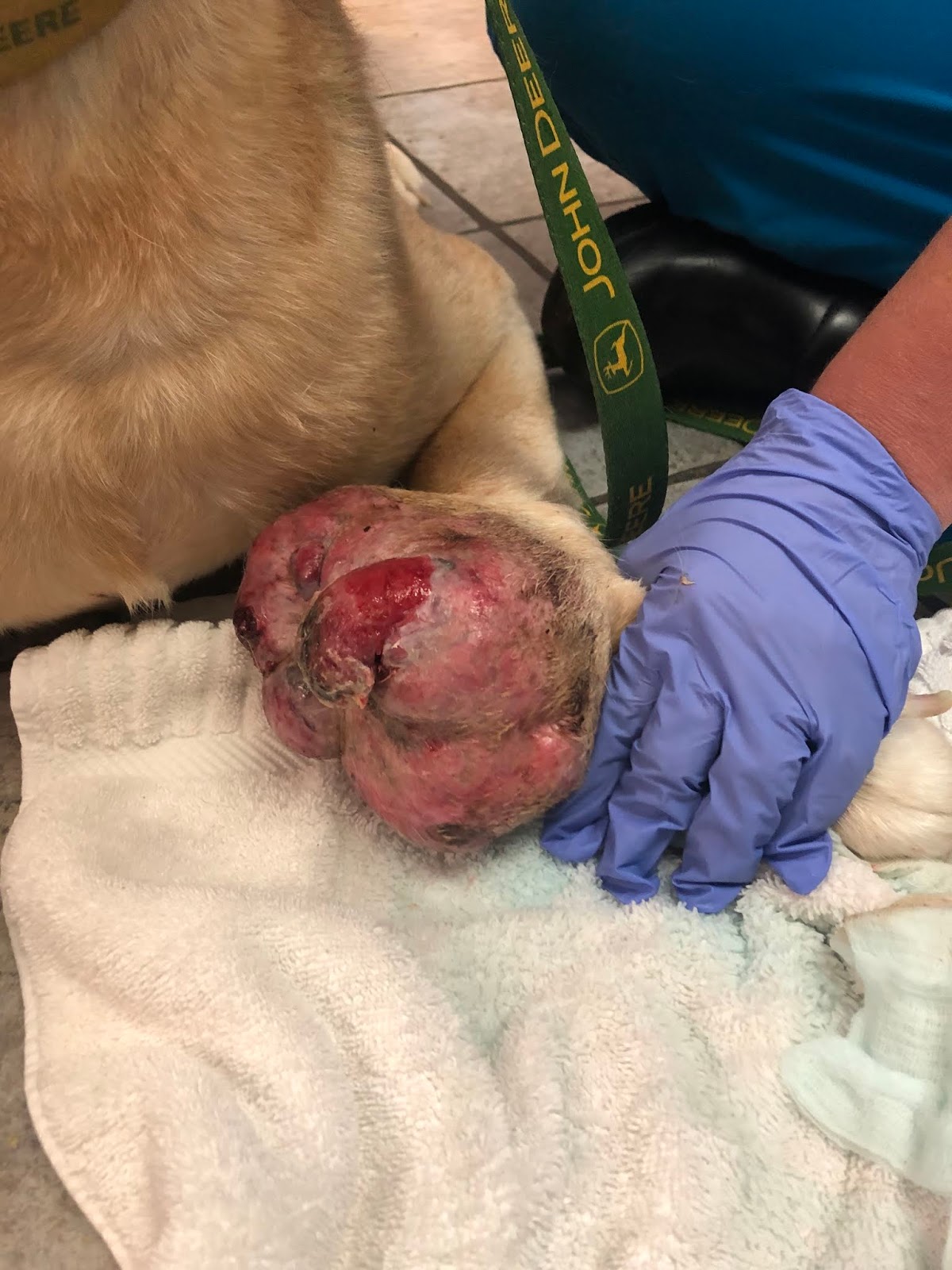
This is Apollo's mass. Firm, raised, irregular and without any evidence of what it might be, or, what might have caused it. 


As with all masses on pets the only way to identify what it actually is, is to send in a piece of tissue of that mass to a pathologist. There is only guessing outside of tissue. If you are looking for more information on this please read this blog; When a Bump Causes You Concern, Slay It With A Diagnosis.


There are so many factors that go into a successful surgery. For Apollo's case we did a thorough pre-op physical examination. We also made sure his vaccines were up to date. I prefer that each patient be as calm and stable as possible. This includes physically (healthy based on exam and blood work), emotionally (all rescue pets need time to acclimate and adapt to their new surroundings). Too often these rescues are rushed in and out and back and forth to find placement as quickly as possible. It costs the pet terribly. Stress and its detrimental affects on the body are underestimated and too often overlooked. If at all possible give a pet time to go into surgery in the best possible place, happy, calm, relaxed and healthy.


The next part of a successful surgery is surgical planning. I start every surgery with the plan in my head. The order to which I will execute the surgery, the amount of tissue I want to remove, and the plan for how I will close the area after. You need to know where you are ending before you begin, and then you also need to be prepared for plan B, C, D, etc if the previous doesn't go as planned/hoped for/expected.


Apollo's surgery was a challenge because there is not much room on the wrist. I can't cut too deep, or wide, or have any extra tissue to close after I removed his mass. The mass extended both wide and deep. No room was left over to let me close the sides after I removed the mass.


The goal for every mass removal surgery should be discussed with the pet parents before the anesthesia is turned on. 

Ideally every surgical event is what we call a "one and done." Once surgical expense and event solves the problem. It provides both the diagnosis (meaning we removed a large enough tissue sample that the pathologists feels exceptionally confident in their diagnosis. AND, there are clean margins that prohibit the mass from being able to return. 


In all but the most exceptional cases we should never place our patients under repeated anesthetic events, NOR, require additional financial investments from our clients.

Too often I see veterinarians offering surgical services and NOT attempting to remove the mass in its entirety. It is a financial and emotional burden that is placed on patients and clients. 

What happens if the mass is malignant? Or, invasive/destructive over time? Do we require clients pay for surgery twice? Put our pets at an anesthetic risk twice, or more? Many clients cannot afford twice? Or, feel the case is not worth the diagnosis the partial mass removal has provided. 


Many of the cases that I see have been told the "mass is probably bad" i.e. likely cancerous, or, the pet is too old to put under general anesthesia. People are essentially discouraged from surgical excision of a mass for reasons that too often ;eave them at a place where they are euthanizing their otherwise happy older pet because the mass is now so large it is open, draining, and painful. 

I cannot even tell you how many dozens of older pets that we have given extra enjoyed months of time to because we just tried.. we tried, and SUCCEEDED, in the mass removal. See Spencer's story here.


Apollo's mass was in a tough spot: the lower leg. It was the size of an acorn on the outside of his wrist. 

I had to remove the mass and then make a large flap of skin above where I had removed the mass to close the hole the mass left behind. It is commonplace to close the sides of the site and leave a linear incision, but, the legs don't leave enough skin to do this.

The fear with an advancement flap is that everything you cut will die. Instead of a quarter sized hole of non healing tissue we have an area three times larger than the mass was.


After Apollo's surgery I placed a bandage. It serves a few functions;
1. Protects the incision.
2. Allows a few days for the incision to have very little stress on it with movement of the leg.


This is Apollo one week post op. The tissue is looking perfect! 


Here is the histopath results for Apollo;
Calcinosis circumscripta refers to a non-neoplastic nodular focus of
mineralization and is considered to be a localized subgroup of
calcinosis cutis. The cause of calcinosis circumscripta is currently
unknown, but the majority of cases most likely involve trauma followed
by dystrophic mineralization. In some cases it may be an incidental
finding in young rapidly-growing large breed dogs (especially German
Shepherd dogs). This lesion most commonly occurs at sites of previous
trauma (bite wounds, ear crops), over pressure points (footpad) and
other bony prominences (spine, elbow), and occasionally in the tongue.
There is no evidence of neoplasia, and etiologic infectious agents are
not observed in the examined tissue sections. The lesion appears
narrowly excised.

What makes this case so notable?

1. The rescue made decisions based on what Apollo needed first and foremost. Not cost, but care. His adoptive family knows what his mass was. They don't have to worry about what it might be. How it will affect his lifespan, and the cost of all of this as a new family member.

2. His mass removal BOTH diagnostic AND curative. Every case in every surgeons hands should start with this as the goal.

3. Apollo has the best chance at success for a future with known information. He's not a mystery of unknowns. We are filling in answers for him as we discover who he is. He has a solid foundation to succeed!


The cost of care for Apollo's case included;
i.v catheter $40
i.v. fluids $50
i.v. fluid pump $25
anesthesia $250 for 2 hours, it is based on surgical time
castration $150
nail trim $0
analgesics post op $50
laser for mass removal $220
mass removal $250
sutures $30
SQ fluids $35
biopsy $150
antibiotics $30

total $1280. Apollo received a rescue discount (not shown here).


Friday, August 9, 2019

Hope. Stealing, Losing and Resurrection. How the fate of veterinary medicine hinges on hope.

Fighter. Maybe not a "prized fighter," but, none the less, fighter. This is my job.

Driving home last night it hit me. I fight. This is what I wake up, diligently-doggedly do all the day long, and then attempt to subdue myself out of each night. And, I do this every-single-day.

It's exhausting, don't get me wrong. I'm sure that there wasn't some detour along my life-path where I made a conscious decision to become this person. Live this life. But, alas, it is the one I recognize as my own now and I wonder if I am alone? I suspect I am not. There is great angst in always being cortisol-intoxicated to fight the next brawl in the next room. Junkie-syringe slasher style. This is the stuff ER doctors, race-car drivers, Navy Seals, and inner Baltimore City high school teachers are cut from.

Many vets are compelled into vet school to be that healer of furred affections. I took it a step further. I started to advocate, demonstrate and change the way I lived my life because of how I saw the world treating, or rather, more aptly, mistreating, animals. I couldn't live to save some of them, the "pets" and eat the rest. Or, wear the others. Ask the moms at my clinic who have chickens, cows, goats, or pigs as "pets" if they can eat them? Resoundingly the answer has become "NO!"

The fighter evolved. She grew. She came from that place where you recognize all living beings are looking for the same things. A place to belong. A family to love them, and a day full of liberty and freedom within the world around them. At our most basic level we all want to be free to live our life as our soul tells us to.

The fighter in me has molded the doctor I became. The person who sees each patient who walks in as an independent life worth saving. An integral part of some persons life that is incomplete, emptier, and less valuable without them.

When I started to fight for more than I was, more than I needed, and more than I had to, I realized that the most important part of that fight was the hope it gave to others. I realized that where I saw a fight they saw a chance. A glimmer that it was not all as hopeless as they feared and they didn't have to surrender in desperation to avoid their companions suffering.

Hope is abundant and yet it isn't shared enough. Why? Why wouldn't we give away the few things we veterinarians have in our over-abundant, yet too often over priced tool box for free? Like confetti? Why aren't we casting it like raindrops? Why isn't every single case started from this place? This mantra;?

I will fight for your pet,
and,
I will not steal, squelch, or dismiss hope, ever!

Why doesn't every healthcare decision start here? Universal investment at ground zero.

Now I know the pessimists out there, the jaded, angry, and lost are going to balk at my over optimistic view. They are going to lash out the defensive, dismissive banter about why this isn't realistic! Or, why it isn't even responsible. God forbid they even throw out some legal crap about liability in the face of unethical moral conduct.

So, to all of them here's my real-life professional advice to this beaten, broken, angry, over abundantly suicidal profession. We aren't God. We have to get off our power tripped judgmental pedestal. For ourselves and our patients sake we have got to stop being so brash and burnt that we spread that pessimism like a plague. We are all the same, each of us is a practitioner. There isn't one person who knows everything. None of us have some magical crystal ball that miraculously tells the future. We cannot spew a diagnosis to our clients who so often come to us with few, if any, resources for the diagnostics they need, like a magic 8 ball. We, more often, and too many more times than we want to admit it, we just don't know. We don't know what's at the core of our patients issues more often than not.. And, if we don't know the diagnosis why are we even speculating the treatment options, never mind their associated costs? Why, because we think we know. We think we know better than the parents who love them. And, erroneously, we think we are liable and/or responsible for these. We aren't. We are supposed to be honest. We are supposed to be advocates for our patients. We would all be better off if we were just verbally and emotionally open, honest, and humble about the depths with which we do not know. We are also supposed to protect the public who shares this community with these patients, but, these are exceptionally rare cases. Stop using fear as bait. Stop telling our clients all the stuff our lack of diagnostics can't rule out. Be honest. Treat people like the loving parents they inherently have to be if they are going to walk in your door and ask for help.

We would also benefit if we all allowed hope back in to live in medicine. If we all fought for it we wouldn't be killing ourselves off in numbers 3 times higher than the next statistic of the next most depressed profession. We wouldn't be emotionally bankrupt and our debts wouldn't be mounting. Our guesses are too often incorrect, assuredly without being medically sound, and these cost lives. It burns souls, and can destroy the lives of those people who call upon us for help.

When my Jekyll-pup was diagnosed with prostate cancer, one of the most deadly types a dog can encounter, I sought and bought hope in bundles. I specifically sought out an oncologist who doesn't carry a medical bag with rationed  portions. I sat down with her on day one of our journey to help my pup with an agenda. I needed to feel like I had  teammate on my wrestling squad. I also knew that I needed a map to start our journey. A place to begin, and a speculative place (or places) to stop. I knew I could, would, and even was ok with visiting crazy-town along the way. Crazy-town for a vet like me is that place where the stuff no one else conjures as 'acceptable for a pets quality of life' resides. I was concocting up novel surgeries to re-route the urethra around that pestiferous prostate. I could rebuild him, make him better, stronger, (not faster? maybe?) then he was before. I had the technology to build the first bionic beagle! I knew I had this fighter in me who wasn't going to surrender my beagle without a knock-down-drag-out fight! I knew I needed help with navigating myself away from crazy-town. My oncologist, Dr Jeglum, helped me stay hopeful while not going all Oscar Goldman and Dr Rudy Wells. We agreed to keep trying as long as Jekyll needed us to. We wouldn't stop at the conventional. We would try every option, every possible combination and therapy. I was hoping for more time, which I got 9 months of, while buying hope in bundles I bought time in months. I needed these to get me through his passing. I needed him to be living while I was fighting and then I needed to be able to go on without him at least feeling as if I had done everything I could for him.

People pay for hope. It is a valuable commodity and a religious tenet. Whole civilizations were started there.

What I see far more often is people who have been dismissed, over looked and cheated of options. Options that have hope intimately anchored to them.

Why???!!! Why would we ever NOT give options? Are we so lazy, so jaded, so indifferent that we can't take the extra time to sit down, look into our patients eyes, see the soul of a fellow being as still fighting for their life and their time in the sun of this planet we call home? They still have a life to live. A soft patch of grass to submit to. A warm purring tune to play on our laps. A day to make better for the human that adores them.

I see the cases that other vets have denied hope for. I see the cases no one else took time or interest in fighting for and in them I found the reason to keep going.

Where it has brought me is to this place, driving home, where I want to exchange the fighting gloves for the surgical gloves. The place where tears of pet parents change from inability to accept fate to hope filled possibility. We all want to face life, our mortality and the lives our days have accumulated into as this, Hope.

Never steal the hope. It is the single greatest gift we can give.


This week brought me two crying clients.

One was Joey's mom. Joey passed away this week. I had been taking care of him, his diabetes, his urinary stones, and his omnipresent smile for a year. He was built of defective parts. They eventually quit on him, but, he never quit being joyful. His mom told me, as we were talking about how far he had progressed into multiple diseases with little hopeful outcome that she trusted me because I was "the first person who spoke to her, not at her." She loved her Joey and I know that as I write this she  is at her home missing him. She has had 5 strokes over the last year and Joey was her only constant companion. She had to let him go and I know it is hurting her immensely right now, and will for the rest of her life.


The second case was Spencer. He is 12 years old. A lab. Most labs are lucky if they see a dozen years. His years had brought him painful joints, diabetes and blindness. He also had a huge ugly, awful death smelling tumor on his wrist. Someone had decided he wasn't worth options. The tumor grew, as tumors will. It got so big it couldn't feed itself, so, it started rupturing and dying. Dead carcass is fetid smelling. You can actually be alive with dead tissue hanging, falling and breaking off of you.. This is what his tumor, on his wrist, was doing as he stumbled his way along.. wagging, lab-fashion the whole way.


His mom was hysterical when I proposed we remove it. "No one ever told me it was possible." She was a new client. New that evening. Spencer was not a good surgical candidate, but,, this was his only hope. We were either going to save him from his tumor, or, euthanize him because of it. She told me that "this was the first time anyone had given her hope for him."

Here are his post op photos;


Here is his story.. in video time.


I cannot save every life, in fact, every life I see, help, embrace, will be lost. We all die. I have to tell every client this. That at some point in our journey the road will end. There is always death. But along the rest of this road there is love and with love there is always  hope.

If you are a pet parent and your companion is struggling there are ALWAYS OPTIONS! ALWAYS! And please never lose hope. You can lose everything else in life... hope is given away. Relinquished, and no one can take it from you unless you surrender it.

If you need pet help please reach out to me at Pawbly.com. It is free for all to use. If you have a pet story you would like to share please add it to our collection.

I am also available at Jarrettsville Vet and YouTube.

Monday, January 26, 2015

The Bump That Gets Too Big. (Warning; Surgery Scenes). Why a team approach will always tilt the odds in your favor.


This is Cody's story.

He is an older Springer Spaniel who has been visiting me for the last four years. He came to me seeking a second opinion because his primary veterinarian had given him a very poor prognosis and no plan.

Now, I am a realist. Medicine is about statistics... (by the way, I loathe statistics, numbers; boring, scenarios; boring, population studies; boring, math..well, you get the picture), but as much as it is boring it is a factor in guiding our decisions and our recommendations. Veterinarians look at the physical exam findings, lab work, and then decide which diagnosis fits your pets billet. From there we discuss treatment options and  their corresponding most likely prognosis. To many clients it is a difficult wad of information to chew on and digest, never mind to try to make a decision upon.

My job, as your vet, is to help you all understand your pets ailments, options, and decide where to go with them.

Some vets do this better than others. If your vet, (who I will almost guarantee is one smart cookie), cannot adequately articulate and help you understand which direction to head in, or even worse, if they cannot give you any options, or sign of hope, it's time to rethink the value they add to that relationship.

Soapbox Time: WE HAVE AN OBLIGATION TO HELP YOU NEVER LOSE HOPE, OR AT LEAST PROVIDE YOU WITH AN OPTION TO HELP END SUFFERING! If your vet doesn't give you this find one who will.

Cody's parents did not want to give up on him. At eight years old he was their kid and they felt he had a few years left ahead of him. They came to visit me and we laid out a plan this included a change in diet, a nutritional supplement, carefully planned scheduled monitoring (which includes a plan for Best AND Worst case scenarios), and access to me, or any of the other veterinarians at the clinic to help when the plan changed, as it inevitably will.

Cody has a plan, a clear written list of items for his family to do at home, a schedule to follow and a support network to utilize if anything comes up along the way that his family needs assistance with.

That was over four years ago.

Over those four years Cody has blown two cruciates, had them surgically corrected. He has beaten the odds at every challenge. He has an army fighting for him, and we all know that the odds always shift in your favor when you have a team approach to your problems.

Cody was visiting this time because one of his many bumps had gotten rather large and worrisome.

Like many dogs Cody has gotten a little lumpy as he aged. We have kept track of all of them, monitored them closely and none have changed size, shape, or texture. Well, that was until this one. Cody's previously thought to be a lipoma (benign fatty tumor) had all of the sudden gotten much bigger. It had evolved from golf ball sized to bigger than softball.


Cody's mass is on his lower neck/upper chest area. It is firm, round, and felt as if it was adherent to the underlying tissues (in other words I was not able to get my fingers underneath it and pull it away from the muscle). The skin covering the mass was very red, had visible blood vessels and the hair was beginning to wear off. This is a sign of the mass being either abraded by the surfaces that he is laying on (thereby wearing off of the hair and causing the skin to thin), and/or the skin is being stretched to the point of beginning to tear). Either scenario is a problem.


We discussed Cody's current predicament.

His family had come in because they understood that something had to be done.

Their options were;
1. Do nothing. Not a good one, because unless we thought Cody had only a few weeks left that mass was going to open and we would have a heck of a time (I used the word "impossible") keeping it from bleeding continuously, and/or it could become a source of infection. It is impossible to keep these kinds of masses bandaged, and even keeping as bandage on does not prevent infection. Chronic bleeding will lead to anemia and there is no permanent way to treat this without stopping the source of the bleed. You will end up with your back against a wall deciding whether to euthanize your pet because you cannot manage an open and non-healable mass. Don't wait for this. don't euthanize your pet without trying to heal them.
2. Take it off, cross your fingers that you can close your incision and remove the cancer in total just in case it is a tumor that can spread. to other parts of the body. Plan and hope for excision to be curative.
3. Perform a fine needle aspirate and/or biopsy.  We do these to try to identify what the mass is before deciding which step to take next. Sometimes we classify this as "de-bulking" because we feel that we cannot get the whole mass removed cleanly.

Cody's family opted to take off the mass before it opened up and became a big messy problem.


That same evening in addition to Cody's physical examination we checked a CBC, full chemistry, urinalysis, and three view chest x-rays. 

Thankfully, everything was normal. Cody was scheduled for surgery the following week.

I have to admit that I was pretty nervous. None of us want to admit to being paranoid, but I was afraid that I had pushed my luck too far with Cody already. This was the sixth "older dog not really sure what I am going to find mass removal surgery" in about as many weeks. Could I really be so lucky to not have one of these guys NOT make it through surgery?  And, damn it, I liked these clients a lot,, we had been through too much together already.. weight of the world on my shoulders we went into surgery.


They always look waay more ominous when they are shaved.


The first big sigh of relief. The preliminary exploration of the mass and it all appears to be fat!


Now all I have to do is get my fingers all the way around the big ball of fat, hope that they don't encounter any big angry blood vessels and get this thing off.


The lipoma is off, and I have enough skin (always think about this before you place scalpel to skin) to close the incision. Almost nothing is worse than having a bigger problem after surgery than you did before because there is too much tension, or, it takes months and months to heal because you didn't have a good exit strategy.


A big mass always leaves you a big hole.


Starting to close is more technically challenging than any other part of this surgery..


In the end there is a large incision. It always looks worse after than it does before,prepare your clients for this.


TAH-DAH!

A closed incision must be able to maintain function. Expect some pocketing, some bruising, and monitor very closely for any signs of infection. Some pets need to be hobbled. We bandage the front legs together so they cannot splay open accidentally, or otherwise, and put excessive stress on the incision.

Cody recovered well and seems to have once again proven that if you have a team behind you, and you face the challenges life throws you head on with them, anything is possible!

Related Blogs;


If you are a pet person and would like to help others, or, if you are ever in need of help with your pet, please join us at Pawbly.com. Pawbly is a place where pet people can meet other pet people and exchange their questions, experiences, and thoughts. It is free and open to anyone who loves pets. We know that together there is a way to help every pet in every corner of the globe.

If you would like to follow me on Twitter I am @FreePetAdvice. Or find me at the clinic Jarrettsville Vet, in Jarrettsville Maryland.

This is my team.. resting for the challenges life might throw them..later.