
There are enough sad stories in this world. No one needs, or wants any others....

This is Weasely. He arrived in a tiny yellow carrier at the front desk of my veterinary clinic on October 10th 2016 via a chauffeur from the local Humane Society.
"They want to drop him off?" I heard the receptionist announce rather casually and open-endedly toward no one.
The clinic at this time of day is a bustling, chaotic mass of dogs, cats, children, parents and vet staff. We more closely resemble a subway station turned MASH unit then a small town veterinary clinic.
Like any seasoned parent I knew better than to blindly and dismissively shout out, "OK!" go on with my day to only be shell shocked by the sad case who needed my attention hours ago, that I had overlooked at intake.
I walked out of my busy backlog of waiting patients to peek into the carrier to see the hidden content.
There sat a tiny speck of orange fluff. Eyes small slivers of recognition. It was immediately apparent that he was sick, depressed, insignificant and crippled. He was mercy in a box.
These introductions take all of 10 seconds. He had some speckled sad story of misfortune and if I sent him back to try to survive in a shelter the odds were slim and already certainly against him. He simply needed too much and they had too many.
"No." Short, oblivious, absent.
"OK, leave him here."
I went back to the pace of the sprint that is our normal over busy, over crazy, mildly chaotic veterinary life.
I scribbled a few notes of instructions and passed his carrier and his first treatment plan to the able kitten savior technicians JVC employs.
Laura met me in the treatment area a few minutes later. Without needing to explain she had taken charge. She had been through a case like this before. Her own dog, Bella, landed her second chance with us almost a decade ago. This is her dog's story. Bella's New Legs blog.

Weasely wasn't a mystery to us. I knew he would need a week or two to get over his upper respiratory infection. He also needed a month or two to get his deformed front legs back in straight working order.
Here is how a vet thinks about these cases; Triage. Immediate life saving care is directed to the infection and disease. Legs, well, legs are accessories. We will start to train them now, worry about their form and function later.
- Respiratory infection plan for a 1/2 pound kitten;
- Amoxicillin drops, a tenth of an ml every 12 hours. The most important part of this plan and the single reason sick kittens need a vet.
- Erythromycin ophthalmic. A small strip over each eye twice a day. Save the eyes, the eyesight and treat immediately.
- Deworm. Kittens come with worms. Please use a veterinary prescribed product. The over the counter stuff is dangerous and too often also deadly.
- Feed! If they are eating on their own leave out food 24/7. Change it every 4 hours.
- Keep warm! A heating pad on low under the towel or blanket. And keep them inside draft free and safe.
- Remove all fleas! Immediately. See my videos on how to do this.
- LOVE, LOVE, LOVE!

Here is how we treated his legs;
- Day 1-3 was tiny pieces of a tongue depressor wrapped in soft vetrap. One small circumferential piece of tape held the tongue depressor in place. Essentially Weasely needs something with some soft rigidity to help support his relaxed and bent wrists.

By day 4 Weasely's eyes and respiratory infection have markedly improved. He also has a nice big round belly! He is gaining weight, muscle mass and becoming a healthy kitten!


- Day 4-14. Laura made plastic braces by cutting a syringe cover in to two halves. She smoothed the plastic edges and then applied elastic tape to cover the edges.


He still has lots of laxity in his wrists but he is walking on his feet and not the side of his forearm.


It is vital to remember that we have to heal Weasely's body and spirit! Socialization is as important to his overall health and long term prognosis as his splints are.

 |
| That's a lot of toes! 22 in all! |
With any type of splint, brace or cast, you are going to get pressure sores and wounds. For this reason and for the ever changing evolution of a tiny sick kitten growing so fast you cannot blink I wanted Weasely to stick close to the clinic.

We changed his bandages and splints daily. By about day 5 he started to have sores where the splints were touching his skin. This required daily antibiotic soaks and changing the splints, and/or, adding more padding.


By about day 8 we changed to soft padded splints.

He went into a foster home within a week. Because every pet heals on their own time we wanted him to be socialized, loved, and encouraged to get up and use his new legs. A foster home is a much better place than a busy clinic for this.
This is Weasely with his foster family.

Where he was LOVED.

And spoiled...
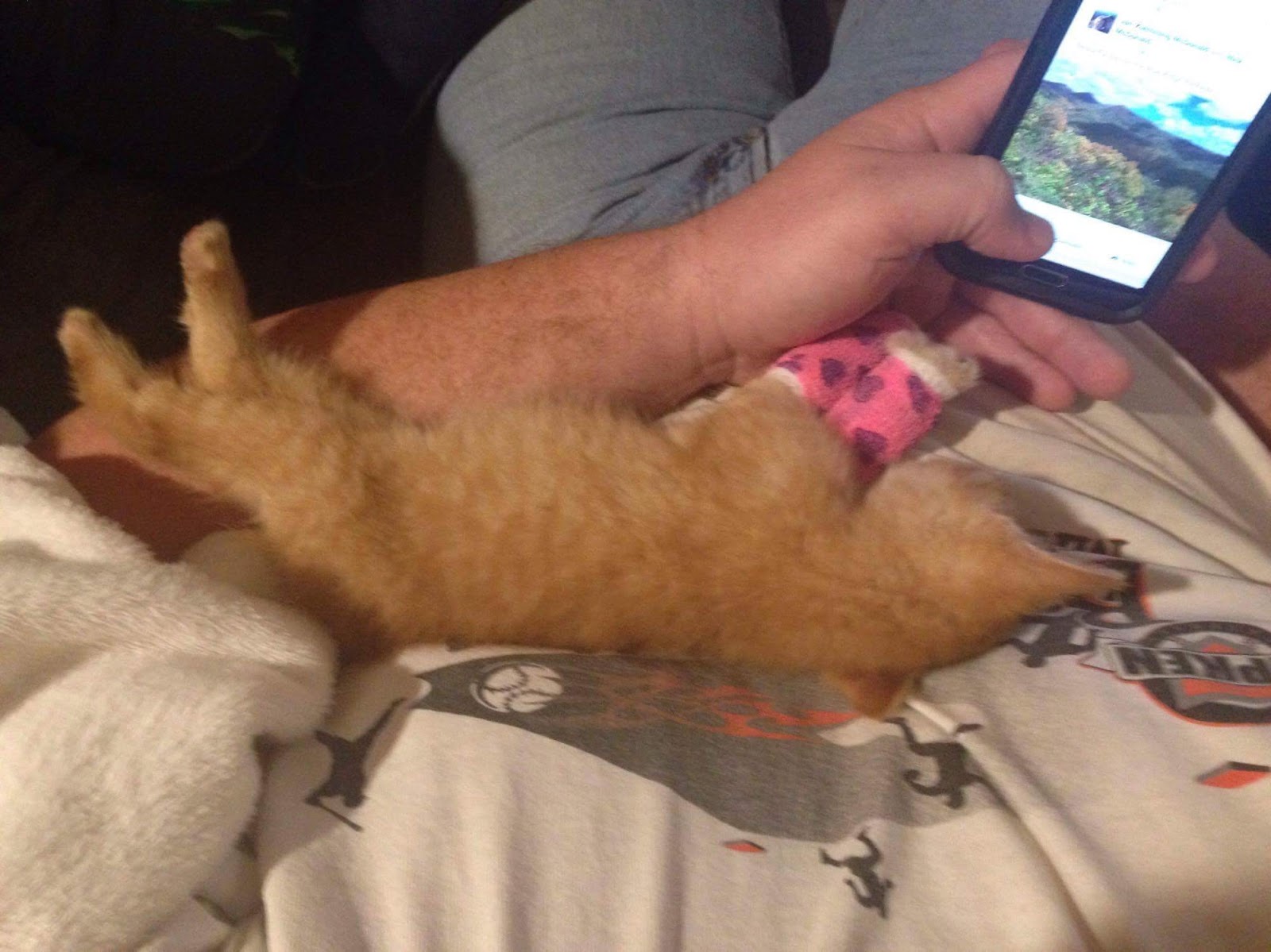
And discovered he was a cat..

Who loves people.


It has been a month of treating his legs.. and now they are perfect.

He is back with us learning how to be a friend and looking for his forever home with his new friend Thor.

Miracles come in all sorts of obscure packages. You don't have to look far for them. You just have to accept them as a tiny opportunity to be bigger than the often overlooked. And, you have to remember to love.

Weasely happened because Jarrettsville Vet does a few things;
1. We advertise that we are here to help the pets of our community.
2. The local shelters and rescues know that they can swing by and drop off a little soul in need in a little carrier.. even on our busy days. We don't dismiss or disregard there is need even when there isn't a paying client.
3. We utilize all of our resources to make happy endings. There is a small army of people who help at every step. Our clients, families, friends and supporters make this happen.
4. We have staff who provide pro bono care generously and unselfishly.
5. We have a box at the front desk to collect donations. We call it the Good Samaritan Fund. It helps cover the cost of these cases.
We never walk away and we don't give up. It is our credo and it is all you need to allow little miracles to happen.

Related blogs;
Bella's New Legs.
Borrowing Battery Juice.
If Wealth Were Measured In Good Deeds.
Open Admission Shelters Are NOT Safe Houses.
Leave Them Here.
If you are an animal expert, or pet lover, or have a question about your pets care please join me on Pawbly.com. We are a place for exchanging information to benefit pets lives globally.
I can also be found at the clinic, Jarrettsville Veterinary Center in Jarrettsville Maryland, on Twitter @ FreePetAdvice, or on YouTube.


