Showing posts with label biting. Show all posts

Sunday, March 15, 2026

The Dilemma Of A Bite

What do you do when you get bitten by a dog?

I get this question about once a year. 

Today the question came from a friend via a phone call. He explained that he was just out walking by himself, minding his own business. He walked by a dog on a leash and the dog jumped at him and bit him on the leg. He did nothing to provoke it. He didn't pause, or turn, or make any gestures. He wasn’t talking to the dog or the owner. The dog was on a leash. He was just walking by.  After the dog bit him another person who witnessed the incident came up to him and told him that the dog had previously also bitten that same dog. 

He called me shortly after. " I don't know what to do?"


Every bite has a cause. A dog is as complicated and unique as any of us. They bite for a whole host of reasons. The secret is to unpack whatever is causing them to think that a defensive action is the appropriate response to a stimuli. The question is why do some of us react to a stressful, or fearful experience and decide to act upon it with a dangerous response?

The question is what do you do when you are bitten by a dog and what does the person responsible for that dog need to consider?


When I am talking to a client about a bite every veterinarian is always going worry about rabies because rabies is 100% fatal. So if a client comes to me and says I got bit by a dog or you know. My first piece of advice is to treat it as you would a car accident. 


1. Make sure everyone is ok. Call the police if there is an injury that might be considered severe, or life threatening. If you do not think it is life threatening seek medical care as soon as able. Be warned every animal bite will be mandatory for the medical provider to report it.

2. Collect information from everyone involved. You should get a picture of their id. Exchange each others information. Should this be something require legal action you will need that information for insurance, etc.


Most of the bite cases that I hear about come to see me typically because their dog got in a dog fight with another dog/animal and then the owner jumped in the middle and they were bitten inadvertently.

The difficulty is that once the police get involved lots of things can happen that people are not prepared for. One of them is that if this dog has any previous bite histories then the law can step in. I have been given a court order before to euthanize a dog for excessive bite history. The pet parent had fought in court to try to save her dog. She fought hard. She lost. Her dog had to be put down. I struggled with the decision. The reality was that this dog was going to be put down regardless of how much it crushes me to euthanize a healthy animal. If I didn't do it the shelter would. His mom couldn't be with him there. He would be scared and they would not handle him the same way we could. We sedated him calmly and peacefully and we all sat around him on a big blanket in the back field where he was peaceful. It was awful but,, well,,,, it was the least awful I could make it. This has played out 3 times in my career. There are times where I want to surrender my euthanasia license to save a piece of my soul that struggles so hard.


I believe that there are no "bad dogs" there are dogs who are desperately uncomfortable and do not know how to react appropriately when they are stressed. This case, like all of them, had warning signs. The worst cases of bites are when pet parents try to manage the situations by blaming others, or changing the environment to try to avoid a trigger. The problem is that the triggers change and evolve, and a dog who will react with aggression will likely do that for other scenarios and situations you cannot foresee. The other issue is that not every bite is going to happen on an adult in an area that is not visible. I have seen people have their faces bitten. Their nose or mouth removed. Requiring years of surgeries. I have also know of  examples where children and adults did not survive.


I always talk to people about that. I have to ask; what are you prepared to do? Sometimes my own dog has been on the leash and growled at another dog passing by and then the other dog responded with the same kind of tough-guy attitude. Then I get myself in the middle of it by reminding him to not be such a jerk. He is always on a short leash right beside me, and, I am always watching him. If there was a dog off-leash who acted like he does, came over to us with the same big-dog-sassy attitude, I am sure I would end up in the middle of a dog fight. He is just an insecure moron about some other dogs. I will never fully trust him and he is never allowed off leash because of this. I am his mom and I have to face the fact that in his head he thinks it is appropriate to be defensive and protective.  But in your case, you weren’t doing anything and a dog bit you. There was something that happened in that dogs' head but the problem is you didn’t illicit it. You weren’t one of those obnoxious people that walks up to a dog and sticks your you know, hands and face in their face and kind of violates their privacy just assuming that every dog is happy to meet a total stranger who oversteps their presumed welcome. You were just walking along. So the difficulty for me with your scenario is that if this was completely unprovoked and you already know somebody else has been injured then you probably have a responsibility as a citizen to report it because although you didn’t get hurt, you’re also a big strong, healthy guy and you’re not a child who you know might’ve really had significant injuries. I always kind of start with what’s the worst case scenario how would I feel if I didn’t address the worst case scenario? We all also have a civic responsibility to other people in the community.

"I know who this person is," he said.

.... wait what? 

"You know the person you know the person with the dog?" He did. They are a friend of a friend.

Then I would say the best case scenario is to start with the olive branch right like this visit at the end of the day is a dog who’s struggling with something right and if this is a responsible owner and I really am happy to talk to her. She needs to understand that her dog is struggling with something and she’s ultimately responsible for it and if she doesn’t address it, the court is going to step in and she will have to literally flee the state she will she will she will be given a court order to have that dog euthanized. They probably won’t cross state lines, but that’s what she’s gonna have to do and that’s what people have done and I’m not saying that’s what you should do but that’s what has to happen. She needs to understand that her dog is struggling with something and doesn’t know how to deal with it and is redirecting that aggression on somebody else if that means that she medicate her dog while she goes into training and that dog never leaves the house without a muzzle on. She should also have a vest put on it that says "do not approach, in training." Something that gives a visible warning. Then that dog is never let outside without a muzzle on. She can get a basket muzzle, which is not difficult or prohibitive with their ability to pant, eat and drink, but she needs to do something or she is one going to have to put her dog down. That will go on her record and she may not ever be able to adopt a dog again.


"Thank you."


People get defensive,, but there is a problem. And it will repeat and someone will be hurt. 


Disclaimer time. I am not a lawyer or behaviorist. This is my opinion based on decades of vetmed.


Photos above are the dogs of the Ukraine. I still think about them, and that place, every single day.

Saturday, February 27, 2021

Investing Too Much. When, and Where Do You Draw The Line?

Perhaps I went into this for all of the wrong reason(s)?

Maybe not the wrong reasons, but, perhaps the expectations were unrealistic? Maybe there was too much of me in this endeavor for others? Maybe it's the other way around?

These are the questions I ask myself as I muck through the maze of my daily life as a veterinarian in general practice.

One of the many delightful faces of my vet life day

Yesterday I spent a long time, (to be honest 20-30 minutes), with a sobbing client as she dropped off her dog, Brunswick, for a forelimb amputation. She was, (as every single other amputation pet parent has ever been), reluctant to consent to this surgery. Of all the procedures that we do, and, for all of the many indications this procedure is recommend for, there is no other life-saving, pain alleviating surgery that is met with such pet parent reluctance and resistance. In my clinic over the last 15 years that I have been practicing, I would say that only about 1/4 of the pets who need this procedure, and, I believe would benefit immensely from, actually get it. Most pet parents will sacrifice the pet to spare the removal of a limb. There is this incredibly difficult and deeply rooted mental block on consenting to limb removal as a treatment option. We were at this place; sitting in the front office, debating whether to consent to cutting off the leg of her otherwise perfectly healthy and happy pup.

Brunswick is a timid 7 year old, 50 pound, mixed breed dog. She is a tawny brown with big erect triangular ears, a wide faced and her soft white body is liver spotted from neck to tail. She has a history of a mass removal from this leg that yielded a diagnosis of "lipoma" many years ago. That mass has returned, slowly growing within the armpit of her front leg. It is now pushing the limb out and away from her torso. It has gotten so large that it has exceeded her skins ability to further contain it. The underside of the arm was red, raw and ulcerating. The mass that has been slowly growing for years now is outgrowing her. The cold cruel eventuality of Brunswick's leg was lose the leg or lose her as she would soon have an open wound that would never heal but instead continue to erode her leg, cause her increasing pain, and chew its way up her neck and across her sternum. 
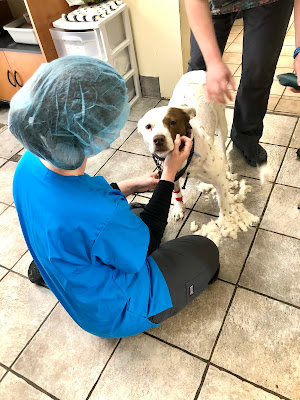

Brunswick walks front legged short stepped, cowboy style. It manifests as a limp. The mass is hidden from obvious view by her bushy hair. The dappled coat hides the magnitude of the mass until you pet her. The diameter of the upper part of her left front leg is easily twice that of her slender athletic right leg. Her demeanor is always stand-offish for a few moments, but, if you are patient, quiet, and gentle in allowing those few moments to pass she will warm up to you to flounder flop on her "good" side for a full belly reveal. It is her not so subtle invitation to focus your affectionate rubs on the tender fleshy part of her belly. She is easy to fall in love with. Her handicap simply reinforces her charm. Her mom adores her. She will tell you that "Brunswick is her first child." 

And, now,,, here we are. Sobbing. Crippled with fear and doubt, and stuck about what to do with it all.

Many conversations get to this point. That critical pivot point where biology, disease and prognosis has met the timetable of limited options. That juncture in a pets life where you have to choose? Are you a proactive parent seeking to gain as much time with your pet as medicine is able to provide? Or, do belong to the crowd that does not believe in surgical procedures for pets? Do you choose to invest multiple thousands of dollars, hours, and caregiving requirements to gain the precious commodity of more time with your companion. Do you value your pet as a member of your family? Are they one of your kids? Can anyone possibly speculate all of the twists and turns that lie ahead if you do, or don't, take action? 


Most pre-op surgical discussions go like this. 

In Brunswick's case we had already done multiple examinations. Two with me, one with the surgeon. At each time we (the "professionals") agreed the best resolution to this tumor was to remove the leg. There were about a dozen emails back and forth to discuss every possible question and concern. And,, yet,, here we were, crying at drop off. 

I sat with her and said; "I know how hard this is. Please do what you think is right. Not what anyone else tells you to do." I firmly believe that this needs to be said to every parent. The road ahead is too full of twists, turns, and potentially even life-threatening landmines. I should add the cost of care, but, for me it is not a part of the equation I will let decide options. If we believe a treatment option is needed we will find a way to make it accessible. (Note: we use multiple payment plan options to help people not let the financial burden be the deciding factor).


I try to ask myself who will benefit from these decisions? Who am I looking after? These are huge weighty decisions with dire consequences. I try to be unbiased, neutral, indifferent. I try to present facts, argue all sides. I soo often feel that I fail miserably at this. I am not ever able to remain indifferent. I am not on anyone's team outside of my patients and their family. It is the dark force that grips my soul surrenders my conscious heart at midnight.

Brunswick post op

Here's where the muck meets the sole. Brunswick needs this operation. She will die within a year from the mass if she doesn't have it. How do I advocate for that? A: I just have to be honest. Then I have to accept the consequences. But, I know Brunswick is loved and I know her mom is making this decision based on that. Seems silly to some, maybe? But that is always enough for me. I am not the vet for indifferent people who don't value pets. That I cannot do. That would kill me.

My pups; Frippie and Storm

These are the elephants I carry on my back all day every day. They remain cumbersome, consuming and catabolic even after I get home at night.

I didn't sleep much after midnight. That mystical witching hour.  My typical work day has me arriving home after 9 pm, a 12 hour day of work without breaks, meals or niceties logged in the record books.  My shear exhaustion leads me to literally passing out on a pillow having foregone the obligatory teeth brushing, face washing, moisturizing and evening medical supplement regimen. They are all tossed out the window for the sake of sparing my legs the 80 paces they would require. There are loads of nights like this. Wrung out dry. I enter home as this zombie-eyed shell. I sleep for 3 hours and the death cipher lets go her grip for the anxiety ridden stressed-out-Suzie to take claim. Its always this exchange of custody each night between the hours of midnight and 2 am. A shared custody battle as the sun sleeps. 

My Frippie always brings me a gift

Why does the day weigh so hard? Brunswick is one example.. this is another. This one happens too often these days. COVID has created a huge demand for puppies. None of them are being socialized appropriately and for some (often breed specific) it is causing potentially disastrous consequences.

The other emotional dilemma of my day was an 11 month old German Shepherd, (let's call her GS), who visited for a pre-spay exam with bloodwork. Her mom had brought her inside the clinic vestibule on a one foot leash to a tight prong collar. Even with moms double fisted grip she could not get GS to remain with four feet on the floor nor have any kind of focus. She had no control of her adolescent puppy, and, she knew it. She told me that she "doubted I would be able to get her blood." She passed my technician the one foot lead and watched us all as we struggled to lead her to the treatment area. All GS needed was a 5 minute physical exam and 30 seconds to pull a blood sample. These appointments are not charged for as they should only take 6 minutes to complete. That didn't happen.

GS was a happy, outgoing 75 pound determined to party firecracker. She was elated to be around people, and in absolute resolve in not sitting for longer than one split second for anything. She knew commands, and she knew how to decide to avoid them. She surged, jumped, boxed, and thrashed. She twisted arms, crashed heads, and started to lunge and bite to have her demands heard.

Our dinnertime excitement

I always stop here...... The three of us; myself, my technician, and GS. We all looked at each other. What to do now? Take a breath? Try a different tactic? All of the above? We took breaks. We tried treats. We tried calm quietness. I tried a large muzzle, just to see if that would settle her. Fifteen minutes into the endeavor and one thing was clear; Nothing worked. We were at the place where one of three things was going to happen;

    1. I lose my patience and I hog tie, muzzle and we pig-pile on her to attempt to bruticaine (brute-force-paralysis vet lingo), and see if she is so shocked by this she gives in.  I just turn into a cold hearted drill sergeant. Bark orders. Intimidate. Force her to be what I want her to be. Force her to hold this command until I feel she has learned who is in charge. Quickly restrain GS and get it done. Get the blood. Skip the exam. Smile and return her to mom. After all what she doesn't know isn't my problem. She can't claim naivete when she already admitted unruliness. Make friends with the owners, even if it  is at the patients expense. A lot of vets have learned this trick. Two faced. Sweet to people, not so much to patients. A bite will likely follow at some point. What the real consequence of this is; To hell with the next guy who has to deal with her.  Might work for some dogs, never works for shepherds. Shepherds are too intelligent, they cement resentment like dolphins. If I do this to her she will never again come happily into our doors.. She will start every future interaction with fear and aggression. A bite will follow at some point soon.

    2. I give up knowing the short game loss is worth the long term gain and we have a family meeting to try to find a way to make her appointments more enjoyable and productive. Her mom had already expected that today wouldn't go well. We come up with a plan for next time. This should include training at home with the family to allow others to handle her. Working with a trainer to help her focus on commands and execution of them with focus and safety. And medications to help bridge the gap as we work on training. 

    3. I just get bitten. No chance to compromise, or convince her that we are not trying to hurt her. She just explodes and bites as fast as she  can. She is done with us and she will remind us she is in charge. 

What happens when a "bite" happens? Paperwork, fear, and almost always the pet parents compounds the tragedy by isolating their dogs in an attempt to avoid future potential bite provocations. Muzzles, prong collars, yelling, over protecting orders and mounting anxiety across all fronts. It's a snowball. Attempt to avoid situations leads to a lowering of estimation of the pets perceived threats. They used to like everyone. They were puppies meeting a world of new sights, sounds and smells. Now they are guardians that bark at the door knocking, or, strangers. You can't take them out in public anymore because now they bark at everyone. Everyone is a perceived threat. They are 100 pounds and you cannot restrain that amount of determined muscle. They become isolated. We reinforce the idea that everyone is a stranger. I used to see them every two to three weeks. We had fun visits. Now I am the stranger. I ask for unreasonable acts of discipline and focus. They don't know me and they certainly can't see a reason to obey me. Hence the bruticaine and indifference. 

Buster


Who's fault is a bite? Well, for the huge majority of clients vets see daily they would say it is our fault. For every time I have handed back a shepherd to say "we need a different plan to make this visit enjoyable." I almost always get, "well, you don't know how to hold her. She is fine with me." Oh, how I long to reply; "Ok then you do the bloodwork and  the spay. I like my fingers and face." Or, "she would never bite me, therefore, you are the problem." 

Here's my advice; it is the advice that every seasoned pet care professional will give you. Train your dog to accept a muzzle. It is NOT a reflection of a persons failure. Nor the pets. It is a tool to provide assistance as we transition out of anxiety based fear laden actions and reactions. Every pet parent should openly and provide permission for a muzzle to be used if deemed necessary. Man-handling, bruticaine, that is not permissible.. ever (unless a pet is endangering another's life). How do we insure this? Trust. If you don't trust your pet care professionals ask to be present for all possible procedures. Ask, demand, insist that pre-anxiety medications be given. Set ground rules for care. Resistance is a flag for scrutiny. Leaving a practice because a person intervenes on your pets behalf is only going to hurt your pet. 

About 30 minutes after I aborted pushing GS any further I sent her home with a training plan and sedatives to try at the next vet visit. I chose to not push her, not exacerbate a bite, and not make it impossible for the next time. Here's what I got for that, a call from the husband saying "they had a bad experience with us and they are going elsewhere." I doubt I will ever see GS again. There is pride before a fall. There are Shepherds relinquished everyday because no one intervened on their behalf at this critical development time. And, worst of fall there are vets who get court orders to put animals down after a "bite" history deems them a danger to the public. Will the next vet push her so hard she bites? Or becomes passive aggressive? Or fears people so much she reacts with defensive aggression to everyone outside of her family? In my opinion she needs help. Will she  get it? It's one of the reasons I awaken at midnight with elephants.
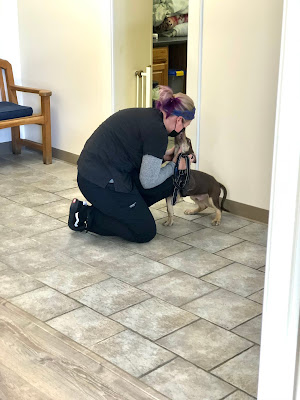
Tex. His first puppy visit. My goal is to have every patients visit look like this.

The truth is that people pine as much as I do, if not more, on what to do for their companions. What is the right/best/safest/compassionate course of action to take? What will consequences for that looks like? Will I hate/berate/beat up/chastise myself for the action, or lack there of, I take? I have been in these shoes. At every moment of my professional life I remind myself that I am still that devoted pet parent who is in turmoil about what to do? Do I trust my own judgement? Do I have enough pertinent information to base my judgements upon? Is there trust here. Maybe GS's parents lack that? They just don't trust my call? The reality is that she is being set up to fail, not flourish, and her "bite" won't be on my account of failing her. 

Brunswick. One week post-op forelimb amputation

What these two cases have in common is that I did my best to make decisions, present options that were in the  best interest of my patients. period. I can fall asleep knowing that. The rest, the worry, the grief, the elephant on my shoulders that I failed them, their parents, or the relationships we have is the midnight hour that clutches my throat and drags me into the abyss of self-doubt of avenues from that first decision to "do no harm."

Magpie helps me motivate for another morning.

For more information on anything and everything pet related please ask us for free at Pawbly.com.

If you are a pet care provider who is willing to help pets in need with your advice and compassionate words of kindness please consider joining us and adding your pet care experiences and thoughts at Pawbly.com. We are always in need of reputable professionals who can educate and inspire.

For more information on Jarrettsville Veterinary Center please visit our Facebook page, or website; JarrettsvilleVet.com

I am also posting lots of informative videos at my YouTube channel here.


Tuesday, July 16, 2013

The Worst Situation In The World

Today I wanted to share Dr. V's blog. She is sheer literary genius (seething jealousy) but this one is as eloquently written as I could ever hope to do, so I'll just accept inferiority and defer to her.

Please let me know what you think.


The worst situation in the world

A couple of days ago, the wonderful Dr. Nancy Kay posted a story I hope all parents (human and pet) read about the trend of kids and dogs in pictures getting into potentially scary situations.
If you haven’t read it yet, she punctuated the apprehension she feels seeing pictures like this:
oh god
And this:
oh boy
with a story from her own practice, where a parent disregards her attempts to help her children interact with their dog more safely. And the story ends, after the dog bites one of the children in the face, with Dr. Kay tearfully euthanizing the dog after another home could not be found.
While most of the respondents reacted with sadness about the situation, a good-sized number of commenters took Dr. Kay to task for euthanizing the dog. While she is too gracious (or smart, but I’ve never pretended to be that) to respond to the people who think they know what goes through the mind of a veterinarian in these situations, I feel somewhat compelled- OK, really compelled- to say this:
You have no idea how hard, how awful, how utterly agonizing these situations are, because if you did you would never call her a murderer. And until you’re the one holding the syringe in your hand, I implore you to take a step back and return the discussion to its original context, how we all need to do a better job by working together to prevent these situations in the first place. Because here’s the truth:
That is an utterly impossible situation to be in. Yes, vets have a lot of wiggle room when it comes to “my cat is peeing on the rug” or “my dog has flea allergies” or even “my dog growled at a kid” to say, “I am not comfortable with euthanizing this pet.” But once a pet bites a person, a line has been crossed and everything changes.

The law is stacked against any dog who bites

Once upon a time, a person went to their veterinarian and said, my pet snapped at my neighbor and I don’t know what to do. The veterinarian said, let’s try to work through this with a good behaviorist, or find a rescue who can take this on.
Later on, the dog bit someone. The person who was bitten sued not only the owner but the veterinarian for not suggesting the aggressive dog be put to sleep. And they won. That is the legal precedent we function under, the standard of care to which we are held.
So let me reiterate: if a dog comes to us after biting a person and we do not counsel the owner the dog should be put to sleep (even if the owner never brought it up), we are liable if that dog bitesanyone in the future. If a dog with a history of biting a child comes in, the owner requests euthanasia, and you refuse? You are basically agreeing to hand over your license, your livelihood, and your ability to be an effective advocate for anyone should another bite happen. Even if a rescue agrees to take the dog, which despite protests to the contrary is pretty rare. That is not to say I have euthanized every dog who’s ever nipped- far from it- but yes, every time I send them away for behavior work I’m taking a risk that only I can truly assess.
And when you have an extreme case in front of you like Ben? That is a horrible, awful corner to be backed into as a veterinarian. There is no happy solution. You’re either a murderer or someone willing to gamble away their entire career on a really bad bet or someone passing the buck to a shelter employee. It is awful and nausea inducing and likely to cause migraines and the sort of thing we all struggle with and few are brave enough to mention out loud for fear of judgmental types who think they know better questioning our dedication to animals. So you take that weight on yourself, mentally apologize to the dog for the crap hand he has been dealt, and cry. At least that is what I did the one time I was put in the same position.

Solving the problem we all helped create

I don’t want to play advocate Olympics here and saber rattle over who has done the most good for dogs, but if that’s your thing- Dr. Kay, for example, quite literally wrote the book on animal advocacy. And it makes me sick to my core to have people react to her with nastiness because of that unwinnable situation that we have all contributed to.
We contribute when we suggest any situation be handled through specious lawsuits.
We contribute when we throw shade at each other and erode the trust between the public and veterinarians.
We contribute when we roll our eyes at well meaning but ultimately uninformed parents instead of trying, with kindness and care, to change the way we educate new parents about pet safety. With compassion, and consistency. I am sure the people who took the above pictures love their kids and their dogs, as do I: only difference being I have no pictures like this because I understand the risk more than they do and don’t allow that situation to happen in my house.
Now if you’ll excuse me, I have to go continue the conversations I’ve begun about ways to make life easier and safer for parents then get on a plane to South America for a volunteer spay/neuter initiative . Signed, your local animal murderer/advocate (you decide).


Here is the comment I left on her blog;

Thank you for writing this, for being honest, and for not living in the grey zone.

I find that I often have to practice medicine by addressing worst cases scenarios and deciding which consequences I can live with. It is a constant juggling act of helping pets, protecting human beings, and being able to live with the decisions that are made.

I know that in some cases I must chose between a pet, a human being, and my conscious. I also know that even though a human being is in many cases at fault, the pet will pay the ultimate price.

Along the way I have had to make heart-breaking, gut-wrenching decisions, and then follow through with being, judge, jury, and executioner. It is not a task for the faint of heart, nor the soul devoid of compassion. 

To not care anymore is to abandon the purpose of my chosen profession.

I am the last person in that pets life to let them down, and I carry the responsibility and the disappointment through every day of both my personal and professional life.

Every night I hope that the actions taken that day will still let me wake up the next and remember all of the reasons that I longed to be a veterinarian in the first place and still want to get out of bed.

To read the entire article, view the comments and subscribe to Dr. V's blog, please visit Pawcurious

Tuesday, October 18, 2011

Your Vet, The Psychologist

Mrs. Stompf always carried her little Yorkie Sydney into the clinic the same way. He would sit up in the bend of hr elbow, front legs wrapped around her neck, head buried under her chin, and hoping that if he couldn’t see us then of course we couldn’t see him. (Perfectly sensible if you are a dog, or a three year old). She carried him everywhere. He is one of my patients that I wonder if he has ever felt a floor or grass under his feet? Although he seems perfectly content to not know what they feel like. And, I think his mom feels that he is safer in her arms. They have both built a very inter-dependent lifestyle around each other. They are each others’ security blanket. It is the reason many of us seek a pet. It is that unconditional love, acceptance and mutual need for each other’s company.


I am trying to recall if I ever saw Mrs. Stompfs’ husband escort the two of them into our clinic? She is a very good client, who is very devoted to her constant little hitch-hiking Sydney. She watches his every move, behavior, and action. Trouble is, I never get those reports from her in the first person. I receive every report from her in the third person. Well, actually, I get the reports from the vantage of her husband. He would interpret her observations and findings and then she would relay them to me. I would often ask her “what her thoughts are on whatever Sydney-issue of the moment we were discussing was?” And instead I would be told, “My husband thinks it is…” Those discussions were a little futile and frustrating for me. On one level I had to try to interpret for Sydney via a middle man, it's not like trying to identify a pets problem isn’t hard enough when they don’t speak, try trying to figure it out when your patient doesn’t speak and their caretaker doesn’t have their own voice.
Everywhere Mrs. Stompf went Sydney went. They were as connected as a pirate to the parrot that perched on his shoulder. Sydney was an extension of her. I understood very early on that these two needed each other as much as any pet and parent ever could. She needed his companionship, and he returned the devotion by being afraid of everyone (and thing) else in life. It is the reason many of us seek the companionship of a pet. It is the unconditional devotion, acceptance, and love that only a pet brings to our lives. It is the reason we are so drawn to pets, and it is the reason so many pets develop behavioral issues. Pets, in many ways, are like children. They are an independent complex assortment of genetics (that’s why my Beagle Jekyll can’t stop howling at the wind), and “learned behaviors”. If you never let your pet meet, greet, interact, or play with another person or pet they will think that anyone (and anything) else is something you fear. It is often a difficult, delicate dance we as Vets have to try to maneuver as we try to address the behavioral problems, (sometimes only the Vet recognizes the too tight tie between a pet and their parent) and not disturb or disrupt the bond between a pet and parent.
I think that the reason most dogs bite or mis-behave is a general lack of early appropriate socialization. There are many articles written about this, and a huge over representation of behavioral problems, i.e. separation anxiety, because single women over protect and over shelter their pets. In almost all cases they don’t even understand their part in the process, or that their actions influenced the end behavior. To this I would offer the following advice. Your obligation to your pet is in many ways the same as it is to your children. You are there to help provide protection and assist them into becoming an independent (almost) self sufficient part of society. Your pet needs all of the same training as a 3 year old does. No biting/hurting others, don’t be afraid of the world if you are with your friends/family, and we all need to eliminate in an appropriate place.
It is often a difficult discussion to have with a client. How to explain to them that the reason their dog bites at everyone else, tears up your house when you walk out the door, or can't travel anywhere is because you never introduced them to the world and the other people in it? I have learned that it is a delicate fine line between addressing the problem and not placing blame on the owner or resentment toward the behaviorist trying to help recognize, address, and treat the problems. And then there is the whole big can of worms where some owners don't actually want their companion to like anyone else.


The following is from "New Dog Choosing Wisely and Ensuring A Happily Ever After" by Dr. Bruce Fogle. I love this book. It is a great resource for all owners, but especially the owners looking for a new pet.


And also some information on Behavioral Problems from The Merck/Merial Manual for Pet Health