Meet Max.

Max is a typical Lab, effervescent, energetic, and incorrigible. He has two speeds; On, as in Full-On, and sleeping. He is so energetic that he is crated during the day. I know lots of clients who think that their dogs have "outgrown" the crate, but, I think that having pets crated when you are not at home supervising them is a great way to insure a pet who rests and has down time. Mind you this takes training and acclimating, ideally starting as a puppy, AND, carting also helps us in the veterinary medical assistance in that we can prescribe cage rest so that pets are forced to relax and rest. It is especially important for the little dogs with bad backs. These pups need to rest, really sleep and rest. No access to anything. Please don't try to convince your vet that your dog will not jump pn and pff the couch when you leave. They are dogs, they are as sweet and innocent and as incapable of a good decision as a toddler is. Crate rest is an important life long training and healing tool. Max is a crated dog. He is also a happily to be crated dog. So he wags in his crate. He also wags out his crate. If Max has his eyes open he wags.
Max also lives inside. Outdoor dogs, wolves, all creatures in the great outdoors don't suffer from happy tail. They don't have walls to inhibit their happiness. And lets also be honest outside wild animals don't wag much. they have busy schedules to keep them busy and focused. Happy, well, happy is an emotion built on luxury.
When Max came to us he also came with a long, many year history of wagging his tail into beaten burger consistency submission,, that still never stopped the wagging.


A dog with a beaten, sore, painful paw (the other extremity) that we talk about on pets will carry that foot and not use it all to walk on. The nerves that feed the toes and foot are abundant and extremely sensitive. The tail, well it is primarily a bone rod with a paltry bit of leather like skin covering it. No fat, no thick skin like the sole of the foot, nope, just a somewhat flexible whip that swings aberrantly on a whim or a wish.


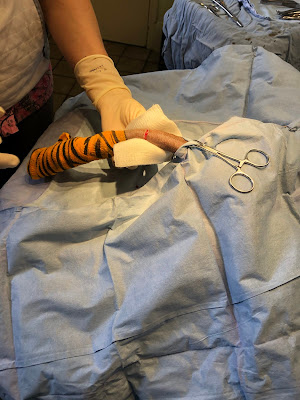

Max's previous visit was to start antibiotics, attempt to wrap and protect the tail and discuss options for eradication of the condition we could never seem to manage long term. Max's dad, like all of us would be, was pretty frustrated that the tail never seemed to heal for long. A line of blood lashes lined the hallways. The tail would be found bleeding every night they came home from work. Max and the family never got a break.
Here is the conversation that I had with Max's dad when the subject of amputating the tail came up;
1. This might not be the end. A tail will always wag if the happy soul at the other end of it tells it to. Did you know that even pets with complete spinal paralysis can still (sometimes) wag? Yep,, a happy dog will tell you even through paralysis of all of its legs!
2. We have to keep the tail incision site, no matter how short that tail is, protected for weeks. That takes a huge amount of dedication and oversight on Max's family. An e-collar at all times, frequent post op visits, and protecting that tail are hugely important. If he is allowed access to his tail we will have to redo the surgery.
3. If the surgical area gets infected, traumatized (by him chewing, laying, or banging it on anything) I have to remove more tail. The tail is docked by removing segments of the tail bone, which is essentially pieces of vertebrae. You only have so many pieces and then you risk jeopardizing the spinal cord that innervates and commands Max's ability to pee and poop voluntarily.


When Max came to us he also came with a long, many year history of wagging his tail into beaten burger consistency submission,, that still never stopped the wagging.


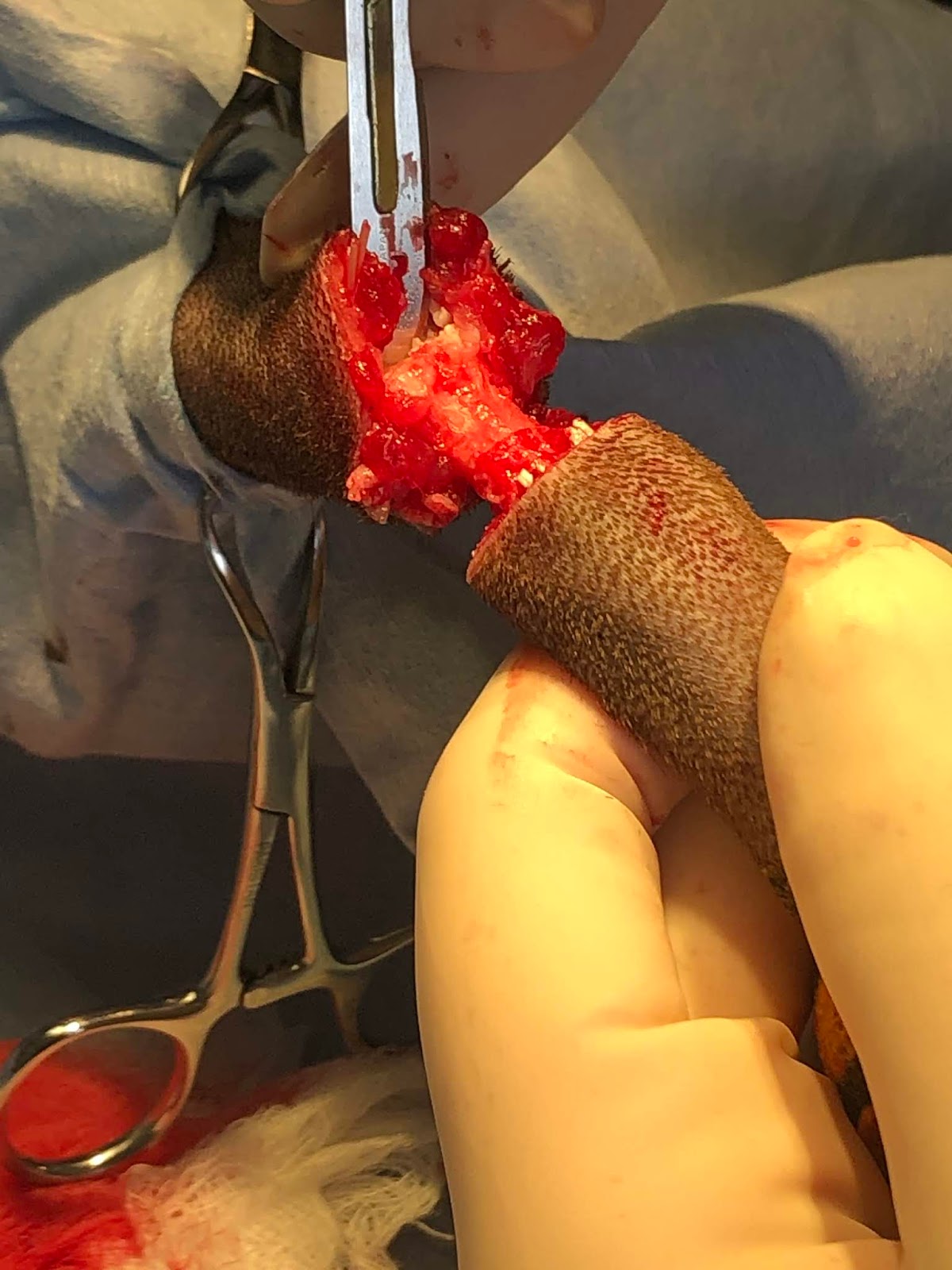
These are surgery photos from Max's tail amputation. We shave the entire tail from about 6 inches above the expected incision site to the end. We also tie it up so I can aseptically (keep the surgical area sterile) wrap it out.

Draping the tail so that only a small area stays in the surgical field.

First cut is one of the most important. Every surgeon will tell you that they do A LOT of pre-planning and always keep a few back-ups plans in their back pockets. Once you start you have to be able to figure out every single possible scenario to get out with a happy ending, and what the pet parents were expecting.

Here is the conversation that I had with Max's dad when the subject of amputating the tail came up;
1. This might not be the end. A tail will always wag if the happy soul at the other end of it tells it to. Did you know that even pets with complete spinal paralysis can still (sometimes) wag? Yep,, a happy dog will tell you even through paralysis of all of its legs!
2. We have to keep the tail incision site, no matter how short that tail is, protected for weeks. That takes a huge amount of dedication and oversight on Max's family. An e-collar at all times, frequent post op visits, and protecting that tail are hugely important. If he is allowed access to his tail we will have to redo the surgery.
3. If the surgical area gets infected, traumatized (by him chewing, laying, or banging it on anything) I have to remove more tail. The tail is docked by removing segments of the tail bone, which is essentially pieces of vertebrae. You only have so many pieces and then you risk jeopardizing the spinal cord that innervates and commands Max's ability to pee and poop voluntarily.


Max is still under general anesthesia. His surgery is done, but, now we need to bandage the area before he wakes up and starts wagging again.

I've tried lots of splints, covers, and protective options on tails. The problems are always the same;
a. the tail tapers so that a big wag will cause the bandage to just fly off.
b. The tail, the incision and all healing tissue will respond better if it can breathe, so, the plastic cone enclosures I used to use left the tail stump wet, sweaty and delayed in healing,, air,, we all need air!
c. How to protect an incision and end of tail in 360 degrees and also allow air?
My latest answer has been a spoon splint. It is the blue spoon shaped item to the right if the end of his tail above.

Bandages are the balance of protection, comfort, and durability. It is an art form that takes practice.


This is Max (note; still smiling!).
He came to visit about 3 days post op so I could check his incision. As much as it is imperative that the incision site, and new end of his tail, stay protected post-operatively, it is also really important to check the incision frequently. Bandaging protects the healing tissue, but, it also hides a problem should there be one. Max also has an e-collar on 24/7 so he can't lick or chew the end of his tail. A dog, or any and every, post op patient will try to lick, bite, or chew at a painful area. So how do we know what is detrimental chewing curiosity, and, what is an indication of a hidden under the bandage problem? well,, we check the incision frequently, and, we pay attention to our patient. Not eating, or not eating well, pain, or signs of reluctance to do normal activities are all signs of a potential problem. Listen to your patients. They will tell you there is an issue, if there is an issue..

The incision is a little red, but holding well, and Max didn't mind us changing, cleaning, or re-bandaging the tail.
I also replaced the bandage in front of his parents (they are EMT's), so they can replace it at home if needed. We send home extra banding supplies,, JIC.

I want pet parents to see the surgical site at every visit. Everyone should know what it looks like at every visit. How else can they also monitor progress and know what normal and abnormal is? I keep parents involved in all aspects of their pets care. It helps them feel empowered, involved and invested.

Max approves!
Bandage changes happen every 3-7 days. As long as the tail is wagging comfortably, being held at a normal height and angle and showing no signs of wetness, blood, or a bad smell we change it in the clinic with parents present. I expect it will need to be bandaged for about 6 weeks.
For more on Max read his Pawbly.com story here;
The cost of Max's care;
Pre-op exam; $50
Pre-op blood work, full panel $170
antibiotics for infected end of tail $30
surgical cleaner for end of tail $15
Surgery costs;
surgical package; iv catheter, fluids, pump, anesthesia, instrument pack; $250
tail amputation $200
post op pain NSAID $16
splint application $50
additional suture $60
refill antibiotics $30
e-collar $16
Max's story is posted with his families permission. I thank them for allowing me to share his story, photos, and process.
If you have any veterinary questions please ask me for free at Pawbly.com
If you would like to learn more about our veterinary hospital please visit the
You can also learn more about lots of veterinary topics at my YouTube channel.


