Sunday, December 21, 2014

Which At Home Product Works Best on Your Dog's Ears?


I get tons of pet care questions about ears. Both in and out of the clinic.. Ears are one of  the most common client complaints that bring pets in to see me. 

I understand most people think that a smelly, itchy (as indicated by head shaking or rubbing the ears), redness,or  pain are all the same thing; an ear infection. But the diagnosis is not so simple. Without a diagnosis it is almost impossible for any of us to give you a treatment.

Here  is one of the most common questions that I get:

Question from Chris on Pawbly.com;

"What do you think of Zymox enzymatic solution for treating dog ear infections? (My English bulldog has a red, wet ear with yellow discharge.) What about the different hydrocortisone concentrations - 0.5% vs. 1%?"

Here is my answer;
"Here is the constant dilemma with ears; you have to treat an infection that you are diagnosing. That is the reason we look in the ear and take a sample of the debris to look at it under the microscope, if there is any.

Here is where clients misdiagnose and misuse ear medications. 

In many many bulldog cases the ears are inflamed due to an underlying allergy and need both an otic and a systemic steroid or antihistamine, or a combination of both.

These guys need to see their vet when the ears flare up. Often the ears are the first sign of an impending or underlying problem. I love bulldogs to pieces but most need frequent life long management for their skin issues. It is best to start that relationship now. Don't treat on your own. If you guess wrong you will probably make it much harder  to treat the next time. In my experience there is always a next time.

Here is my blog on dogs and ears. It has a lot of important information. Ears, everyone has them, no one treats them right.

Sincerely,
Krista"


My pups, Jekyll on the left, and Charlie, on the right.
Can you guess which one has ear issues?
(Yep, the long big-eared beagle on the left).


More on Ear Hematomas (what happens  if your pet keeps shaking their heads).

If you have a pet question you can ask it for free at Pawbly.com. Pawbly is a place dedicated to helping pet people by providing lots of information to help build and strengthen the bond between you and your pet. All answers are provided by people who care, and it is a community built on support and knowledge, all centered on pet care. Please join us today!

If you want to talk to me directly you can meet me on Twitter @FreePetAdvice, or in the vet clinic, Jarrettsville Vet, in Jarrettsville Maryland.

Friday, December 19, 2014

Pets Are Not Property. The Case of Bela. Whose deceased owner requested he be euthanized at her death so they can be buried together.

Bigfoot was brought to us after his dad died
and the rest of the family decided they didn't want him.
Do you believe in second chances?

There are many aspects to being a veterinarian that are difficult. I have talked about a few of them before. The stress of compassion fatigue. The difficulty of dealing with clients who can be shallow and selfish. Those who view their pets as disposable whims of fancy by dumping them when they no longer match the house decor. (Yes, I actually had a client request a euthanasia because her black cat no longer matched her new white furniture). Or, those who abandon the middle aged, older, or ill pet for a cheaper new edition. (See Levi's story). The list goes on and on. It can be depressing and bleed your soul dry as you try to be a doctor for a patient someone else is supposed to be both emotionally and financially responsible for. It can be extremely difficult to maintain a genuine degree of care and compassion when a client seems to lack the same. You get stuck in the middle.

But what do you do when a seemingly loyal pet parent wants their healthy pet destroyed upon their death? Is it possible to love so much that it is detrimental to your pet?

In the news recently is the case of Bela, a healthy 9 year old German Shepherd whose owner died and left a request in her will to euthanize him so their ashes could be buried together. Bela's story here.

There has been an uproar on social media and a band of highly charged outspoken animal advocates have gathered to try to save him. He has been offered refuge, homes, and sanctuary. BUT, he is property and that leaves his fate up to a court. To make matters worse for him the lawyer in charge of his fate states that his owner feared his aggression and lack of socialization were reasons enough to not seek a home for him after her death.

Do you think that this is uncommon? It isn't. Over the last years I have had one client ask me to honor her wish of euthanizing her two dogs should anything happen to her. She believed that no one could love them, or care for them to her standards, and that it wouldn't be fair to the dogs for them to be left to someone else. She lacked faith in her family, her friends, our society, and believed with her whole heart that their lives were better off if they were ended when hers was. It was a conversation I will remember my whole life. I told her that I understood her concerns, and that I knew she loved them, but that I had seen soo many pets find a second home, and go onto to live a second life with another family. Yes, for some pets it took time, and yes, for some they might miss their original life, BUT, every single pet was alive. Pets live in the moment. They love again, they forgive, they don't feel sorry for themselves, and they adapt. For every pet we have declined to euthanize we have seen new lives grow, new chances, and new miracles. They happen, they take faith, devotion, and time, but they happen.

j
Sunshine,
Bigfoot's brother arrives for me to  examine, update vaccines, and find him a new home.
His dad's father sits next  to him, still grieving the loss of his son.

Here is a story of pets that we didn't put to sleep when their owners passed away;

Pheobe. Her family brought her to us to put to sleep because her mom went into hospice and none of the remaining family wanted her. She became the companion to a dog who suffered from severe seperation anxiety. She also went from an obese, lethargic, withdrawn dog, to a bubbly, happy, energetic dog. Her life changed so dynamically that I would not have known her to be the same dog if I hadn't witnessed the transformation firsthand. Pheobe's Story here.

There have also been a handful of clients who died and left no plan for their pets. ALL, yes, ALL have been housed with us, adopted out, and gone on to live the rest of their happy life. What will happen to the pets you leave behind blog.

Bigfoot celebrates Pets With Santa 2014 with us at the clinic.
He was with us three weeks before he found his new home.

So, where do I stand?

On Bela's case, as with every pet, I stand with Bela. But, I also recognize the complexities of his case. Bela's mom made the most common  mistake I see with German Shepherd's. Bela was inadequately socialized and trained at a young age and this has made him into a socially hesitant member of our society. The only dog I have euthanized due to aggression was a young German Shepherd who almost killed his own owner after he surprised him when he was walking into his own house. BUT,  I  do not believe that every aggression behavior case should  be given up on. Bela is in a sanctuary now and they should be the a part of this discussion.

Pets are not property. Until this archaic, incongruous notion is redefined into something more consistent with they way we love, honor, respect and treat our pets situations like these will occur, pets will be disposed of without consideration, consequence, or voice.  Our pets, our four legged-furry children enrich our lives, save them, protect them, and yet we deny them rights and protection worthy of their contributions.

When you deal with death, abandonment, grieving, medical mysteries, angry clients, fearful pets, and the mixed bag of grief and joy that being a veterinarian involves you learn to trust that life has a reason, you are a small part of a big picture that will keep you humble, curious, and believing in something  more

Sunshine found his home in 1 week.
There are amazing people, just as there are amazing animals in this world. You just have to open your eyes, your heart, and have faith that they will meet. I know anything is possible if you try.

We have a great deal to learn from our pets. They forgive, they love, and they can adapt. Life is about second chances, and loving one another. Are our pets the only ones who intuitively remember this?

If you have a pet question please visit Pawbly.com. We are an open pet centered community dedicated to helping pets by exchanging pet care information and support. You can also find me on Twitter @FreePetAdvice. Or, in person, with some other pet in need of a home, at Jarrettsville Vet, in Jarrettsville Maryland.

Merry Christmas to all!

Update;
Bela Is Saved! He will be moving into Best Friends Animal Sanctuary soon! Is it a miracle? Yes, of course, but it is more a testament to how much we love our pets, how much power lies in the hearts of people, and how anything can happen if you believe AND you try. His story here.

Tuesday, December 16, 2014

Can Veterinary Care Evolve With Our Clients?


Maggie and Molly. 
I'm interested in hearing about what is important to you. You, the people in veterinary medicine that my veterinary clinic serves.

There are so many articles written already about "How to do almost everything." But I wonder who really ever asks our clients about what they need from us, instead of what we think we need to be doing for you?

There are numerous surveys available to query our clients about our clinic's appearance, our customer service, patient care, and overall experience, etc.. All incredibly important and valuable information for every practice owner to hear, but we are always asking for help about what we do, instead of asking you what we can do  to help you and your pet?

My big gripe with veterinary medicine is that too many of us live in a bubble. We are incredibly important to the lives of our patients and their families (yes, that is exactly the order in which I see it), but we don't change our direction or outward focus until we smell a predator lurking in our yard. Those predators are not only increasing in numbers, they are well organized, deep-pocketed, and savvy. What do we have going for us? We are humble, genuine, and durable. The landscape around us is changing. Our clients will not leave us because they don't value us, they will leave us for two reasons;

1. Price point. We probably can't win this battle.
2. Convenience. We better start focusing on this.

Princess Penelope
Let's look at the good and services that we provide;

Pharmacy. This highly lucrative component of our practice represents close to 30% of our revenues. We are going to lose this. It is going to go away. We can complain, lobby, and formulate erroneous reasons why our clients  are better served paying more for a product procured before they depart our doors, but the price points dictate decisions when the delta grows and it will keep on growing. Or, the big box stores will win their battle to require written scripts for each prescribed product. How are we going to argue that one?

Vaccines. For decades these were our primary marketing tool. Our bread and butter. In my practice the largest revenue remains from those clients who seek our services for an Annual Physical Examination and Vaccinations. I don't think that I can count on one hand the number of clients who came in for an Annual Examination that Didn't Require an accompanying vaccine. We have set ourselves up for a big problem. If we don't begin to build impenetrable bonds based on genuine care of  pets well being AND an unparalleled knowledge base we will begin to lose the weakest of our kind and foreclose to the corporations circling a growing, lucrative. Vaccine clinics are sprouting up like out-patient minute clinics. In fact, your local big chain pharmacy is drafting plans to offer rabies, distemper, and kennel cough vaccines. How is that going to impact your bottom line?

Surgeries. Well, if you don't see or feel the pressures from low cost spay and neuter clinics yet, you will. Better bone up on the cystotomies, cruciates, and GDV's. Can you imagine "spay/neuter" or "dental" only vet clinics that can provide these at half the cost that we do? I can.


Whatever large portion is the backbone of your revenue stream depends on is being squeezed and is in jeopardy.

It is going to become easier and cheaper to circumvent our practices. We will become the general practitioner to pet that we are the patients who go to see our own general practitioners. We are patients of minute clinics, flu shots at our grocery stores, and consumers who shop from the couch.

If you aren't trying to figure out a way for your clinics presence to be felt and influence from your pajama clad clients living room someone else will, or is.


Here's my question?

What do you think your clients want from you?

What do you think they need that we aren't providing them with?

How are we evolving to meet the needs, wants, and lifestyle changes of our customers?

It is not a model of "business as usual." It cannot and will not sustain, at least not in a successful sense.

One of my reasons..
my Jekyll.

I went to veterinary school for a few reasons, at the top of my list was my ability to help those closest to my heart. I never wanted to feel that I was at the mercy of anyone except a fate and a higher beings calling. It is nice to have a clean  hospital with a nice staff, but before I became a veterinarian I was a client. My biggest fear was to be unable to decide what to do. Or that I was unable to provide for them as they needed me to. I did not want to feel helpless and hopeless. I'm guessing that my perspective is not unique.

Where am I going to start? I'm going to start at the same place every other business with long term viability does.  I'm going to ask AND listen. Be more proactive and evolve to an ever changing landscape. Most of all I am going to be the veterinarian I needed when I was a client.

I want to hear what you think.. please leave a comment. You can also find me on Twitter @FreePetAdvice, in the clinic Jarrettsville Vet (where I will be doing a survey of my clients), or ask me a pet question, add your thoughts to others, at the place centered around helping you with the resources and knowledge to take better care of your pets Pawbly.com. Pawbly is free to use and open to everyone who loves pets.


Sunday, December 14, 2014

Internal Bleeding; Rodenticide Toxicity. A tale of two outcomes. Palmer's hemothorax story.


Pets With Santa at Jarrettsville Vet 2013
If you aren't getting attached to your patients I would venture to guess that it is because of two reasons.
  1. You forgot why you became a veterinarian, or,
  2. You are exhausted from being a veterinarian.
I get too attached. I admit it. It happens when you love something.

This is Porter. I met her two years ago when she arrived with her mom and siblings fresh off a transport vehicle from a high kill shelter in the south. She was one of the many rescue kids we see because we work so closely with Black Dogs and Company Rescue. She happened to be walking into the examination room as my friends were visiting me in the front reception area. Within about 30 minutes of arriving at our clinic she was in my friends arms and on her way to her new home.

It was impossible to not love her from the moment you saw her face. She is a timid, gentle, bundle of sweetness. She will throw herself into your lap and burrow a nuzzle that is as irresistible as it is endearing. So you can understand why and how I get attached. Once I love you I never forget you.

Palmer was in the clinic almost weekly at first as we struggled to get her up to date on her vaccines,  get her nourished, de-wormed and used to being on a leash with a family. We spayed her a short time later and she was the little black shadow who went everywhere with her busy family. I saw her, and spoke about her often.


Spay day, June 2014
There are pets who change the lives of their people. And there are pets who change the lives of their vets. Palmer is both of those. 

On Saturday November 8, 2014  I got a call from Palmer's mom. She was worried because Palmer had vomited a few times, was panting and was lethargic. I asked if she had gotten into anything? Or had been injured? They assured me that she hadn't. I was getting ready to go to a dinner party and told them that I thought she should be brought to the emergency room. They elected to continue to monitor her through the night and wanted to bring her in to see me in the morning. At 9 pm I received another call that she had worsened and they were on their way to the ER. At 11 pm I called to check on them.

Palmer was pale, dyspnic  and tachypnic (short troubled, rapid breathing). She was critical. An x-ray of her chest was taken and showed that she had blood in her chest. She was placed in an oxygen cage to help her breathe better. I spent the next hour talking to them and the ER vet. It was a clear reminder of how frightening and fragile life is. The ER gave Palmer's family a $3,000 estimate and wanted a deposit. They couldn't afford this. So Palmer's life was left hanging on an x-ray and a list of possible etiologies. Hard as we tried we couldn't get her history to fit a likely scenario. This is where an experienced ER vet, a diligent devoted and observant family, and a pet with a complete and accessible medical record make all of the difference in the world. 

Palmer's chest is full of blood causing her lungs to be squished to the back of her chest.
Therefore, they cannot expand normally,
hence her panting and lethargy.


Her family left her at midnight to see if the conservative plan of oxygen, fluids, and time would help. At 8 am Sunday morning I called back to check on Palmer. Her family was electing to euthanize her because they couldn't afford to do all of the diagnostics the ER was proposing to try to diagnose her. They wanted to bring Palmer to me at the clinic to look at her. I was sad, frustrated, and my typical stubborn obstinate self. "Please don't bring her to me so I can kill her." It was a selfish thing to say. But I meant it. I told them that I was going to do whatever I could to save her. I meant that too. I tried repeatedly to get some clue as to what had happened to her that could have caused this. They reassured me over and over that it couldn't be a toxin, or trauma. That left a few bad, and likely untreatable, scenarios left.

I called the ER again and spoke to the vet. We both knew that Palmer's family was leaning toward euthanasia. Together we talked about Palmer's case. The ER vet hadn't run any diagnostics outside of an x-ray because her family had declined them due to cost. If Palmer didn't get a diagnosis quickly AND cheaply we believed she would die. It is a terrible real-life predicament. 

"OK," I said to the ER vet. "Palmer is 3, it is probably not a tumor. And, even if it is we can't treat that. (Too expensive and very poor prognosis). There is no evidence of trauma. Just run a PCV/TP and a coag(ulation) profile. That's the only real possibility that is treatable."

Ten minutes later, and for less than $100, Palmer had a diagnosis; Rodenticide Poisoning. She was bleeding into her chest from ingesting rat poison. Her family did not use it, and she had no known access to it, but it was inside of her and killing her. She was immediately started on vitamin K. 

A few  hours  later she was still critical and still fighting for her life. Her parents called me again and I opened my big mouth, again. "She needs plasma." The ER's price for this was $600. "I'll give you mine or pay for what she needs." A day later Palmer left the ER wagging and happy. She made a full recovery in a few days.

Turns out she had gotten an animal carcass from the mulch they had delivered two days before she fell ill. (Don't use rodenticides anywhere. Please! It kills more than rats every single day. There are more humane methods to keeping pests out of your house. (My favorite.. 4 cats!)).

Two days later she came to give me a hug at the clinic. I live, and work, for those hugs.


Palmer changed the way I practice medicine. She changed the way I am accessible to my clients.

I called the two emergency clinics that we refer to and asked them to call me if one of our pets was there and was being euthanized because of cost or uncertainty. I can't change fate, disease, or the fact that medical care can be expensive, but I can change that powerless fear that many people euthanize over. Or, at least I can try.

If you have any  thoughts on Palmer's story I would like to hear them. Please leave a comment below, or you can find me on Twitter @FreePetAdvice, or at the clinic, Jarrettsville Vet, or on Pawbly.com. Pawbly is an open online comunity for pet people. Our goal is to empower you, educate, and assist you in taking the best care of your pet as possible. Pawbly is free for everyone to use and open to all pet lovers.

A tale of two outcomes..coming soon the blog on Nickle.

Friday, December 12, 2014

Living with Bleeding on the Edge, Ear Tip Dilemmas


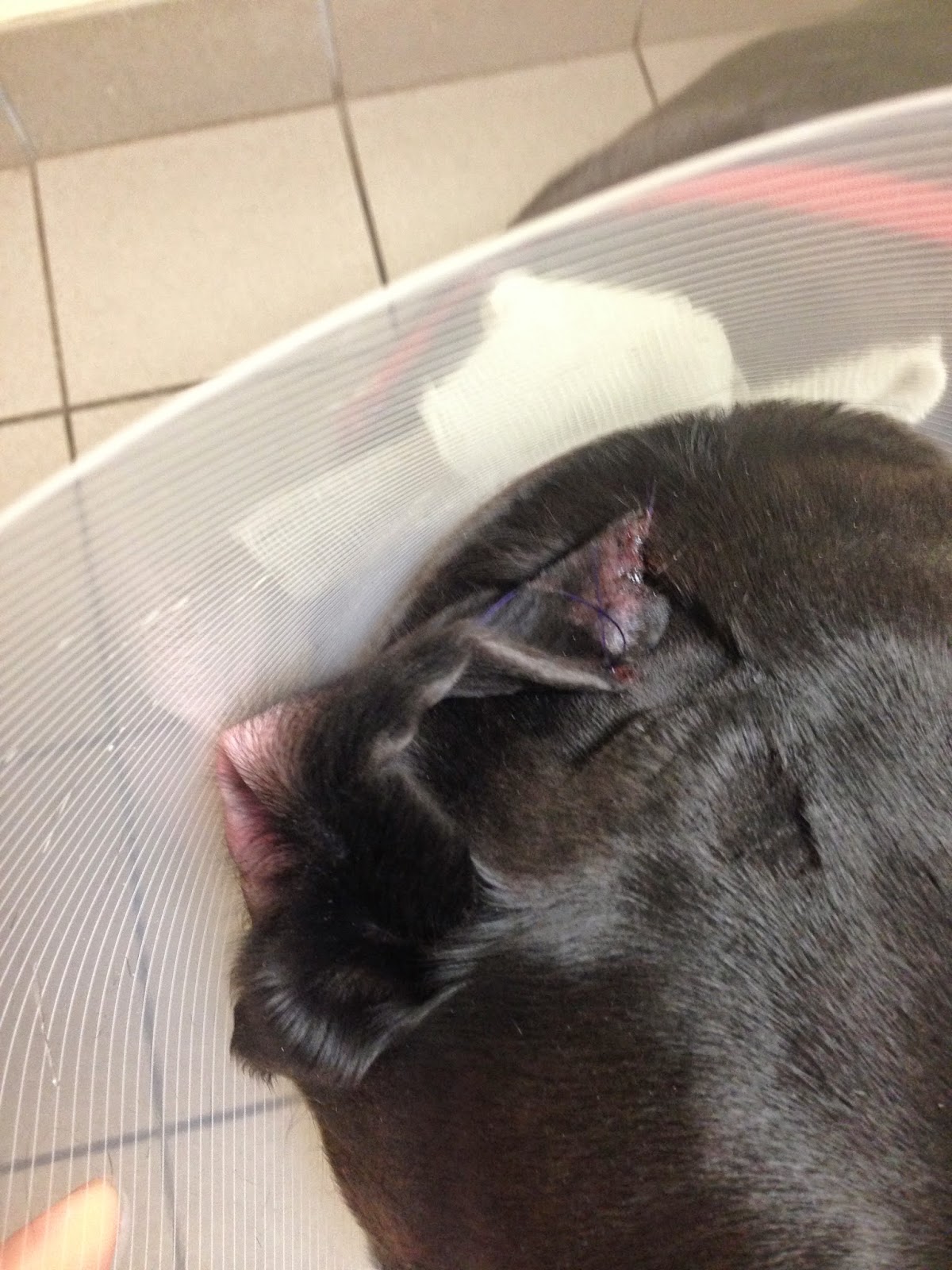
This is Domino. He is an older lab mix who got himself into a tussle with his brother. Truth be told he is not always the first to give a wag and head bow. He is more likely to give a shifty eye and hackle raise. He probably instigated the argument.


As with most quick dog fights there is usually a lightening fast eruption of fury and then it all dissipates and life goes back to normal. For most domestic disputes I don't get a phone call or a visit unless there appears to be one of two things;
  1. Limping, Or,
  2. Bleeding

For Domino there was still a little pesky bleeder on his ear tip that even after one trip to the ER wouldn't stop.


The bleeding from the ear can be profuse and frightening. It is best treated by two simple steps;
  1. Clean the tip with soapy water.
  2. Apply direct and constant pressure. Hold a paper towel, gauze, or wash cloth on the end of the ear for 15 minutes. Do not look at the ear tip, do not blot, just firm direct pressure. (Oh, and use a clock, it really can take this long to stop a bleeder).


The two places that I most commonly see incessant bleeding are;

  1. The ear tip, and 
  2. The tip of the tail. 
Both places are problematic for exactly the same reasons. They are almost impossible to keep still and almost impossible to keep from banging around and rupturing the delicate blood clot that is vital to allowing a wound to heal.


Dominic had been to the ER the night before. Not because his mom feared that he would bleed to death overnight,, (although many of my clients fear this when they see blood splatter from flinging a tail or an ear),  but simply because it looked like he might. 

At the ER Dominic's mom stated exactly what was obvious,  that the end of is ear would not stop bleeding.


At the ER he was sedated and the inside of the ear pinna was sutured to the outside of the pinna. (Think of it like sewing the edge of the pillow back together). Here is the problem; There is a thick piece of cartilage (like the stuffing of that pillow) that lives in between the soft velvety pieces of the inside and outside of the ear flap of a dog. To close this successfully the skin needs to be longer than the cartilage and be sutured in a super-meticulous sewing pattern. This is difficult to do without a perfectly still patient and about an hour of anesthesia time. Dominic got a quick couple of sutures to hold the edges together and the ER vet bandaged the ear tip.  It didn't hold longer than a few hours. A few shakes of the head and that attempt at stopping the bleeding was kaput. Bandages on ear tips or tails are a difficult beast to tame into submission for longer than a moment.


I only know this because I too have failed in the debacle of bleeders that drive clients to the doors of emergency clinics  in the wee hours of the morning after awakening to a blood bathed  room.

A  few important reminders to readers: blood looks scary. But you can't bleed to death from a tail or an ear, or a toenail, (well, it is very, very unlikely). Apply pressure and be calm. Go to see your vet in the morning. If an ear or tail continues to bleed there is no bandage, no glue, and no amount of trying to restrict motion that will stop them from bleeding. If you can keep the clot on the ear tip or the tip of the tail it will heal. If they continue to be banged around, by either head shaking or tail wagging then I just don't think much else works except for crazy proactive measures.


Here is my answer for problematic ear tips. I suture the ear to the head. Here's how I do it;
  1. Identify where I want to suture the ear tip to the head and clip the hair there.
  2. Apply a topical anesthetic to the  ear tip and a local anesthetic to the point  on the top of the head that I suture to. Wait about 5-10 mintues.
  3. Have a good pet restrainer. We use a muzzle and a firm hold. We also give a very deep scratch, or use treats to distract and encourage allowing us to make two quick sutures.
  4. I place two quick holding sutures between the ear and the head. The sutures do not have to be deep, but they are easier to remove if they are large enough to see and cut at healing time.
  5. If the ear tip (or tail tip) can be kept quiet it ill heal in about 2-3 weeks. A wound will always heal if kept clean, healthy, and just allowed to rest.


Now I know that many people love sedation. I, in many cases, do not feel as if the expense and the time delay warrant the use of a possible cardio or respiratory depressant. As long as I know I can perform the procedure quickly and safely I use a local anesthetic and a well-trained assistant.


E-collars are vital to the success of these cases. One foot rub, face rub, or inquisitive friend and all of your endeavors are put into repeat mode.


I recommend that the patient return in 2 weeks for a re-check. IF the wound is completely healed I quickly cut the two sutures and send them on their way. If not, wait until the wound is completely healed. One tiny little edge of a scab can quickly return you to blood bath state.

The cost of his treatment at my clinic, which included an examination, e-collar, topical antibiotic cleaner, sedation and suturing was about $150. He returned two weeks later for his suture removal. His ear was completely healed and the re-check (as with almost all of our re-checks) was free.

For those of you pet lovers out there I invite you to visit me on Pawbly.com. Pawbly is a place where anyone and everyone can meet to exchange pet care information and advice. It is free to use and provides quick, credible information to anyone in need.

If you are looking for help from me in person you can find me at the clinic at Jarrettsville Vet, in Jarrettsville Maryland. Or, find me on Twitter @FreePetAdvice.

Saturday, December 6, 2014

Foreign Bodies and Feet. When to Intervene.


We get a bunch of phone calls and appointments for limping dogs. Lameness is one of those things that can have a million causes and an equal number of options to fix it. Lameness also comes in many degrees of severity.

As a general rule of thumb there is no rule of thumb for these. A slow progressive lameness can be a bone tumor, a knee injury, or even a tick borne disease. An acute complete lameness could be a fractured bone, blister, or broken toenail. Or, maybe all of these but the other way around.

This is Bridger. He is an athletic German Shorthaired Pointer. I was lucky enough during his exam to have a mom who knew exactly when, and thought she knew how, his lameness occurred; He was running in the woods, she heard him yelp! and then he was limping. That was about 4 days ago.

Over the last four days his foot had become swollen and painful. His family thought the cause was a splinter so they lanced it and bandaged it. But, four days later, and still the foot wasn't getting better.


Here are a few important points to remember when dealing with a wound;
  1. Listen to your client. Always give them the benefit of the doubt and then..
  2. Pay attention to your patient. Your job is to do not (further) harm and to get them some relief.
  3. Have a short term AND long term plan. Discuss all treatment options initially. For me, I usually take a somewhat conservative approach initially. Surgery might be on the menu but for this guy it was not option A. He was acting normally (outside of a wound). As long as I trust my clients ability to follow through with the conservative plan we try, talk, and prepare for Plans B-Z. There ARE ALWAYS options! Bridger's initial consult cost about $100. 


Here are some tips for those of you managing a wound at home;

1. Few  things in life beat the broad spectrum antibiotic powers of plain old soap and water. It cleans (and kills) almost everything. And it is safe. At the first sign of a wound supply copious amounts of soapy water.

2. Bandages.. I have a few good things to say about bandages. BUT, I also have a few bad things to say about them. They close in the bad stuff, like infection and close out the most important stuff, like your ability to see and smell the death, disease, and dirt that lies beneath. The only exception to this is to use a bandage as a way to supply compression to a wound as you drive your pet to the vet. 

And should you choose to not heed my warning, I can state without doubt that bandages placed by good intentioned pet parents cause more problems than they solve.

3. Smell.. a bad smell is infection. Go to the vet.

4. A limping foot is pain.. Go to the vet. They will usually prescribe an NSAID.

5. Red skin happens before purulent (puss) happens.. Go to the vet at red skin and/or puss.

6. What appears to be a small surface wound can be a tiny portal to a huge festering deep wound. Deep wounds may need surgical intervention and exploration. In some cases a drain needs to be placed to assist in flushing out the infection. 

After a day of soaking the foot and antibiotics Bridger's family woke up to this!


When an infection lets loose it can look like an explosion. After recovering from the shock of a blood bathed room they looked at Bridger's foot and saw the culprit. Which was easily removed. A large splinter had been the source of the infection, pain and inflammation. (Thanks to them for sending me photos!)


What did they need to do after the splinter eruption?

Keep soaking the foot every 12 hours for another 2 days. Finish the antibiotic (always finish your antibiotics!), and keep the wound clean and dry. If Bridger goes out on a wet muddy day he needs a bootie. I wouldn't expect that he will need the NSAID any longer. Once the foreign body is out they aren't painful. In fact, if they are I would suspect something else is still going on, so go back to the vet. 

Here's another tip on pain medications. Listen to your pet. Use the pain medication IF you think your pet benefits from it. Do not just keep administering it without asking yourself if the pet needs AND benefits from it. All drugs have potential adverse side effects, these are best avoided by only using when needed and as prescribed. 


Related Blogs;


Any pet question can be asked for free at Pawbly.com. Pawbly is an open pet centered community dedicated to helping you find better ways to care for your pet. Veterinarians, trainers, behaviorists and all of the rest of the pet loving people of this planet can be found in one place, Pawbly.com. Stop by and say hello, ask, or answer a question, or just pop in to learn more about pet care.

To find me you can got to Twitter @FreePetAdvice, or find me in person at Jarrettsville Veterinary Center in Jarrettsville, Maryland.

Monday, December 1, 2014

What To Do For Your Pet with Osteoarthritis

There are so many really good questions that come through Pawbly.com. And so many that I forget to mention.. You see the problem is that for me they all seem like the routine stuff that I expected everyone knew already. I suppose that when your day is full of exchanging information and educating people that you forget there is a whole world out there who are all asking, or thinking the same questions. Pawbly gives me a reminder to share the information that I know applies to so many.


Here is a question that came in today;
"What helps a dog with arthritis?"

Here is my answer;

"This is a question that I get asked a great deal. In fact I was just reading a few recent publications and articles on this topic because so many people are taking such great care of their pups that they are living longer and longer...sort of the pet equivalent of baby boomers!

My first piece of advice is to make sure that it is truly arthritis.. Your vet can perform a senior examination to look for reluctance to sit, difficulty ambulating, decreased muscle tone in legs, thickened joints, decrease range of motion, etc. It is super important to not confuse this with other diseases that mirror many of the same traits as arthritis; like cancer, Lyme disease, muscle diseases, etc.. I also think that radiographs are very helpful in diagnosing one disease from another in these cases.

After your pet is diagnosed with osteoarthritis there are many things that I recommend. Here are some of my favorites;


  1. Make sure that your pet is at an optimum weight. Every little pound worsens the joints significantly. It also severely impairs mobility. And as your joint disease advances it is imperative to maintain muscle mass.
  2. Try a great senior diet. My favorite is Hills J/D, but there are many good options.
  3. Add Omega-3 fatty acid. I think it helps some of my patients immensely.
  4. Start a glocosamine-chondroitin product. I like Dasaquin.
  5. Get into a strict (diet if needed) exercise plan. Keeping those muscles active and healthy is key to keeping the legs moving.
  6. Ask about a NSAID. They are miracle workers for some dogs. I have actually had clients discussing euthanasia due to inability to ambulate go home try an NSAID and call me the next day that there dog was acting like a puppy again. Some of those dogs have gone on to live another 6-12 months as happy active pain-free pups.
  7. Try acupuncture. I have an associate at my clinic who works wonders with our seniors.
  8. Try an orthopedic bed. So much nicer on the sore bony bodies.
  9. Massage. At the end of a long day a little TLC and rub reminds us that we are special and loved, it also provides important bio-feedback to the brain that the legs are still here and awaiting the next order.
  10. Booties. I got a pair for my old girl and it kept her up and walking for months longer than her little feet could alone.
  11. Harnesses. There are all sorts of devices that help get your pet up, assist with walking and keep their feet under them. Ask your vet,, or me, and I would be happy to pass along a few that have worked for us.
  12. Make their world a little smaller and a whole lot safer. Maybe the walk from the potty area to the bed can be shortened? Maybe you can find a new home base for your dog close to the front door, where the food, water and orthopedic bed can all be stationed so that he doesn't have to overexert himself to keep his necessities at hand?


Lastly, a devoted, patient, and generous parent is the most vital element to helping our seniors age gracefully and happily. Keeping your pet active, pain-free, and leading a life still full of quality days is your job. Be their eyes, ears, chef, physical therapy assistant, and  doting responsible parent. Ask for help from your vet and remember it is all about the quality of the days, never the quantity.

Here is a story of my dog Savannah learning to live with her age related struggles."

Very Best of luck to you both!
Sincerely,
Krista


The very best part of Pawbly, well, next to it being free of course, is that you can add your pets experiences, your thoughts, and your own words of encouragement and advice to this. Pawbly is about helping other pet people. If you have a pet question please visit all of us at Pawbly.com.

To find me Tweeting about other pet stuff @FreePetAdvice.

Or visit me at the clinic, open 7 days a week  at Jarrettsville Vet.