Friday, August 16, 2013

Surgery Palooza!


Tuesday and Wednesday were our annual surgery-jam session.

We are so fortunate to have incredibly talented surgery specialists who are not only good friends, but also patient superb teachers. It is an opportunity to learn new tricks and hone skills from the best of the best. It benefits our patients, our staff, and renews our self confidence in the sometimes very intimidating arena of surgery.

Here is a little photo album of most of the pets we saw. I will do my very best to write about each
 of them..(I am so far behind.. ;-(  but I am trying).


The first surgery of the day. Addison, the Afghan hound, who we all think looks like a muppet. An adorable, silky, sweet-faced cartoonish character.


Now, for those of you who think that spays are beneath a surgeons time and effort, there are always great tips to learn and isn't it better to learn them on a surgery we do daily? Never ever underestimate the value of learning/watching an expert perform a "routine" surgery!


Dr. Lanz can make the simplest surgeries, and the most intricate all look easy! That's true genius!


Second surgery of the day, 3 month old kitten with a fractured tibia.
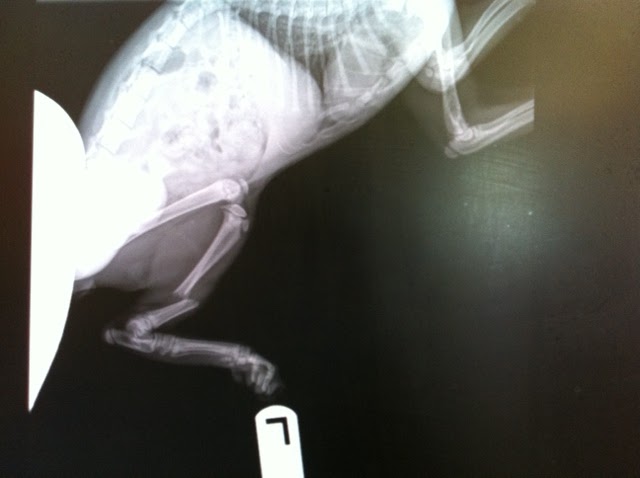
Broken tibia.
The radiograph should be flipped the other way,
(to all of you vets out there, I know it bugs the crap out of me too,
for the rest of you that don't what I'm talking about, forget it).
I'm just elated that there is a leaded glove in there. I usually have to crop out the bare hands...


What  is with these kittens with broken legs??

No more, please!

Kit, the three month old kitten, ready for surgery.

In the real world of specialty surgery (AKA where the 'ideal standard of care' exists, (in a land far, far away paved with gold and inhabited by people with Gucci shoes, Mercedes Benzs, and waiting rooms with organized magazine racks. I have never been there, I just hear that it exists), this surgery would have cost upwards of $1,000. Here at JVC it was done out of our donation account (THANK-YOU to all who help keep us able to help others!).


The initial approach to the fracture.


Yikes!
These bones are half the size of your little finger bone, (if you have a small little finger).


Four hands on one kitten to fix one tiny splintered bone.


Getting the bones lined up is half the battle. Now all we have to do is thread two tiny bending wires through the marrow cavity, (No, this is not always an easy task). The smaller the bone, the smaller the pin, and the more it wants to bend as you try to push it into and through the bone. Never mind trying to keep the top fragment in-line with the bottom fragment as you push a bending pin.


Presto! Fixed!

Awesome!


A cat with chronic anal sac problems. At today's exam the right anal sac is full of what feels like asphalt. It cannot be expressed, and it is bothersome to this kitty. Painful to touch and will only resolve by one of two methods;
1. Surgical removal,
2. Abscess and rupture.


The spoils of the surgery. Both anal sacs removed. No more butt pain for this kitty!


This is Lilly. She came in for a re-check because her skin was not getting better on the anti-histamine and steroid I put her on a few days ago. Her story is coming soon, its a good one!


Pogo came in for his two week re-check. He is walking almost perfectly. Driving his foster mom a little nuts (she's not used to terriers). He is still looking for a home. Please pass this along if you know anyone.


OH!, this is another great story!

This is Dallas, and his huge eyelid tumor. Story to follow shortly. (Boy, I am putting myself under some pressure and scrutiny now). Feel free to remind me, if I don't follow through.


Little Hunter, growing like the corn around here.
Everyday needs to have a puppy visit incorporated to keep us smiling.


My dear friend, mentor, and genius surgeon, Dr. Lanz.

Thanks for all of the amazing work, laughs, and help!
See you next year!
If you have any questions about pet care, veterinary medicine, surgery, or anything pet, you can find me, and Dr. Lanz at Pawbly.com.

Thursday, August 15, 2013

The Hardest Days are Not The Days to Wish Away

Sometimes this little piece of space is not the educational prose that I intended it to be.

Sometimes it is just a little piece of my day, a small snapshot amongst a whirlwind of crazy busy multi-tasking and demands.

Today was a day filled with surgeries; teaching, learning, and offering services to clients for rock bottom deals in an effort to help a pet, teach our staff, and be able to offer more services for our future clients and patients. It is a day we schedule yearly. I love the thrill of the fast pace, the challenging tutorials and the belief that was happens under this small humble roof is life-changing, inspiring, and unparalleled. I firmly believe this.

But today between the chaos and the surgical skills we challenged and honed, I stopped for a brief moment to spend the last few moments of a dear patient I have seen almost weekly for the last three years. It was a very sad goodbye to a very dear long time friend.

When you see a patient consistently and persistently for years you get attached. Attached to them, their evolving changing diseases, and their parents. Lucky suffered from terrible ears and skin for the last three years. It was a never ending battle of changing medicines, protocols, and swapping a new treatment for an old one that had failed to deliver.

"The enemy of my enemy is my friend," and Lucky's endless illnesses, diseases, and constant supervision bound us all to a common goal.


Lucky never suffered from a rare or untreatable disease. Her story won't re-write any veterinary text books, nor will her time with me redefine how I practice medicine, but her life will always be one that I remember vividly and explicitly.

Her daily life was a series of scheduled well rehearsed movements set in perfect synchrony to deliver a litany of drugs, washings, cleanings, and feedings. Her daily requirements were more complicated than most humans in an ICU.

There was never a hesitation to comply, nor was there ever a hint of doubt that she was worth the time and effort required.

We should all be so Lucky.


Saying goodbye was not easy. It was necessary and it was time, but often our blind devotion leads us to being unable to recognize the end. That sheer unyielding devotion to push fate beyond its limits, leaves us feeling as if there is no end, and there is no giving up.

I know that in many cases I have to be the advocate for my patient. That I have to remove my personal feelings, my stubborn tenacity and say that there is nothing more we can do. It is not what people want to hear. They want some ray or glimmer of hope, and I feel obligated to always try to provide this. I am not God, it is not my place to admonish defeat, and the greatest power any of us have is to provide hope.

But, I also owe my friends, my patients, and my failing optimism, honesty.

Lucky was tired, she was unhappy, and she was beyond any last ditch efforts to reverse her present state. It was time to let her go. And so her parents did.

And with that goodbye, in the midst of my weltering waves, like the eye of the storm, my day had a few moments of peace, and clarity, and purpose.

There is never a good-bye to good friends, and
how Lucky we are to have found each other.

Monday, August 12, 2013

The Pearl in the Gut. AKA Swallowing Rocks, And Fishing To Extract Them


This is Titus. He is a rambunctious, energetic, animated, effervescent 18 month of Doberman.

He is the puppy of an avid life-long Doberman breeder who has come to realize that "a puppy is an awful big handful when your life is slowing down and you are well into the comforts of retirement." He is loved, but he is too much to handle for his mom. It was a hard pill to swallow and an even harder confession to make. But, her ability to care for him, hold him safely and confidently at a walk (or lunge), and her ability to meet all of his mental and physical needs.

I give her kudos and credit. It is often a difficult thing for people to admit, but it is imperative to be making tough decisions that are in the best interest of your pet. Be honest, be open, and be kind. If you can follow these all things are possible and in the end you can live with the decisions that are made.

When titus came to visit it was because he had developed a very bad habit. He was eating rocks. When it was reported to me I asked "Why? Why do you think that he is eating rocks?"

"Well, because he is a Dobe," she replied.

"I don't know what that means?" I answered.

"Because they are all stupid. They do stupid things."

"I just don't eat things without a reason." I said it and I stand by it. I always believe there is a reason.

When I find a pet doing an odd, nonsensical thing I start to dig. I encourage my clients to start digging and we don't stop digging until we figure out the reason, we solve the problem, and we are prepared for a recurrence. That's our duty as guardians.

Things to investigate;

  1. Diet
  2. Intestinal fecal check
  3. Boredom/behavior/anxiety/fear, etc
  4. Check a full blood work panel and urinalysis (including thyroid).
When Titus arrived he was not his normal hyper-crazed self. He was a bit subdued, and he had been vomiting off and on for a few days. He was dehydrated, and his belly was sore to the touch.

We took an x-ray and there is was. a big honkin' stone stuck dead smack in the middle of his intestines.


OK, here is the big dilemma when we are humming and hawing over whether or not it is time to go in and explore a belly. 

If you have a dog that is vomiting every time they eat, or vomiting everything they eat, or stops producing feces it is my vote to go in and take a look. I have regretted waiting and not going in far more often than I have regretted going in. Keep an excellent history, monitor very closely and use x-rays and ultrasound and most importantly your own gut feeling when deciding whether or not to do an exploratory surgery.

I have gone into dogs bellies and expected to find an obstruction and instead found only a quiet not moving gut. But even in those cases after massaging the intestines, exploring every inch of it, those dogs have woken up and felt better. 


I spoke to his mom about my concerns. That stone was too big to make it through the intestines. I was pretty sure of that. She wanted to wait overnight, and if his vomiting continued she would be back in the morning.

The next morning we were met by an early call from a very concerned mom. Titus wasn't eating and he was vomiting persistently. He arrived a few minutes later. A repeat x-ray showed the same big stone in the same place.


Getting prepped for surgery.


The stone is next to my left hand, and the intestines beside my right hand is significantly bruised.
This is where the stone was stuck, and the gut bruised and then the stone moved a little bit further down stream.
Repeated bruising to the gut leads to scarring, inability to function, perforation and even death.


The stone has been removed and the intestine is surgically closed,
being very careful to not spill any intestinal contents and
suturing very carefully so that the incision doesn't open.
The gut is a very strong muscular tube. It has to be able to withstand liquid moving through it,
and lots of motion.
Dehiscence (opening of the incision is a real concern).


An omental wrap is placed to help keep the incision closed and aid in healing.


After a leak test (move ingesta through the area of the intestines where the incision was made another look through the abdomen is done, and lastly we flush the belly with warm saline to remove any ingesta that may have spilled or leaked.


Closing the abdomen.


In an exploratory surgery it is often required to make a large incision. In almost all cases the incision extends from the rib cage to the pelvis.


Titus's pearl.


Now all we have to do is figure out why he thinks he should eat stones and prevent him from doing it again. (AKA, now the real work begins).

If you have any questions or comments please leave them.

If you have any pet related questions you can reach me at Pawbly.

Baby Titus
On October 15, 2013 Titus was put down due to severe aggression and dominance issues. I was not present, and I could not participate. It was the decision of his family who feared that after biting three people he could not be trusted. I am sorry to all who were a part of this awful conclusion and deeply saddened by the sequence of events. Life just isn't fair and there are sometimes no reasons to try to accept the hand that life deals you.

Friday, August 9, 2013

Do You Believe In Second Chances?


Do you believe in second chances?

Do you give them? Do you wish for one, or two, or more for yourself?

What would you do if you could have a "do-over?"

I think about this. And as much as I would go back and do things differently inside I am glad I can't. It reminds me to not screw up the here and now. I would waste lots and lots of time if I knew I had a free pass to just do it over.

This is the story of Diamond. Her life is a three-peat of do-overs. And if I had to place a chip on the table I would bet the house on there being a four-peat.

Diamond was brought to our clinic about four months ago. She was a card on a carrier in a long list of cat carriers. It was a spay-and-neuter-athon day at the clinic. The sort of day where names where irrelevant and the goal was just to draw a line through the list in as short a time as possible.


I vaguely remember the first time I met her. A pure black young girl who only stood out because one of the handlers felt a small round ball under her skin behind her ear.

"Doc, what do you think this is?" she asked.

Half ignoring her I felt the bump her finger lay upon, "BB." I half consciously replied.

BB's are unfortunately not an uncommon finding. We live in the country and people are despicable sometimes.

"Hey, I feel another," the girl chirped again. This time the BB was on the other side of Diamonds face.

"Can we take an x-ray?" a whole cackle of volunteers asked in unison.

"Yes,,," I quietly replied. I was in surgery and I say yes to almost everything. It allows me to stay focused and quiets the storm for a few minutes.

There were seven small metal pellets strewn about Diamond's body. Left, right, front, back. She was a graffitied buckshot canvas. And a miracle to be standing before us.

Attempt Number 1;
Her spay began like every other spay. She arrived at my surgery table belly up, clipped, washed, and spread eagle machines providing her dreams with quiet calm oblivion.

Scalpel, cut, dissect, enter abdomen, scoop uterus, clamp left ovary, ligate, cut, follow back to uterus to other ovary.....umm,,,hello? other ovary?

There was no other ovary. Diamond was seemingly missing her right ovary. Her uterine horn led to a dead end of scarred, clumped unidentifiable, somewhat familiar mass of stuff that looked like it was at one point a loop of intestine, a kidney, and omentum.


I stop plucking for pieces of tissues that my hands recognize. This cat is a mess, she's going to blow my pace. I look for a volunteer, a volunteer who can make a decision.

"Close her up, and move on to the next."

Needle drivers, suture, thumb forceps, sew, sew, sew, close up the belly, make it look pretty and the lifeless body goes to the next station in the assembly line.

Four months pass, and a call is placed to the rescue.

"We adopted Diamond from you a few months ago, she has been acting like she is in pain, yelling, screaming, meowing, there is something wrong with her."

They relay the message to me. "Crap, I guess that right ovary is still in there?"

Tell them to bring her back we will go in and take a look for it.

Attempt Number 2;
Diamond arrived a few days later. She had been out of heat for as many days. We re-scheduled her surgery. I explained that I was already going fishing for a needle in a haystack, the needle is a lot bigger if she is in heat. So we will wait for her needle to amplify.

Attempt Number 3;
Diamond sat in the surgery cage waiting for her number to be called. When it was her time on deck we opened her cage and the devil erupted out at us.

Talk about hormonal, this girl was ANGRY! I now knew why her parents were a little worried about her erratic behavior.

Once again Diamond lay on the stainless steel table. Once again I went on a fishing expedition in her belly.

There it was again a conglomeration of coagulated curiosity. All jumbled and jelled together.

I picked, parted, fumbled,,,, I opened the incision larger, I pulled out anything not tied to something else..

Finally there it was a tiny cystic bubbly thing about half the size of a pencil eraser buried in tissue that it shouldn't be. All nestled by itself in the bottom of an intricate network of tissue.

How had she been shot so many times and not been injured? One of those BB's had penetrated her abdomen, severed the ovary from its stem and caused it to adhere to everything else surrounding it.

As I held her presumed ovary in my fingertips I debated. How could she be so lucky to survive gunfire, and me be facing not being able to fix her?

"Crap," of course it was a Friday, we close early, and this mess needed about three hours more than I had to dedicate to it.


I gloved out of surgery and placed a call to her parents. I was worried about jeopardizing the glued pieces of colon, intestines, pancreas and omentum.

We agreed that the difficulty of Diamonds surgery wasn't worth the cost of losing her. They felt that as long as she "wasn't in pain they could live with the hormonal outbursts."

I closed her up again.


A few days later Diamond was back at the office.

Her family was concerned about her incision. I was losing sleep about her attitude.

I had spent the last days thinking that I had made a mistake, I should have spent the three hours in surgery. I should have helped make her life better, her house quieter, and her family love her more?

Oh, the guilt.


I called my friend to ask his advice.

I had done the surgery for free, both times. He told me I had done enough. It was their decision now. I should refer her surgery, I should walk away with a light heart.

I wasn't and I couldn't.


"If she was my cat i would remove the ovary." I said to her family.

"But? Isn't it risky?" they worriedly replied.

"Well, it might be, but if you don't she will be going into heat, and I am worried about your sanity with a screaming cat who hisses and might even lash out at you, and you have small children,,," My mind had been racing with every sort of worst case scenario. I was afraid that Diamond would be back on the street, or abandoned at the shelter. I had seen her, she was vicious.

Her mom paused. "No, we love her, she is a part of our family. We will never abandon her, and we love her just the way she is."

I can be found @FreePetAdvice, @pawbly, or if you have any pet questions you can ask away Pawbly. Please feel free to comment. And as always, Thank You for reading.

Thursday, August 8, 2013

A Repeat Offender. The Ear Hematoma


How miserable does this poor kitty look? When I entered the exam room I was met by this uncomfortable face. She was a quick easy diagnosis.

I skimmed through her medical record.

  • indoor cat
  • spayed
  • friendly
  • up to date on all veterinary care
  • new patient to our clinic
  • previous history of ear hematomas


Her ear is full of fluid and looks like a pillow. The fluid in the ears is making them hang. Instead of having normal looking ear flaps that stand up (erect ears) she looks like a Scottish Fold that just spent ten rounds in the boxing ring.

The veterinary terminology for this condition is aural hematoma. A hematoma is a collection of blood that is stuck in a pocket. It is like a bruise.

Hematomas happen due to trauma. Either self induced trauma like scratching your ears, or shaking your head so violently that the blood vessels in your ear rupture. The blood then pools between the front and back skin and around the thin piece of cartilage in the ear flap. The pool of blood resembles a pillow. The problem with a hematoma in your ear is that the blood has no place to go. The hematoma gets stuck. Without some way to provide drainage for the hematoma it will just sit there. Over time the blood coagulates, solidifies and causes the ear flap to scar and distort. In people (boxers in particular) we call it 'cauliflower ear." In pets the ear flap contracts, shrivels, and calcifies. Pets with chronic recurrent ear hematomas develop scrunched deformed ear flaps that close off the ear canal, precluding air circulation, and trap dirt, debris, moisture, and other gook inside.


I see ear hematomas primarily for the following reasons;

Dogs;

  1. Ear infections.
  2. Allergies.
  3. Fleas.
  4. Scabies.
  5. Playing or rough housing with another pet and they either run into some hard object, or the other dog is playing/biting on the ears.


Cats;

  1. Allergies.
  2. Fleas.
  3. Ear mites.
Although if it is a wild/feral cat the above is reversed.

When this kitty came to see me her dad knew what the diagnosis was and he already knew what the treatment plan would include. He had been down this road before. 

Before I could say anything he said, "So, is it OK if I just leave her here until you can do her surgery?"

Many of us vets are happy to have a client that already understands and accepts the diagnosis and treatment plan, it saves us lots of talking and explaining.

But this vet likes to talk. More accurately I like to educate.

"Well, I think that we do need to drain this ear, but I wonder how this happened? Can we talk about that?"


He looked at me quizzically?

"Umm?...Well?...I don't know how it happened?" He replied hesitantly.

We began a discussion of her history, her diet, her in home care, her previous veterinary care and her environment. Initially her dad seemed a bit put off by the barrage of questions. He was here to drop her off and get on with the rest of his day.

We discussed the cat list above. Why would an inside, parasite free, only pet in the household have bilateral ear hematomas? Why would she get them again after a year?

He started to see the reason for my questions and the Q & A turned into a round table discussion.

Isn't it far better to not only treat this episode, BUT also prevent the next one?

Seeing your vet for a problem shouldn't be just about getting a diagnosis and a treatment plan, BUT also preventing?

Next time you are in your vets office ask them about preventative care, it's part of the healthcare plan.

Here is an article on aural hematomas, but I would not recommend treating this at home, and I do not inject steroids into ears.

If you have any questions about this or any other pet care items you can ask me, or any of the other Advisors at Pawbly.com, or @pawbly.

Other blogs on this subject: Aural Hematomas. The veterinarians guide to treating. Dog version.