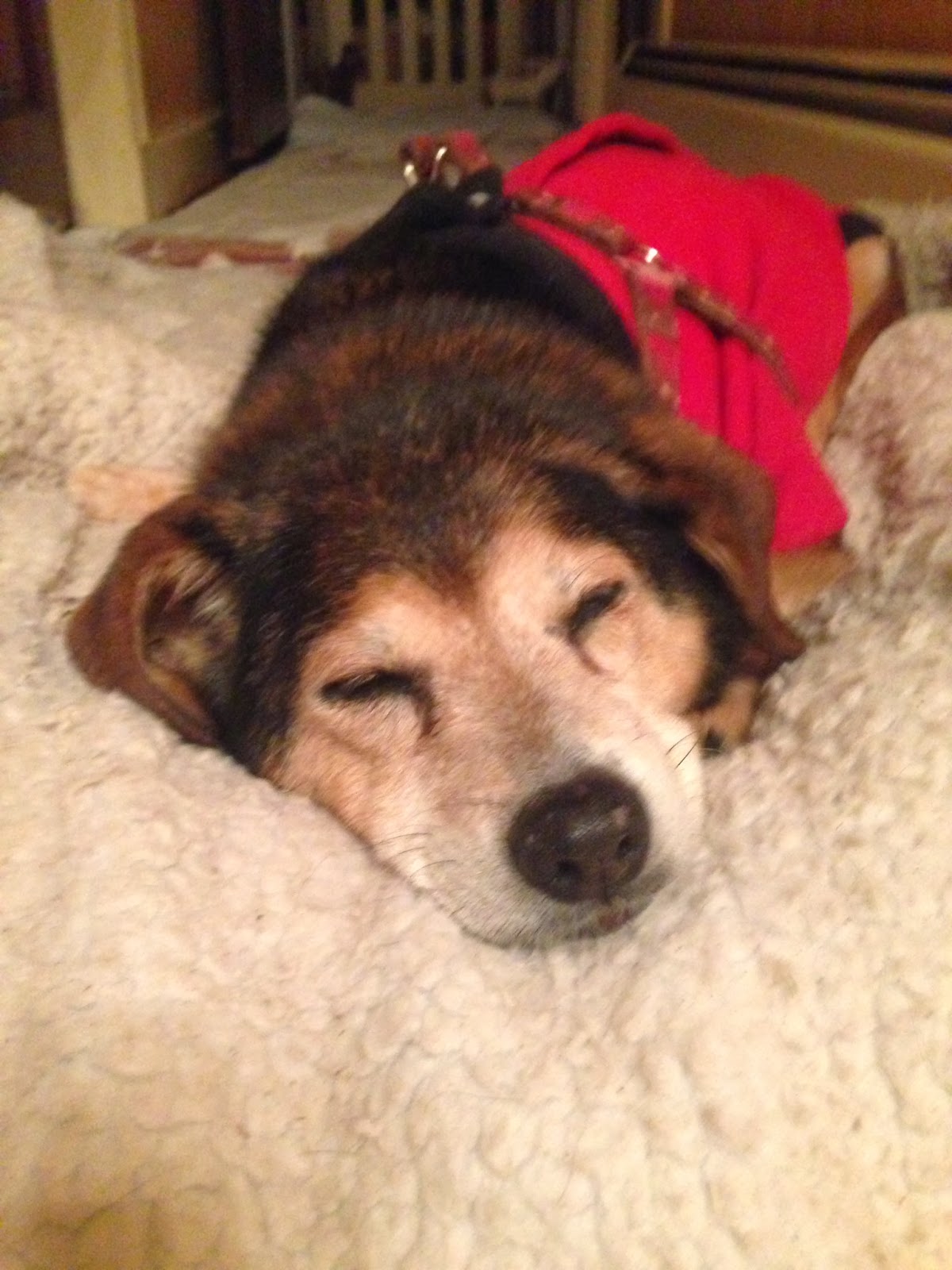
Showing posts with label cognitive dysfunction. Show all posts

Monday, March 3, 2014

The Excorcism

 And so the story goes..

The seemingly never ending saga of an old dog with a fierce determination to persevere and a mom who can't say goodbye..

Savannah has gotten a new set of high performance all terrain shoes. They significantly help her grip on slippery surfaces. My goal is to keep her ambulatory for as long (or forever) as possible. I only put them on after she is unable to keep her feet underneath her. Any crutch I give her will likely make her more reliant and my hope is that she will only need small short periods of assistance as she retains, or hopefully, re-builds her muscle mass.


When two shoes are enough to keep her moving she gets two. When she needs four, she gets four, but I would rather move her to a place where she doesn't need any and not take any steps backwards while we try to keep moving forward.


We take long walks (at least twice a day) over terrain that is varied and includes uphills, grass, pavement, downhills, and navigating through the twists and turns of the yard. She also benefits greatly from the change in scenery, stimuli of being outside and the regimen of daily exercise to help keep her fit and on a schedule of wake and sleep.

Meanwhile, the rest of the family waits with me..and gets up with me,,,and loves the many multiple home cooked meals that get refused by Savannah.

The winter of 2013-2014 has been a long hard cold white winter. It has been tough on all of us. Keeping her warm and walking in spite of endless sheets of ice, tunnels that need to be re-dug every few days, and wind chills which make me pause and re-think every outside exercise walk. I have pushed her thin weak body to the point of exhaustion and still she wakes up each morning to face another day. The silver lining to these stay at home snow days has been more time with her. I am grateful for each moment of each day.

Each aged ill patient of mine has passed while I have been caring for, treating, and trying to maintain the course with Savannah. We have shared our sad days, our attempts to resolve and ease suffering, and still she has outlived, outlasted, and outshined even my most optimistic hopes.

In an effort to help someone else somewhere else with her condition here is what we are doing now;

  1. Melatonin, at bedtime. 3-6 mg (dogs over 30 pounds are at the higher end. But I have been offering more lately). She is about 12 pounds.
  2. Tramadol, 1/4 to 1/2 of a 50 mg tablet to get her to rest at night if it looks like she is winding up and not settling down.
  3. Amitriptyline, a tricyclic antidepressant that is used to treat anxiety and other behavioral disorders. Possible side effects are dry mouth, raid heart rate, and sedation. (I will hope that I don't see the first two). Long term concerns are for the heart.
  4. Long walks twice a day. (Mother Nature could you give me a break for a little while?)
  5. Feed! Feed! Feed..I am almost embarrassed to confess her current diet. Yesterday, for example, she ate two slices of cheese pizza (my husband loves being sent to pick up pizza for the dog. He helps himself to wings and a pepperoni pie while is he there), 2 Beggin Strips, and a pack of moist and meaty. Now, mind you, this is after she turned her nose up to; chicken, rice, soup, dry and wet cat food, and canned dog food.. Argh, I'm trying.
  6. Free access to fresh water. Although yesterday I found her asleep with her back foot completely submerged in it. And one morning I awoke to some weird whistling noise to find her nose almost submerged while she slept.
  7. I keep her bundled up and warm. She has lost quite a bit of muscle mass and chills easily. Her room is kept at 70 degrees and I blanket her at night.
  8. She is never alone. She is either at work with me (Thank You!! to my wonderful staff!!), at my mom's house, with my pet sitter, or with me..boy, it puts a strain on traveling.
  9. I keep her with me as much as possible. Mostly, because I fear her time is short so I am going to squeeze every last second out of her.

My biggest challenge has been keeping her calm and stable. After a few weeks of doing well she starts to become more and more anxious over littler and littler things. More pacing, getting stuck in seemingly impossible places to get stuck in, circling..etc.. It is grueling to watch, witness, and ignore her pleas at all hours of the night. It is exhausting and excruciating. It has caused me on three occasions to debate putting her to sleep. After two or three nights of this I break. I question her quality of life and what I am doing about it. Twice I have given her acepromazine (a potent sedative to relieve her anxiety and allow her to sleep). Both times I have given her a tiny fraction of the dose, and both times she has had a seizure and the wind knocked out of her. She slept for almost a whole day afterward, and had a very tough time recovering after. I was happy to see her sleep and completely guilt ridden to see it hit her so hard. The third time I sedated her was last Thursday evening at 2 am, after she was up all night for two nights in a row, and getting worse. I gave her a tiny amount of morphine subq. It should have taken her about 15 minutes to relax and get sleepy, but, within a minutes she was vomiting violently and passed out. I lay in bed all night thinking that she was not going to be with me in the morning, and feeling a mixed bag of relief that she was peaceful and grief that she was gone.

Twenty-one hours later she woke up, calm, quiet, relaxed and sluggish.

These three drug induced comas were my last resort. Every time I looked at her at these moments I knew I had to do something to give her some respite from her delusional horrors. Each time two days later she emerged herself again. And I was once again grateful to beat the boogie man back to his sideline.

My hope is that she can die an old lady of old dog exhaustion..not a frantic maniacal schizophrene. Its a dual, a long marathon dual between me, the chemist with a bag full of drugs, and that elusive ghost who lives in her head awaiting the exorcism.

For those of you who question my motives, I say, "I am trying every single option to give Savannah a life that she is happy and content in. If I can keep her ambulatory and happy I will try anything and everything. It is my obligation to her and to my patients."

Magpie, on the hunt,,for anything.

Jekyll watches over the kingdom.

Charlie, always playing second fiddle, and too proud to admit it.


The welcoming committee at the clinic.

A big bonus of the job, I get to spend my days with dogs and cats!
And if they will let me, I get to be their biggest fan for as long as they tolerate me.
(Me exhausted after two nights of no sleep with Savannah)

My favorite Jekyll pose.

The pet sitter arrives to take a shift.


And just for smiles....the ever expressive Jekyll, and his long slow wake up and face the world yawn...


May we all be so relaxed and happy to face each day!

If you have a pet question, experience to share, or want to meet other pet enthusiasts you can find us on Pawbly.com. You can find me at the clinic Jarrettsville Vet, or on Twitter @FreePetAdvice, or catching a cat nap in the corner of my house while Savannah takes one of hers...

Related articles to Savannah's condition can be found at;


Monday, December 16, 2013

Surviving the Delusions


In typical Type A veterinary fashion I am becoming a bit obsessed with Savannah's disease. It has consumed every second of my life to the point of not being able to leave her alone, not sleeping, and every point and both ends of the spectrum. Guilt, desperation, and adoration. Every single degree of the pendulum. 

Like all of my demons I try to slay them by learning studying them. Perhaps there is some Achilles heel I can identify? Perhaps I can alter fate? Bend, twist, contort some facet of this disease? Perhaps I can break through and find Savannah lost in a field of daisy's, just sitting there, face in the sun, eyes squinted almost shut, just waiting for me to pick her up and carry her home? She is trapped in a body that still functions in all of the ways that it should, but lost in a fog I can't seem to lift for longer than a few hours. 


I read an article in the latest Clinician's Brief aptly entitled "Cognitive Dysfunction, How I treat it." I read it hoping for another kernel of information that might lead me to finding Savannah's salvation. No luck. It was a re-iteration of what I have already tried, am trying, have given up on, etc..

There were a few pearls that I haven't spoken about that might help others.

Cognitive Dysfunction Syndrome (CDS), Dr. Margaret Gruen states is much like Alzheimer's in people. I would agree. Savannah has some really good days, or parts of days, and some painfully anxiety ridden confusing and frustrating moments. She is irritated and stubbornly determined to pace, get stuck in ridiculous places, and then cry. She is a toddler stuck in delirium. By Dr Greun's statistics CDS is very prevalent and affects 28% of dogs 11 to 12 years old, and 68% of dogs 16 to 17 years old. In cats it is often a bit harder to identify but is estimated to affect over 50% of cats over 15 years old.

In her article she discusses many of the treatments I have previously mentioned. She makes a very valid point that veterinarians need to do a better job screening and inquiring about the signs associated with CDS. Before Savannah I admit I did not engage my clients in talking about their aging pets mental status. Sure, I would discuss the disease when my client brought up "dementia" or "aging" but I was not proactive like I am with a puppy.

A new puppy visit has a whole list of questions that I ask parents. I talk about vaccines, housebreaking, training, diet, behavior, breed specific concerns, etc. Why haven't I been doing this with my senior patients? I think it is because I took for granted that their parents would mention a problem if there was one. But if it took me all of those months to see it in my own dog how could I expect my clients to identify the slow progressive insidious nature of this wasting disease? OH, the gross neglect that is the ignorance of not living with a disease yourself! 

Dr Gruen's advice on "How She Treats CDS" are as follows;
  1. Treat and manage comorbid medical conditions.
  2. Provide environment and behavior modification.
  3. Provide nutritional support.
  4. Provide pharmacologic support.
My interpretation and practice with my "Real-Life" is;
  1. Savannah at 18 years old is struggling with renal impairment, liver impairment and delusional emotional instability. Managing her comorbidity conditions is, like everything else we are doing, a juggling act. She is on 8 medications, some of them twice a day. The renal and liver diet are not enticing enough for her to even contemplate licking. Diets to manage these are in direct contraindication with Point number 3. Now, that is not to say that you shouldn't try to treat and manage the other diseases that your pet has. As I said in the last blog, you have to know your patient and you have to be ready to be unconventional AND realistic. Your pet may not tolerate the menu of a check list of what they are supposed to be getting/doing. 
  2. Environmental and behavior modification. OK, this is a good point to talk about. A schedule is imperative to try to keep their sleep/wake cycle in some sort of balance. All pets need mental stimuli and as your pet ages and withdraws from the outside world it is important to keep them interested and challenged. Boredom is the root of many behavior issues. When Savannah gets pacing and worked up I dress us both for the winter outside our door and go for a walk. It is the fastest way to get her back in her own head and relaxed. 
  3. Nutritional support. These days it is "try to stay on a good healthy diet that wont exacerbate the kidney or liver, so we start with offering the "best" option and then progressively work down the options to "whatever works." Tonight it was eggs, sausage, and cheez nips.  
  4. Drugs. Oh, the litany of drugs. The good news is that after about two months she will almost take them without snarling like a mountain lion. She's still the same feisty independent uncooperative beagle that she has always been in this department!


Here's what I want to add today. These articles, however helpful, from the experts need to have some "real-people" really living with these patients to put it all in perspective. Now, I write prolifically, and certainly I don't have personal experience with all of the subjects of my blog, BUT, with every article, and paper, and drug sheet that I have read on CDS here is what's missing. 

CDS pets will drive you to the brink. It is the crying baby that won't sleep, the old person who is lost in their own private self imprisoned hell.They don't know who you are, and they don't want you to try to help. It is a frustrating, exhausting, sometimes futile, powerless, ghost you chase. There have been endless nights, days of head banging, circling, pitiful existence where I contemplated just ending the mania. 

There were times where I cried in despair, unable to help, tired of endless loads of soiled laundry. Fights with my husband about "why I was putting us both (me and Savannah, he's not giving butt baths to anyone), through this?" And, my personal favorite, "Don't you think she's suffering." (Thanks, honey. Like, I need more guilt?) There have been nights where I have trudged to bed at 2 am to getup again at 2:30 am and said to her, "If you aren't better by tomorrow I'm giving up." 

Someone needs to tell people that it is "OK to feel these things."

And your vet needs to give you someway to navigate through these turbulent murky waters. Have a disaster plan. This disease warrants it. You will need it, and yes, whether or not you want to admit it, you will use it.

Emergency plan. There were, and will be nights that I pull out the acepromazine, (which I should add knocks her out for a day. It reduces her to a snoring puddle. And awakens her a day later unable to identify her legs or any knowledge of having ever used them. Be very sparing with the ace in old dogs), because if I don't sedate her I'm going to neglectfully walk away from her, or think about doing something I will die over guilt about. I used tramadol on her before, I might use it again, if the ace is too harsh on her. Either way I have something to reduce her anxiety so she can rest.


Hospice. It is a godsend to many people facing the loss of a loved one. Ask your vet for someone to help you on those long dark nights. If there are friends to lean on, ask them to help. 

My mom offers to babysit and tells me often, "I don't sleep when I have Savannah, but you need a break, and I am happy to help you both." She is so right. 

I am seriously thinking about how to add this service to my clinic. The support of others is the only way I have been able to walk away from my head banging, crying, head pressing, disoriented, anxious, afraid, unable to console dog. I understand why exhausted mothers pick up their babies and shake them until they stop. I have stood over the dog I have loved for 18 years and hated her for driving me as insane as she is. We are all humans, we can all break, and we all need a support. 

To not mention this, to send our clients out without a disaster plan and a net to fall in is setting them up for failure and guilt. As is CDS doesn't steal enough?

Dr. Gruens "How I Treat Cognitive Dysfunction," in the December 2013 Clinicians Brief

If you have any questions about this or any other pet related item you can ask me on Pawbly (always free to ask or answer a question). Or find me on Twitter @FreePetAdvice.


Wednesday, December 11, 2013

Savannah's Cognitive Dysfunction Diary


It has been a very good week.

Savannah is sleeping, for the most part, through the night. For the last 8 months this has been an elusive ghost. Savannah is my 18 year old beagle-mix. It took me, her devoted mom, and determined veterinarian months to correctly diagnose her with cognitive dysfunction.

This has caused to her days and nights to be upside down. She would sleep soundly for most of the day, then at 10 pm she would pace, cry, circle, and be restless to the point of anxiety attacks. Sleep is a precious commodity when in short supply. After four years in vet school been I thought I could go back to those 3 hour night sleeps?..Oh, I have learned, I cannot. 

It is impossible for man or beast to function normally without sleep. 

Step one was restoring  sleep. Enter melatonin. 

Melatonin is made by the pineal gland which is located in the brain. It helps to regulate our sleep/wake cycles. We hear about it with people who travel across time zones and get their sleep cycle out of whack. 

Melatonin is available over the counter and dosed as 3 mg twice a day if under 20 pounds, and 6 mg twice a day if over 20 pounds. I started at once a day but I am increasing to twice a day. Savannah has always, and remains, a bear to pill. 

The production of melatonin is influenced by your internal clock, the amount of light in the day, and age. Without an adequate amount, or the correct amounts at the correct times of day your sleep cycle can be affected. Some people use melatonin supplements because they suffer from a "seasonal affective disorder (SAD), or winter depression, and even headaches.

There are some reports that melatonin has anti-oxidant properties, can increase platelet production, and slow down the aging process and even cancer.

Like every drug there are possible side effects; these can include, sleepiness, changes in blood pressure, a decreased body temperature, and feeling groggy. 

I tried anti-anxiety pills. They didn't help her sleep. They didn't really help anything. But I will add there are lots of anti-anxiety options to try. We discontinued it because I didn't want to give it long term and not be able to use tramadol. Sometimes we have to pick our poisons and be aware of the long term consequences to our immediate wants/needs.


The melatonin helped with the sleep. But Savannah's root problem, the cause of restlessness, confusion, circling, and anxiety, is, I believe, her cognitive dysfunction. For that I added;

Selegiline. This drug is primarily marketed for Parkinson's disease. It is prescribed in dogs for anxiety disorders and cognitive dysfunction. For dogs and cats the recommended doses are 0.5-1 mg/kg orally every 24 hours, but it can be increased to 2 mg/kg daily. Possible Side Effects, per WebMD


Neutricks, (apoaequorin) by Quincy Animal Health. It is sold as a supplement for a "healthy brain, mental agility, and cognitive focus." It works by supplementing the "calcium-binding proteins that protect brain cells." These proteins are naturally lost in the aging process. 

Directions for use:
Dogs under 40 lb: 1 tablet daily
Dogs 41-80 lb: 2 tablets daily
Dogs over 80 lb: 3 tablets daily
Best dosed in the morning.
Supplement Facts
Serving Size: 1 5 mg tablet
Servings per container: 60

www.neutricks.com It is available from the manufacturer and many retailers. 


 SAM-e (S-adenosylmethionine) is found naturally in the cells of plants, and animals. W produce less and less of it as we age. There have been many studies done to support that it has many beneficial uses. These include emotional well-being, pain relief associated with osteoarthritis, and aids in the restorative properties in patients with liver disease. It is a supplement and available over the counter.

Tramadol. This very commonly used veterinary drug has helped her immensely to sleep through the night. In veterinary medicine this opioid-like drug is used as an adjuvant, or stand alone, analgesic. It can also be combined with our frequently used NSAID's. Unfortunately, it should not be combined with selegiline (or otjher MAO inhibitors), SAM-e (concurrent use could cause additive serotonergic effects), or TCA's. After a week of sleeping I am switching back to an anti-anxiety drug (alprazolam or amitriptyline). If these don't work I may add acepromazine. I tried a short course of the tramadol because she doesn't tolerate NSAID's at all. at even a tiny dose she had vomiting and diarrhea. And since I am not convinced that her problem has a pain component to it, I don't need to add a problem to rule out the possibility of another. After a week of using tramadol I don't think that she has pain, but she is sleeping, and she is a whole lot less anxious.


Proviable. I give this daily to help replace her good gut flora. The anxiety and ever changing diet has stressed her gi tract to the point of chronic soft stools. I expect she will be on this indefinitely.

Acupuncture is also being given weekly. I do think it is helping.

My point with Savannah's treatment plan is that it is an ever changing, and sometimes unorthodox one. My goal is to continue to provide her with a good quality of life, keep her eating, comfortable, and relaxed.

This weeks victories have been getting her back to sleeping through the night. She got to feel snow again on her nose, she isn't pacing or circling (I think this is directly attributed to her decrease in anxiety and being rested), and she is eating.

In the eating department; I am getting fat, she is getting pickier. I feel like the stay at home mom who eats every batch of leftovers. I am creating at least three options with every meal. Chicken (preferably fried), ham, tuna, and the big hit of the week pizza! is usually gobbled up. But I have also been offering crackers, rolls, and hamburger.

She is becoming more and more poyuric/polydipsic. Likely, secondary to the higher salt diet, increased exercise (she is loving walking around the house and due to the inclement weather the long walks outside are waning. But, it is also the progression of kidney and liver impairment. I will continue to monitor blood and urine every few months.

I will keep you all posted on the twists and turns of my new quest to provide good options to my failing pup.

If you have any pet related questions you can find me at Pawbly, and Twitter @FreePetAdvice.

For related links about Savannah's story see;

Living and Losing the Last Moments with Your Terminal Dog

Another Trick Up Her Sleeve

The Tiniest Steps and the Biggest Hurdles

Savannah, Almost Hospice Care

Caring for Your Older Dog

Savannah's Story

Wednesday, November 20, 2013

Living and losing the last moments with your terminal dog.


My days are measured in tiny baby steps. Savannah, my beagle mix is 18 years old, and she is slowing down, losing her marbles, and challenging my ability to understand what she needs.

Together we are taking the smallest steps of backward and forward and keeping in mind the ever present looming fear of the slope that lies ahead and the finality of this journey.


She always hated baths.

Measuring Quality of Life;


Savannah is tired, I am tired. It is a battle between a ghost I cannot see who slips into the little cracks of a being that I used to know so well. She is still there in fleeting moments. I can pick her up, she buries her nose in my palm, breathes me in, and showers me with kisses. I am still here for her. For all of her little slips, for the days that grow darker and for the night that calls her.

Measuring quality of life is an intensely personal decision. As a veterinarian I try very hard to not suggest/suppose/presume, etc. what a family is seeing as they live with their ailing/failing pet. It is not my place, nor my ability, to tell you what your pets quality of life is..but I do try to remind clients that we are talking about their pets quality,,and not our unwillingness to be burdened. It is a fine line. If there isn't a pet parent to take care of a pet I can't offer anyone anything.

For me, and for the decisions that I make for Savannah, her quality of life is measured by the following checklist;

  1. Eating/drinking
  2. Peeing/Pooping...although butt baths are a daily routine,,she sort of slumps as she postures to poop.
  3. Wagging tail. A very primal act, but to me it means she is happy. 
  4. Sniffing. She is a beagle, this is primal too. If she is on grass or dirt, she is sniffing. Her brain needs to keep working.
  5. Sleeping..Well, we are working on this one. We both need to sleep.
  6. Happy. OK, this is a toughie. She has good and bad days. I am keeping her out of pain, and spending lots of time with her. 
Many vets use the old adage, "when the bad days out number the good ones it is time." I don't know if I believe this for myself, so I have a tough time using it as a measuring stick.

The decision to say goodbye is certainly one of the hardest moments in many peoples lives. I take it intensely seriously and I try to talk about their pets condition instead of providing benchmarks to use as a pros vs cons tally.


Home Life;


Her life is lived in the small safe places that she can't hurt herself in. The hallway, the front yard tie out, and the back yard at work. She is still happy to have the ground under her feet. To smell the footsteps of the critters that passed by, linger below, and elude my ability to perceive. She is still a beagle. Sniffing, eating, and wanting to live a pampered life.


Basic Hygiene:


But there are bathtubs, butt clean-ups, and pee pads. They are the inevitable landscape of every elderly hospice patient. It is a side of being a parent that not everyone chooses to take on. My husband thinks I am being to anthropomorphic. I remind him that he is entitled to his opinion, and that she is my responsibility, and that I will not choose to let her go because she is a burden.

And I remind him that she is still in there, a little harder to recognize, but still there. She is a different version of herself but she is eating, drinking, peeing, pooping, wagging, and walking. When one of those escapes her I may open up the floor to discussion with him about the next step that is right for her.


She has good days, and bad days, and I am watching her at every tiny step.

I can promise her, and only her, that I will say goodbye, and I will not let her suffer.

Joe dancing..with Charlie.
Can you see Savannah's tie out between the two trees?


Sleeping:


There have been nights where neither one of us get more than an hour or two of sleep at a time.

These almost broke me.

There is a reason that sleep deprivation is used as a form of torture. 

There were times where I got angry. Where I wanted to end it all right then and there. I get it. I understand my clients who give up here. I am not judging, nor am I trying to convince anyone that my way is the right, or the only way.

Sleep can come in waves of 10 hour stretches at 10 am and then be a fleeting uncapturable ghost at 10 pm to 6 am. I have battled back and forth about pinning a diagnosis on her.

My rule-outs;
  • She is not in pain.
  • She is not hungry, thirsty or in need of bathroom facilities. I know because I offer all of them at least twice.
  • She is losing it? Technically called cognitive dysfunction. (Sometimes I believe we are both losing it,,,no sleep does this to you).


Savannah has the best bed in the house..warm, comfy, and highly sought after by the puppies.

The run of nights that that stole any chance of sleep had to end. 

I tried exercising for hours to get her tired. We walked and walked and walked from 6 pm to 9 pm. And then she paced from 9 pm to 9:30, slept an hour and repeated this all night. I can't sleep through her anxiety.

So I tried the anti-anxiety medication alprazolam. It calmed her, but she still didn't sleep.


Ask Your Vet for Help;


So I tried Tramadol. BINGO! Tramadol is used primarily to treat pain. For Savannah it is providing her sleep. BUT! I am also considering adding back an anti-depressant, and/or a cognitive dysfunction drug. And both of these are contra-indicated if using tramadol.

So, here we are, sort of treading water, and sort of unsure which oar, or direction to go in next.

Other things to try; melatonin, and SAM-e, (both are over the counter more natural options), acupuncture, the b/d diet (Science Diet b=brain), 

I already keep her light on for her all night. This help immensely.


At 8:45 pm Savannah gets a half of a 50 mg pill, and she sleeps all night! It has been four glorious nights of sleeping from 10 pm to 6 am. She is happier, calmer, and I am able to function again.

Is she anxious? Is she suffering from dementia? Is it pain? Honestly, I am not sure. I am trying to address all of her needs and keep her eating, drinking, peeing and pooping as we navigate through these uncharted waters.


Eating:

I am offering anything and everything.

We are at the point where sustenance is more important than nutritional value.

Gone are the days of dry kibble and we have almost abandoned any hope of boring prescription food. We make two meals at every feeding. She likes variety, and her tastes change hourly. Lately the Honeycomb, spaghetti, and bread/rolls/buns is her preference. That's after she turns her nose up to chicken, ground beef, and hot dogs.


Maintaining Sanity;

 Yours and your pets. This is a hard one to access. It is a balancing act. Trying to keep track of your ability to make sound decisions for both yourself and your pet. How much time and attention do you have to give? How much does your pet need? They are hard questions to answer, fulfill, and follow through with. I have a very good friend who is taking care of her dog with chronic renal failure. She is sleeping only when her dog sleeps, losing full nights of uninterrupted sleep, and feeling like I am, that precious time is slipping away. We fear that day when we have to say goodbye, and yet we know its quickly approaching.


I told her that we need to move in together. And take shifts. It is a marvelous idea. We all need to band together and provide our own pet hospice support and care taking group.


Exercise;

Keeping the body active is keeping it healthy.

All pets will very quickly lose muscle mass if they are not using them. Encourage walks, make mental stimuli and environmental enrichment a priority. It is as important as eating.

Savannah paces. She has a head tilt so she circles. I can tell if she is pacing/circling because she is hungry, thirsty, needs to go to the bathroom, or is just bored. 

I don't discourage the pacing unless I think it is due to anxiety. And if it is anxiety related, I treat the anxiety.


My goal for her is the same it always has been.

I want her to be happy and healthy. The parameters around these evolve as her condition changes. 

The last few months with her have been some of the most memorable and rewarding. I wouldn't give up one single second of them.


 And I hope there are a few tiny little steps left.

Taken today.

And as a little footnote, I finally have a little dog that I can dress up. These two other pups of mine think they are farm dogs. They hate being dressed up, and they will promptly find a poop pile to embellish their new outfit with.

So everyday Savannah gets a new outfit. And everyday I remind her how beautiful she is!

UPDATE: December 6, 2013

Savannah is doing remarkably well. I have tried a few medications and had some limited success.
Here's whats working right now.

She is eating well. I offer at least three options three times a day. She seems to change her taste bud preference daily, so if something doesn't work today, it might work tomorrow. The options that I offer her are; canned dog food that varies between super expensive and junk food. Canned cat food, same guidelines as dog food. Dry cat food, and dry dog food. For some reason I can't explain she will eat a large T/D (Science Diet for dental disease), like a treat, but only about one a day. Ham, turkey, bologna, rotisserie chicken, hot dogs, ground beef. I have a wide assortment of these on hand and cook a little bit at a time. Tuna, rice, noodles (these are a big hit about every 4th day), cheese, peanut butter (always used to give pills, she is almost impossible! I have been bitten twice, which NEVER happens to me!). Soft rolls, she will always eat these, so I offer them whenever she hasn't eaten well. Cereal, Cheerios, and her personal favorite Honeycomb. But on days that she is especially picky I think outside the box and try junk food. The other night she ate white cheddar cheese crackers like they were the yummiest treat ever. When your pet turns their nose up at food and you are flirting with the cloaked death stalker, you offer anything and everything, try crackers and animal cookies, or something outside of their normal diet.

All of this food juggling has caused an increased amount of fecal output, and the consistency is no longer optimal in neither color nor firmness. The burden that an ever changing diet has had on her gi tract has caused gastro-intestinal pain in the form of cramping, gas distension and the discomfort that diarrhea causes. I know that when she is pacing and moaning at 9 pm after eating a good meal it is because her belly is bothering her. She, like most normal healthy pets, defecates about every 12-24 hours. The more meals I feed a day the more frequently she needs to defecate.


The nights were the big problem. She paced, cried, and would wake up for 45 minutes every 45 minutes. I solved this with 3 mg of melatonin, and tramadol. Tramadol is an opiate used primarily in veterinary medicine for pain. I have seen some pets get anxious on it, so always give it with a disclaimer to monitor closely. Tramadol lets Savannah sleep through the night. After 8 hours of rest she is less anxious, happier, calmer, more focused and clear headed. I should add that both of us are.

SAM-e is also given. It is helps to promote overall healthy brain function, and helps to balance emotions by acting as a mood stabilizer.

I also started her on selegiline. Used in human medicine for Parkinson's disease, dementia, and depression. I do believe it is helping her immensely.

She also get Neutricks, for cognitive dysfunction. These are large chewable tablets. She is not terribly fond of them, and because I have to pill her with all of the medications, the larger pills are significantly more difficult to give.


Last week we started acupuncture. After two treatments and the regimen listed above she is doing far better than she has in the last six months.


I looked at her this morning with my husband and said "Damn, Savannah-dog, you just might make it to summer!" She can bury her nose in the soft ground of 2014 and remind terra firma that there is still one mighty beagle left to reckon with.


Cognitive Dysfunction

'Joy Sessions' capture tender moments with owners and terminally ill pets.


If you have any pet related questions or comments, or hints to help an elderly dog live their life to its fullest please share them here, or you can find me at Pawbly.com, or on Twitter @FreePetAdvice.