Without a doubt the fear, apprehension and sense of dismay is thick and overwhelming for most clients dealing with IVDD (intervertebral disc disease). It is persistent and pervasive at the time of diagnosis and for the first days to weeks of recovery, regardless of whether the patient is recovering post-op or with conservative care. With each case there are always many questions, with many remaining unanswered left to the decision of time, circumstance, and luck. It is the equivalent of sudden decisions, life changing odds and prognoses, and fate in some unnamed higher power's hands who refuses to show their face to claim responsibility.
For these cases I try to reiterate and reinforce a few simple things;
1. Be Strong. Even if you don't know what to do or which end is up. Just stand, breathe, and believe you and your dog can get through this. We have wonderful tools to help heal, but giving up defeats them all.
2. Listen to your pet. They will look at you for help. They will wag. They will try. Take heed in them. They always decide, and they rarely give up.
3. The first 48 hours are hard. The first week challenging. But if you can get through the first week and if things have gotten easier with encouraging signs of interest in food, better understanding of bathroom needs, a routine with a friend who needs a little more TLC, then you can get through this.
4. Lean on someone as much as you feel you need to. Ideally this is your vet, your neurologist, your vets staff, your friend and fellow pet lover, or even those of us at Pawbly.com. Ask lots of questions.
Don't leave the vets office until you have been taught and are comfortable with the following;
1. How to pick up safely. I like one hand on the sternum and the other behind the back legs supporting the pelvis. Hold on don't squeeze and don't let a nervous pet make you nervous. If you are worried about wiggly use a towel to wrap like a burrito and be safe.
2. Know how to check for a full bladder. Learn how to palpate, express and monitor. Yes, it takes practice, and yes! you can do it. (I promise, you can).
3. Learn how to monitor defecation, and keep it soft so it can pass easily. Every client gets worked up about lack of poop. I am usually not too worried. Even after 3 or 4 days. If your dog has a disc protrusion/extrusion they have a very painful time even sitting. They usually aren't eating for a few days. If your pet isn't eating there won't be feces for days. Also, posturing to defecate is painful. They either won't try, or they can't push the feces out. Every IVDD dog is placed on wet food and given an oral laxative to keep the feces from becoming dried and impacted in the colon. Use the wet food and laxative to desired effect. The dose is never set in stone, it is used when, if and as much as needed.
4. Learn how to safely use a sling. I want you to keep encouraging and challenging your dog to be a dog. Walk, pee and poop. That's dog basics. Use a sling, place their feet correctly and encourage them to support their weight. As the foot righting improves encourage walking. Physical therapy is 10% putting them in the right spot (I like outside in the cut grass for footing and softness if there is a spill) and 90% giving them the opportunity to go back to the life they remember.
5. Obstacles happen. Don't get discouraged, stay active and have faith. Sometimes medicine comes down to faith, and it is always the better for it.
6. Cage rest is imperative. Not encouraged, but rather, required. If your pet is not used to being in a cage it is often very difficult to keep them calm. Calmness, quiet, rest and rebuilding of the broken damaged tissue is what is needed. How can you discourage movement if you cannot cage them? I will warn you that they will move faster, try to do more, push themselves to doing what they did before, and if allowed to make decisions, they will make bad ones. Keep them caged and know it is for the health, well-being, and sanctity of having a rest of their lives.

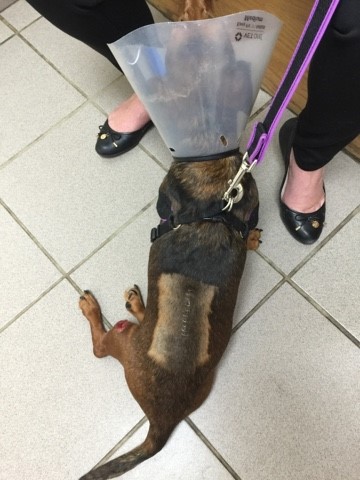
This is Wrangler. His stumble in the recovery process was licking his left knee to the point of an open wound. In spite of his e-collar he was wiggling his nose to the point of his knee and licking obsessively.
Now I firmly believe that our pets are always trying to tell us something. Wrangler was telling me that there was a problem ad he was trying to point me in the direction of it. Wrangler was leaking urine. He knew he was leaking and no one likes dripping pee.

He needed some laser therapy for his knee, another e-collar, and a medicated ointment for his prepuce. We also instructed his family to palpate the bladder with each trip outside. First to get a urine stream going, and second to try to make sure he was emptying his bladder completely. Residual urine in the bladder turns into a possible pool for infection. An overly full bladder will leak.

Double e-collar anyone? If we can't make Wranglers nose shorter we have to make the e-collar longer.

Laser therapy had the lick granuloma cleared up in less than 3 days.

A drying healing knee.

IVDD is the one disease that comes on like a freight train and sinks a pet parent to their knees. It is frustrating, painful, and often seems overwhelming to parents. Have faith, be calm, be patient and don't give up early on. It is a disease your dog can conquer, even if you cannot afford the neurologist, the MRI, or the surgery.
I always try to add associated costs of care with my blogs. All estimates are in USD for East Coast USA
Here is the break down;
Conservative care; Non-surgical medical treatment. Cage rest.
I always try to add associated costs of care with my blogs. All estimates are in USD for East Coast USA
Here is the break down;
Conservative care; Non-surgical medical treatment. Cage rest.
- initial exam to get a presumptive diagnosis. $40-$80. These cases are usually able to be diagnosed on the first visit and do not require advanced diagnostics like an MRI. They have a high incidence of suspicion that is usually accurate at presentation.
- x-ray $100-$200. Should be done at initial visit if the vet suspects IVDD.
- analgesics $50-$150. Includes NSAID or steroid, opioid patch, oral opioid. Do NOT decline these. Your dog needs them. There are lots of cost effective options (like a steroid at Wal-Mart is less than $10. Call me I will loan it to you. If you decline it is simply because you are an awful person.
- Elizabethan collar $20-$40. They can be made. Ask the vet for an old xray film to make your own.
- Sling, free, use an old shopping bag with the sides cut out, or use a towel.
- Cage; borrow from a friend if you don't have one.
- Many places will recommend blood work. If you are tight on funds skip it. It is not going to make your diagnosis and it may not help with the treatment plan. It can be done later.
- Follow up care. Ask how your vet charges for rechecks, phone calls, and emergency care. Expect to see the vet about 3-5 times in the first week or two.
Gold Standard care. No expense is too great, or, I have great pet insurance;
- Includes referral to an emergency care facility for the first 24-48 hours. Usually $500-$2000 and for all of the items listed above.
- Referral to a neurologist for MRI and surgery. $3000 to $9000.
- After care at a facility to help recovery. May be 3-5 days $2000-$3000.
Personal Note; Nothing disturbs me more than a client being directed down a path they cannot afford to be on. If you cannot afford the decompression surgery and follow up care with a neurologist it is difficult for me to advise that you have an MRI done, UNLESS it is to rule out an untreatable life threatening condition like a tumor, blood clot, etc. If the vet or neurologist thinks it is a disc AND you know you cannot afford surgery DO NOT FEEL PRESSURED TO continue diagnostics. Elect cage rest (be compliant and follow up with your vet) and don't feel bad. Whatever you do, don't feel so bad that you give up and elect euthanasia.
For more information on this disease please see these related blogs;
If you have a pet in need you can find a community of helpful people at Pawbly.com. Pawbly is free to use and open to anyone who loves their pet and wants to help them.
I am also available for personal consults at Jarrettsville Veterinary Center in Jarrettsville Maryland. Or find me on YouTube or Twitter @FreePetAdvice.


